
Mass General Brigham Unveils AI Models for Cancer Prognosis from Facial Images
Why it matters
This development could lead to more personalized and effective cancer treatment plans, impacting patient outcomes globally.
What happened (in 30 seconds)
- On October 22, 2026, NBC News reported on AI models developed by Mass General Brigham researchers that estimate biological age and predict cancer survival from facial photographs.
- The FAHR-Face model, trained on over 40 million images, includes FAHR-FaceAge for biological age assessment and FAHR-FaceSurvival for mortality risk prediction.
- Current status: The models are in the research phase and not yet approved for clinical use, pending further validation.
The context you actually need
- Prior research: Earlier studies established links between facial appearance and biological aging, addressing the need for objective biomarkers in oncology.
- Technological foundation: The FAHR-Face model utilizes large-scale self-supervised pretraining, allowing it to adapt efficiently to health-specific tasks.
- Clinical implications: The ability to assess biological age and mortality risk could shift treatment planning from subjective visual assessments to data-driven decisions.
What's really happening
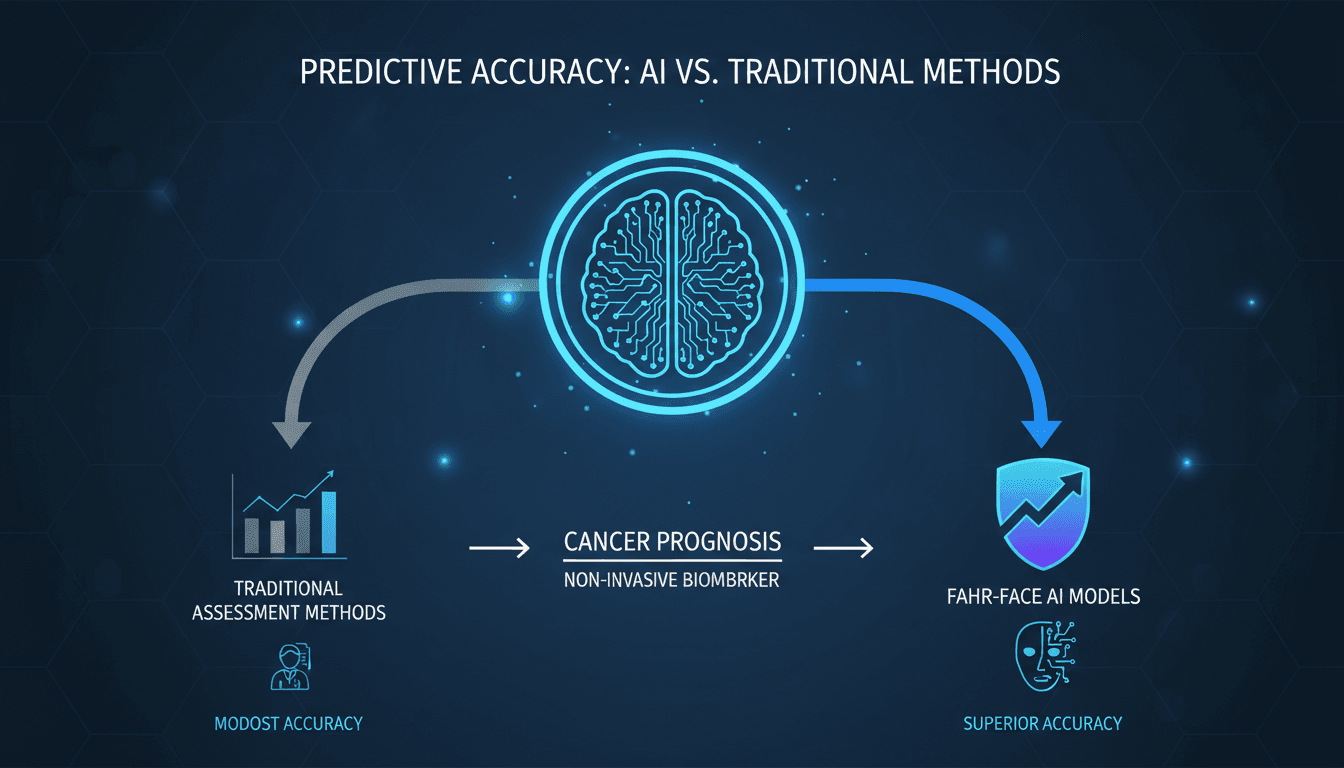
The development of the FAHR-Face AI models represents a significant leap in the intersection of artificial intelligence and healthcare. By leveraging a foundation model trained on an extensive dataset of over 40 million facial images, researchers at Mass General Brigham have created tools that can estimate biological age and predict short-term survival in cancer patients with remarkable accuracy.
The FAHR-FaceAge model estimates biological age with a mean absolute error of approximately 5.1 years, while the FAHR-FaceSurvival model predicts 90-day mortality risk. In clinical validation, patients identified as high-risk by FAHR-FaceSurvival exhibited a staggering 52.5% mortality rate within 90 days, compared to just 2% in the lowest-risk group. This stark contrast underscores the potential of these AI tools to stratify patient risk effectively.
The implications of this technology extend beyond mere prediction. In oncology, treatment decisions often hinge on subjective assessments of a patient's frailty and overall health. By providing objective data that goes beyond chronological age, these AI models could help clinicians make more informed decisions regarding treatment plans, potentially improving patient outcomes.
However, the deployment of such technology raises ethical considerations, particularly regarding data privacy and the potential for bias in AI algorithms. As the models are not yet approved for clinical use, the focus remains on further validation and prospective clinical trials to ensure their reliability and safety in real-world applications.
The public has been granted access to a research demo of the FAHR-Face models, generating interest and discussion within medical AI communities. Yet, experts caution that these tools are still in the research phase and should not be used for routine clinical deployment until further validation is completed.
Who feels it first (and how)
- Healthcare providers: Oncologists and medical professionals will need to adapt to integrating AI tools into their diagnostic and treatment processes.
- Patients: Cancer patients may experience more personalized treatment plans based on AI-driven assessments of their biological age and mortality risk.
- AI developers: Researchers and developers in the medical AI field will be at the forefront of addressing ethical concerns and improving model accuracy.
What to watch next
- Regulatory developments: Monitor for any updates from health authorities regarding the approval of AI tools for clinical use, as this will impact deployment timelines.
- Clinical trial results: Keep an eye on upcoming studies that validate the effectiveness of FAHR-Face models in diverse patient populations.
- Ethical discussions: Watch for ongoing conversations in medical AI communities about the ethical implications of using AI in patient care, particularly regarding data privacy and algorithmic bias.
The FAHR-Face models have shown promising results in predicting biological age and cancer survival risk.
Further validation and clinical trials will be necessary before these tools can be widely adopted in healthcare settings.
The long-term impact of AI-driven prognostic tools on treatment outcomes and healthcare costs remains to be fully understood.
Frequently Asked Questions
- Why it matters?
- This development could lead to more personalized and effective cancer treatment plans, impacting patient outcomes globally.
- What happened (in 30 seconds)?
- On October 22, 2026, NBC News reported on AI models developed by Mass General Brigham researchers that estimate biological age and predict cancer survival from facial photographs. The FAHR-Face model, trained on over 40 million images, includes FAHR-FaceAge for biological age assessment and FAHR-FaceSurvival for mortality risk prediction. Current status: The models are in the research phase and not yet approved for clinical use, pending further validation.
- What's really happening?
- The development of the FAHR-Face AI models represents a significant leap in the intersection of artificial intelligence and healthcare. By leveraging a foundation model trained on an extensive dataset of over 40 million facial images, researchers at Mass General Brigham have created tools that can estimate biological age and predict short-term survival in cancer patients with remarkable accuracy. The FAHR-FaceAge model estimates biological age with a mean absolute error of approximately 5.1 ye
- Who feels it first (and how)?
- Healthcare providers: Oncologists and medical professionals will need to adapt to integrating AI tools into their diagnostic and treatment processes. Patients: Cancer patients may experience more personalized treatment plans based on AI-driven assessments of their biological age and mortality risk. AI developers: Researchers and developers in the medical AI field will be at the forefront of addressing ethical concerns and improving model accuracy.
- What to watch next?
- Regulatory developments: Monitor for any updates from health authorities regarding the approval of AI tools for clinical use, as this will impact deployment timelines. Clinical trial results: Keep an eye on upcoming studies that validate the effectiveness of FAHR-Face models in diverse patient populations. Ethical discussions: Watch for ongoing conversations in medical AI communities about the ethical implications of using AI in patient care, particularly regarding data privacy and algorithm
Public health news, medical research, and wellness coverage.
"NBC News is a mainstream outlet known for comprehensive national and international news coverage with a centrist to slightly left-leaning editorial tone."
— A47 Editor
AI model uses facial photos to estimate cancer survival and biological age
Researchers at Mass General Brigham have developed AI models that utilize 40 million facial images to potentially predict cancer survival rates and estimate biological age. However, the researchers caution that these tools are not yet ready for clini...
Canadian and international health news, medicine, public policy, and research.
"Global News is a mainstream Canadian outlet generally considered to have a centrist editorial stance, covering news with a focus on factual reporting and national interest."
— A47 Editor
Can a photo help predict if you’ll survive cancer? Researchers think so
A team of researchers has developed artificial intelligence models capable of predicting an individual's biological age and their likelihood of surviving cancer treatment based solely on a photograph of their face. This innovative approach could revo...
News from the United States including domestic politics, society, and culture.
"Global News is a mainstream Canadian media outlet generally considered to have a centrist editorial stance, covering news with a focus on factual reporting and national interest."
— A47 Editor
Can a photo help predict if you’ll survive cancer? Researchers think so
A team of researchers has developed artificial intelligence models capable of predicting an individual's biological age and their likelihood of surviving cancer treatment based solely on a photograph of their face. This innovative approach could revo...
Photography news including AI tools and ethics.
"Covers AI’s impact on imaging and creative workflows."
— A47 Editor
A Single Photo Could Help AI Assess How Sick a Patient Is
Researchers have developed artificial intelligence tools that analyze photographs of a person's face to estimate biological age and predict survival outcomes for cancer patients. This innovative approach leverages visual data to enhance medical asses...