
Microsoft AI Diagnostic Orchestrator Outperforms Physicians in Medical Diagnosis
Why it matters
The introduction of MAI-DxO could significantly enhance diagnostic accuracy and efficiency in healthcare systems globally.
What happened (in 30 seconds)
- Microsoft published a study on October 22, 2026, revealing that its AI Diagnostic Orchestrator (MAI-DxO) outperformed generalist physicians in complex medical diagnoses.
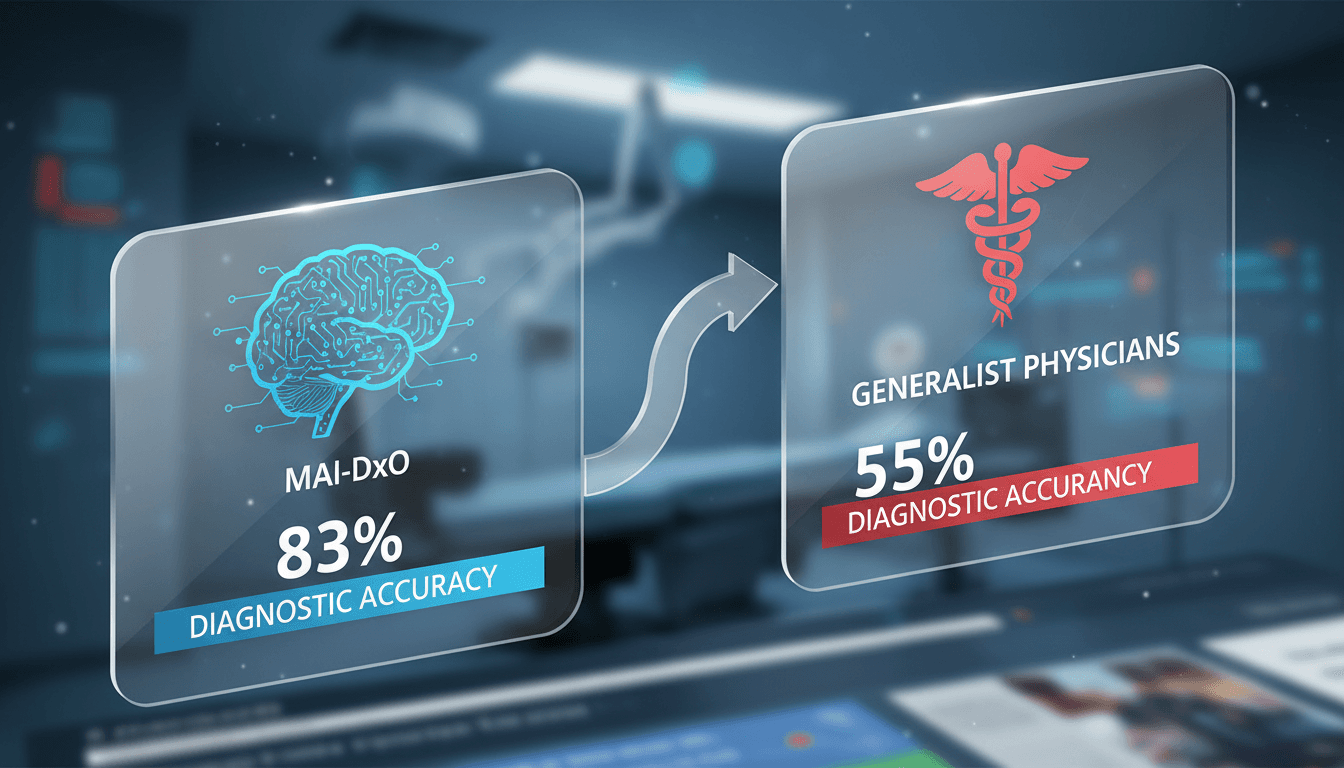
- The AI system achieved 83% accuracy on challenging cases, compared to just 36% for physicians using references.
- MAI-DxO mimics clinical workflows, coordinating multiple AI agents to gather patient history, order tests, and refine diagnoses.
The context you actually need
- Traditional AI diagnostic models typically analyze data in a single pass, unlike the iterative approach used by physicians.
- MAI-DxO builds on previous research into orchestration techniques, aiming to provide reliable and cost-effective AI assistance in healthcare.
- The study utilized over 300 complex cases from The New England Journal of Medicine and emergency department records to validate its findings.
What's really happening
Microsoft's MAI-DxO represents a significant shift in how medical diagnoses can be approached. Unlike traditional AI systems that analyze all available data at once, MAI-DxO employs a sequential, step-by-step methodology that mirrors the real-world processes used by physicians. This orchestrated approach allows the AI to simulate a panel of clinical experts, gathering patient history, ordering tests, and refining hypotheses in a manner that is both systematic and thorough.
The study's findings are particularly noteworthy: MAI-DxO achieved an impressive 83% diagnostic accuracy on complex cases from The New England Journal of Medicine, compared to just 36% for generalist physicians who had access to references. This stark contrast highlights the potential of AI to enhance diagnostic capabilities, especially in complex scenarios where human judgment may falter. The system also demonstrated approximately 80% accuracy on emergency cases, significantly outperforming physicians at 47%.
The implications of this technology extend beyond mere accuracy. By reducing the number of unnecessary tests and streamlining the diagnostic process, MAI-DxO could lead to substantial cost savings in healthcare. This is particularly relevant in high-volume healthcare settings, where efficiency is paramount. The ability to challenge assumptions and weigh costs before finalizing a diagnosis could also lead to better patient outcomes, as it allows for more tailored and precise medical interventions.
As the healthcare industry grapples with rising costs and the need for improved patient care, the introduction of AI systems like MAI-DxO could serve as a crucial tool in addressing these challenges. The study's publication has sparked discussions within both technology and medical communities about the pathways to clinical integration and the necessary regulatory evaluations that will accompany such innovations.
Who feels it first (and how)
- Healthcare providers: Physicians and medical staff may experience changes in workflow and diagnostic processes.
- Patients: Individuals seeking medical care could benefit from faster and more accurate diagnoses.
- Healthcare administrators: Decision-makers in hospitals and clinics will need to consider the integration of AI tools into existing systems.
- Insurance companies: Adjustments in coverage and reimbursement models may arise as AI diagnostics become more prevalent.
What to watch next
- Clinical trials: Monitor the progress of MAI-DxO in clinical evaluations to see how it performs in real-world settings.
- Regulatory responses: Watch for updates on how healthcare regulators will approach the integration of AI diagnostic tools.
- Market adoption: Keep an eye on healthcare institutions that begin to implement MAI-DxO and similar technologies, as this will indicate broader acceptance.
MAI-DxO has demonstrated higher diagnostic accuracy than generalist physicians in controlled studies.
The technology will undergo clinical evaluations and may be integrated into healthcare systems within the next few years.
The regulatory landscape surrounding AI diagnostics and its impact on healthcare practices remains to be fully defined.
Frequently Asked Questions
- Why it matters?
- The introduction of MAI-DxO could significantly enhance diagnostic accuracy and efficiency in healthcare systems globally.
- What happened (in 30 seconds)?
- Microsoft published a study on October 22, 2026, revealing that its AI Diagnostic Orchestrator (MAI-DxO) outperformed generalist physicians in complex medical diagnoses. The AI system achieved 83% accuracy on challenging cases, compared to just 36% for physicians using references. MAI-DxO mimics clinical workflows, coordinating multiple AI agents to gather patient history, order tests, and refine diagnoses.
- What's really happening?
- Microsoft's MAI-DxO represents a significant shift in how medical diagnoses can be approached. Unlike traditional AI systems that analyze all available data at once, MAI-DxO employs a sequential, step-by-step methodology that mirrors the real-world processes used by physicians. This orchestrated approach allows the AI to simulate a panel of clinical experts, gathering patient history, ordering tests, and refining hypotheses in a manner that is both systematic and thorough. The study's findings
- Who feels it first (and how)?
- Healthcare providers: Physicians and medical staff may experience changes in workflow and diagnostic processes. Patients: Individuals seeking medical care could benefit from faster and more accurate diagnoses. Healthcare administrators: Decision-makers in hospitals and clinics will need to consider the integration of AI tools into existing systems. Insurance companies: Adjustments in coverage and reimbursement models may arise as AI diagnostics become more prevalent.
- What to watch next?
- Clinical trials: Monitor the progress of MAI-DxO in clinical evaluations to see how it performs in real-world settings. Regulatory responses: Watch for updates on how healthcare regulators will approach the integration of AI diagnostic tools. Market adoption: Keep an eye on healthcare institutions that begin to implement MAI-DxO and similar technologies, as this will indicate broader acceptance.
Pan-Arab political news and analysis.
"Al-Quds Al-Arabi is a London-based Arabic newspaper known for political coverage."
— A47 Editor
مايكروسوفت تطور أداة ذكاء اصطناعي للتشخيص خطوة بخطوة كالطبيب
Microsoft researchers have developed an artificial intelligence tool that diagnoses patients step-by-step, similar to how doctors operate. The tool has demonstrated accuracy exceeding that of doctors by more than double when handling complex medical ...
Market-moving headlines impacting equities, bonds, and related risk assets.
"Real-time catalysts and volatility drivers across indices and sectors."
— A47 Editor
Microsoft develops AI tool that can diagnose ’sequentially’ like a doctor
Microsoft has developed an artificial intelligence tool capable of diagnosing conditions in a sequential manner, similar to the approach taken by medical professionals. This innovation reflects the company's ongoing commitment to integrating AI into ...
Curated tech headlines including AI stories.
"Influential aggregator surfacing the day’s top tech/AI links."
— A47 Editor
Microsoft says its GPT-5-powered Diagnostic Orchestrator uses agents that mimic panels of experts to diagnose conditions up to 4x more accurately than doctors (Robert Hart/The Verge)
Microsoft has announced the launch of its GPT-5-powered Diagnostic Orchestrator, which utilizes AI agents designed to replicate the decision-making processes of expert panels. This system reportedly diagnoses medical conditions with up to four times ...