
OpenAI and Partners Complete Rapid Analysis of Mouse Brain CRISPR Atlas Using AI Agents
Why it matters
This breakthrough demonstrates the potential for AI to significantly accelerate the pace of scientific research and hypothesis generation.
What happened (in 30 seconds)
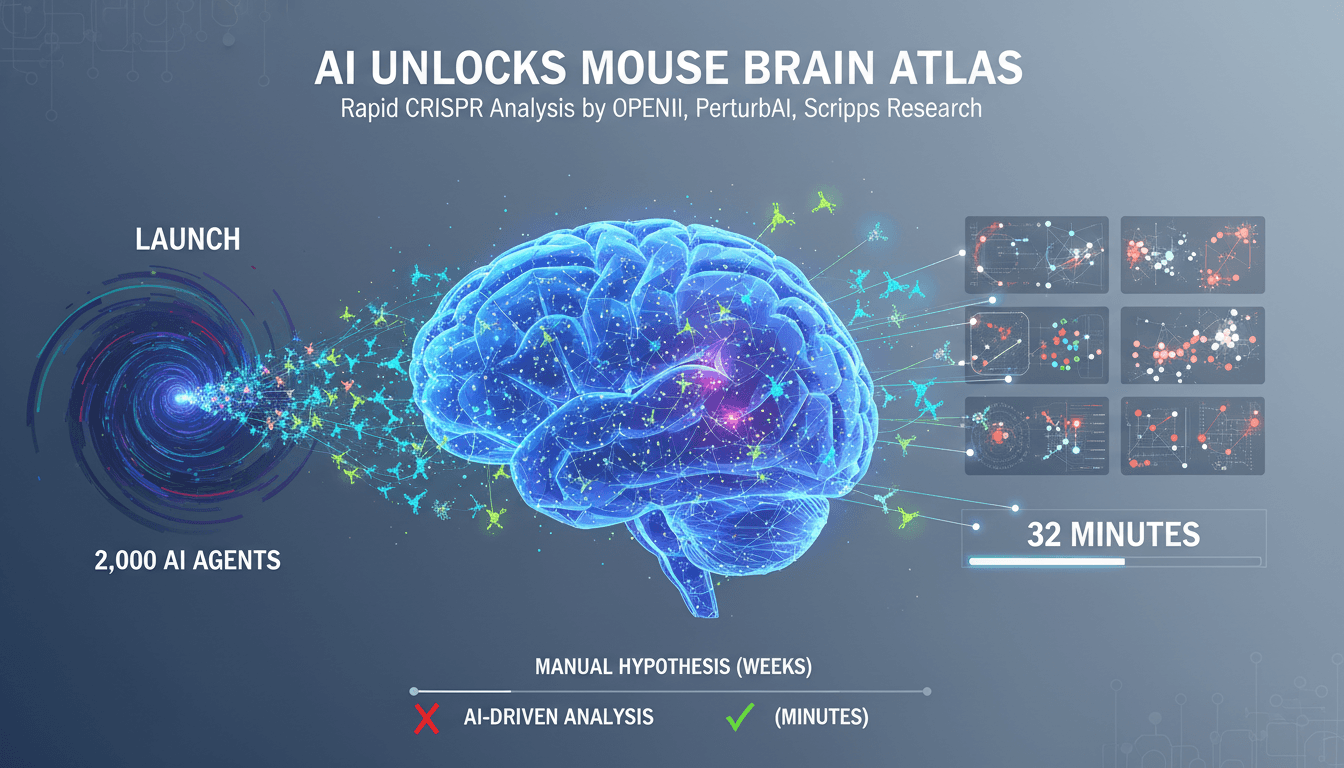
- OpenAI deployed nearly 2,000 AI agents to analyze a whole-brain CRISPR atlas of mouse brain-cell nuclei in just 32 minutes.
- The analysis generated a reasoning atlas with 3,397 findings linked to neurological conditions, including Perry syndrome and tuberous sclerosis.
- The results were published publicly on GitHub, prompting discussions about the scalability of AI in biological research.
The context you actually need
- CRISPR technology has advanced rapidly, allowing for detailed genetic manipulation and analysis of biological systems.
- The Human Cell Atlas project has generated vast amounts of single-cell data, creating a need for efficient analysis methods.
- Distributed AI systems have emerged as a solution to bottlenecks in manual literature review and hypothesis formulation in life sciences.
What's really happening
On October 21, 2026, OpenAI, in collaboration with PerturbAI and Scripps Research, achieved a significant milestone in biological data analysis by deploying approximately 1,946 AI agents powered by the GPT-Rosalind model. Each agent was tasked with analyzing a specific gene disruption from a comprehensive whole-brain CRISPR atlas, which included data from 7.7 million mouse brain-cell nuclei. This innovative approach allowed the agents to independently examine cellular response data, cross-reference existing scientific literature, and propose mechanistic explanations for observed phenomena.
The outputs from these agents were aggregated into a reasoning atlas that contained 3,397 findings, showcasing the power of distributed AI systems in generating hypotheses from complex biological datasets. Notably, the distributed system cited over 700 references, a stark contrast to the mere 11 references cited by a single agent. This disparity highlights the enhanced capability of multi-agent systems to synthesize information and generate insights at an unprecedented scale.
Among the significant findings was a link between DCTN1 disruption and alterations in cholesterol metabolism, which may have implications for understanding Perry syndrome. Additionally, the analysis revealed differential effects of Tsc1 versus Tsc2 disruptions in cerebellar neurons, shedding light on potential mechanisms associated with tuberous sclerosis. These insights underscore the potential of AI-assisted analysis to uncover novel connections between genetic disruptions and neurological conditions.
The preprint publication and the public release of the reasoning atlas on GitHub have sparked discussions within both the scientific and AI communities regarding the scalability of such distributed agents for hypothesis generation. While the results are promising, experts emphasize the necessity for empirical validation of the proposed mechanisms in laboratory settings. This collaboration not only demonstrates the capabilities of AI in biological research but also sets the stage for future advancements in drug discovery pipelines, potentially accelerating the development of therapies for neurological disorders.
Who feels it first (and how)
- Researchers in neuroscience will benefit from faster hypothesis generation and data analysis.
- Pharmaceutical companies may see accelerated drug discovery processes, impacting timelines and costs.
- AI developers will gain insights into the effectiveness of multi-agent systems in complex data analysis.
What to watch next
- Regulatory responses: Monitor for any governmental regulations regarding AI in biological research, as the implications of this technology grow.
- Laboratory validation studies: Watch for upcoming studies that will test the proposed mechanisms from the reasoning atlas in real-world settings.
- Market shifts in drug discovery: Keep an eye on how pharmaceutical companies adapt their research strategies in response to AI advancements.
The analysis was completed in 32 minutes, a task that would take humans months to a year.
The use of AI in biological research will continue to expand, leading to faster hypothesis generation and drug discovery.
The long-term impact of this technology on regulatory frameworks and ethical considerations in research remains to be seen.
Frequently Asked Questions
- Why it matters?
- This breakthrough demonstrates the potential for AI to significantly accelerate the pace of scientific research and hypothesis generation.
- What happened (in 30 seconds)?
- OpenAI deployed nearly 2,000 AI agents to analyze a whole-brain CRISPR atlas of mouse brain-cell nuclei in just 32 minutes. The analysis generated a reasoning atlas with 3,397 findings linked to neurological conditions, including Perry syndrome and tuberous sclerosis. The results were published publicly on GitHub, prompting discussions about the scalability of AI in biological research.
- What's really happening?
- On October 21, 2026, OpenAI, in collaboration with PerturbAI and Scripps Research, achieved a significant milestone in biological data analysis by deploying approximately 1,946 AI agents powered by the GPT-Rosalind model. Each agent was tasked with analyzing a specific gene disruption from a comprehensive whole-brain CRISPR atlas, which included data from 7.7 million mouse brain-cell nuclei. This innovative approach allowed the agents to independently examine cellular response data, cross-refere
- Who feels it first (and how)?
- Researchers in neuroscience will benefit from faster hypothesis generation and data analysis. Pharmaceutical companies may see accelerated drug discovery processes, impacting timelines and costs. AI developers will gain insights into the effectiveness of multi-agent systems in complex data analysis.
- What to watch next?
- Regulatory responses: Monitor for any governmental regulations regarding AI in biological research, as the implications of this technology grow. Laboratory validation studies: Watch for upcoming studies that will test the proposed mechanisms from the reasoning atlas in real-world settings. Market shifts in drug discovery: Keep an eye on how pharmaceutical companies adapt their research strategies in response to AI advancements.
News and guidance for IT pros on AI adoption.
"Enterprise-focused tips, explainers, and news for professionals."
— A47 Editor
OpenAI Ran Nearly 2,000 AI Agents on Brain Data: What They Found in 32 Minutes
OpenAI successfully deployed nearly 2,000 AI agents to analyze mouse brain-cell data in just 32 minutes, revealing potential links to neurological diseases that warrant further investigation. This rapid analysis marks a significant advancement in the...
Daily AI news: models, tools, and policy.
"Independent outlet tracking the fast pace of AI."
— A47 Editor
OpenAI agents analyze mouse brain data in 32 minutes, a job that would take humans months
OpenAI, in collaboration with PerturbAI and Scripps Research, successfully deployed thousands of AI agents to analyze biological data from millions of mouse brain cells in just 32 minutes, a task that would typically take human researchers several mo...
Curated tech headlines including AI stories.
"Influential aggregator surfacing the day’s top tech/AI links."
— A47 Editor
OpenAI, PerturbAI, and Scripps say thousands of GPT-Rosalind agents analyzed data on millions of mouse brain cells in 32 minutes, a job that takes humans months (OpenAI)
OpenAI, PerturbAI, and Scripps Research have successfully utilized thousands of GPT-Rosalind agents to analyze data from millions of mouse brain cells in just 32 minutes, a task that typically requires months for human researchers. This rapid analysi...