
Google Permits Limited Use of Google Photos Data for Ad Targeting Among Opted-In Users
Why it matters
The convergence of consumer AI assistants and ad-monetization engines breaks down longstanding structural barriers between private cloud storage and commercial targeting profiles.
What happened (in 30 seconds)
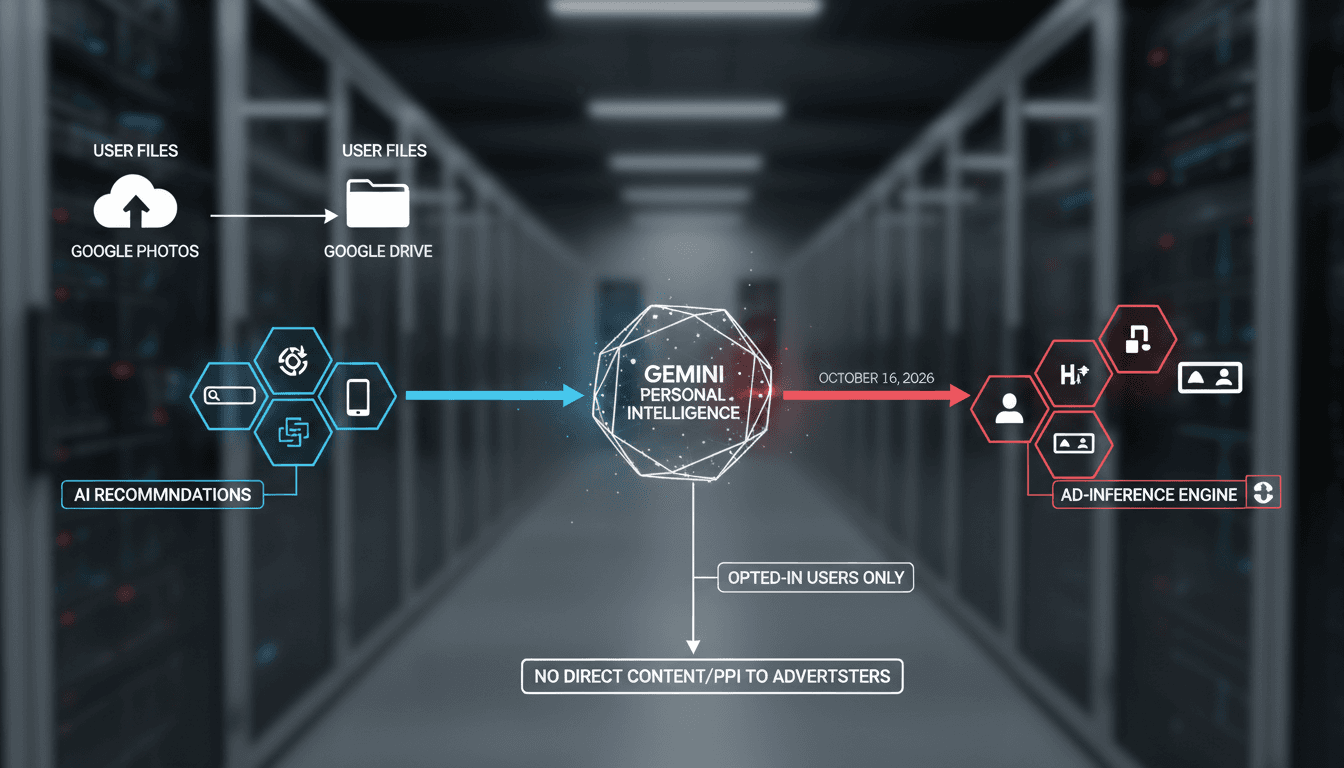
- A core policy exception took effect: On October 16, 2026, Google revised its privacy terms to allow data from Drive, Gmail, and Google Photos to shape ad targeting if you opt in to specific AI tools.
- The mechanism relies on AI features: Connecting services to Gemini Apps or Personal Intelligence in Search allows Google to generate ads based on content summaries, excerpts, and behavioral inferences.
- Third parties remain excluded: Advertisers do not receive direct access to your media or personally identifiable information, sensitive categories remain excluded, and default settings leave the cross-service bridge disabled.
The context you actually need
- A multi-year boundary ended: Since at least 2021, Google maintained strict prohibitions preventing Drive, Gmail, and Google Photos content from directly informing personalized ad delivery across its network.
- The AI rollout expanded rapidly: Personal Intelligence launched for paying subscribers in January 2026 before rolling out to all US users in March 2026 to contextualize cross-app queries.
- Reporting surfaced the language change: Android Authority identified the shift on October 23, 2026, followed by coverage from PetaPixel and other technical outlets documenting the functional link between AI integrations and ad systems.
What's really happening
Google’s October 16, 2026 policy modification alters the structural architecture of consumer data isolation. For five years, Google preserved an explicit wall between user cloud storage—comprising Drive, Gmail, and Google Photos—and its core ad-targeting machinery. That firewall relied on service-level boundaries: what you backed up or drafted remained siloed from the advertising graph.
The introduction of unified assistant layers alters this arrangement. When you authorize features like Personal Intelligence or Gemini Apps to read your personal repositories, you grant them permission to parse schedules, scan document archives, and index visual media to answer natural language prompts. To deliver cross-functional AI utility, Google must merge previously isolated databases into a single processing pipeline. The revised policy documents the downstream commercial application of that unified pipeline: unless you keep those data channels separate, information processed by connected AI tools can feed ad delivery.
The operational reality does not involve selling raw image files or displaying private emails to media buyers. Advertisers receive zero direct access to raw user files, and Google’s restrictions still forbid targeting around sensitive categories. Instead, the monetization engine operates on contextual metadata, derived inferences, excerpts, and automated summaries. If an AI pipeline identifies travel itineraries, recurring equipment purchases, or automotive updates within your synced photos, the system extracts those categorical interests. That contextual signal routes into the broader ad profile associated with your Google account.
This shift reflects an incentive structure driven by computational expenses and feature adoption. Multi-modal AI workloads carry steep capital requirements relative to traditional search queries. By bridging high-context personal data to the ad ecosystem, Google creates a commercial return for operating continuous context ingestion. You gain unified contextual responses across Google Search and Gemini, while Google unlocks higher-intent audience segments derived from personal storage archives. The interaction remains gated behind an opt-in toggle within account settings under Personalization & activity, but activating AI assistant workflows automatically fulfills that condition.
Who feels it first (and how)
- Early adopters and digital operators: Power users who connected Google Photos and Drive to Gemini Apps in early 2026 to automate information retrieval will see their ad profiles adapt to their stored files.
- Creative professionals and photographers: Independent operators storing image portfolios, client deliverables, or equipment records in Google Photos expose functional hardware and travel signals to commercial targeting algorithms.
- Corporate users on personal devices: Individuals handling side ventures or freelance operations via standard Google accounts will find contextual business patterns shaping consumer-facing ad displays.
What to watch next
- Account-level opt-out rates: How many users manually disconnect integrations via Data & privacy settings will show whether contextual AI utility outweighs targeting resistance.
- Expansion of AI assistant connections: Watch whether Google prompts users during standard Search or Drive workflows to enable Personal Intelligence, widening the pipeline of accounts feeding ad-targeting models.
- Clarifications on inference boundaries: Technical updates explaining how Google defines summaries and excerpts versus direct media analysis will establish clear limits for enterprise risk assessments.
The policy took effect on October 16, 2026; advertisers do not receive direct access to files; and users can revoke app permissions via the Data & privacy menu under Personalization & activity.
The majority of consumers activating Gemini Apps or Personal Intelligence in Search will leave cross-service permissions active, expanding the volume of contextual data available for ad optimization.
The exact latency between an AI tool processing a photo summary and that inferred category altering a user's ad delivery remains unquantified across public documentation.
Frequently Asked Questions
- Why it matters?
- The convergence of consumer AI assistants and ad-monetization engines breaks down longstanding structural barriers between private cloud storage and commercial targeting profiles.
- What happened (in 30 seconds)?
- A core policy exception took effect: On October 16, 2026, Google revised its privacy terms to allow data from Drive, Gmail, and Google Photos to shape ad targeting if you opt in to specific AI tools. The mechanism relies on AI features: Connecting services to Gemini Apps or Personal Intelligence in Search allows Google to generate ads based on content summaries, excerpts, and behavioral inferences. Third parties remain excluded: Advertisers do not receive direct access to your media or personall
- What's really happening?
- Google’s October 16, 2026 policy modification alters the structural architecture of consumer data isolation. For five years, Google preserved an explicit wall between user cloud storage—comprising Drive, Gmail, and Google Photos—and its core ad-targeting machinery. That firewall relied on service-level boundaries: what you backed up or drafted remained siloed from the advertising graph. The introduction of unified assistant layers alters this arrangement. When you authorize features like Perso
- Who feels it first (and how)?
- Early adopters and digital operators: Power users who connected Google Photos and Drive to Gemini Apps in early 2026 to automate information retrieval will see their ad profiles adapt to their stored files. Creative professionals and photographers: Independent operators storing image portfolios, client deliverables, or equipment records in Google Photos expose functional hardware and travel signals to commercial targeting algorithms. Corporate users on personal devices: Individuals handling side
- What to watch next?
- Account-level opt-out rates: How many users manually disconnect integrations via Data & privacy settings will show whether contextual AI utility outweighs targeting resistance. Expansion of AI assistant connections: Watch whether Google prompts users during standard Search or Drive workflows to enable Personal Intelligence, widening the pipeline of accounts feeding ad-targeting models. Clarifications on inference boundaries: Technical updates explaining how Google defines summaries and excerpts
Photography news including AI tools and ethics.
"Covers AI’s impact on imaging and creative workflows."
— A47 Editor
Google May Use Your Google Photos Data to Target Ads
Google has said it may use data from Google Photos to target ads at users who have certain personalized AI features enabled, according to a report by PetaPixel. The development is tied to an updated privacy policy, effective October 16, that clarifie...
Tech news and guides occasionally covering AI.
"Independent tech blog with practical tips and news."
— A47 Editor
Google Updates Privacy Policy to Let Gmail and Photos Data Shape Ads Through Personal Intelligence
Google has updated its privacy policy, effective October 16, to clarify that content from connected apps such as Gmail, Google Photos, and Google Drive may help shape personalized ads when users link those services through Personal Intelligence. The ...
Tech news, hardware, and AI tools coverage.
"PC/tech site increasingly covering AI hardware and apps."
— A47 Editor
Google's privacy policy now has a loophole for using your Gmail and Photos data in ads
Google has updated its privacy policy, effective October 16, to clarify that data from connected apps such as Gmail and Google Photos may be used for ad targeting, as first reported by Android Authority. The policy has long said Google does not show ...