
OpenAI and Anthropic Cut Flagship LLM API Prices by Up to 80 Percent Between June and September 2026
Why it matters
A structural pricing war between frontier model developers is turning intelligence into a high-volume utility, stripping away software margins and forcing providers to monetize scale rather than model exclusivity.
What happened (in 30 seconds)
- OpenAI and Anthropic triggered compounding price cuts between June and September 2026, dropping flagship API rates by up to 80% across major product tiers.
- Cache-read token economics absorbed the steepest drops, falling to as low as $0.02 per million tokens on GPT-5.6 Luna and $0.10 on GPT-6.1 Sol to target agentic software loops.
- Rival open-weight architectures forced the shift, as hosting hubs like OpenRouter deployed dozens of lower-cost DeepSeek variants that removed traditional developer lock-in.
The context you actually need
- Agentic coding workflows transformed token mathematics, making cache reads account for 96% to 99% of all token consumption in continuous development pipelines.
- Switching costs fell toward zero, allowing technical teams to redirect production API calls between Anthropic, OpenAI, and open-weight alternatives with minimal architectural overhead.
- Wall Street timelines accelerated commercial aggression, driving both frontier labs to lock down long-term enterprise volume commitments ahead of planned initial public offerings.
What's really happening
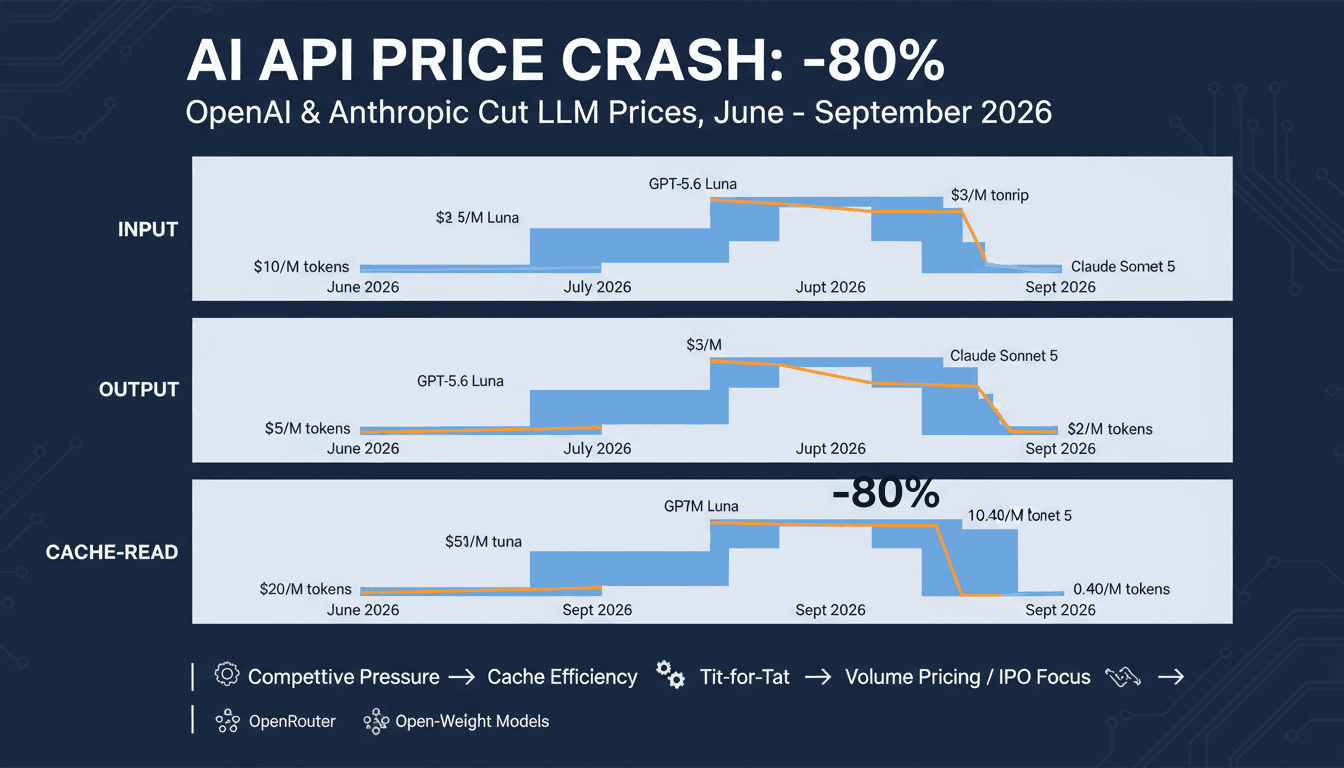
The aggressive downward repricing of artificial intelligence APIs reflects structural commoditization rather than corporate generosity. When OpenAI introduced GPT-5.6 Sol at $5 per million input tokens, $30 per output token, and $0.50 per cache read alongside Luna at $1/$6/$0.10 on June 26, 2026, Anthropic countered four days later with Claude Sonnet 5 at $2/$10/$0.20. By July 30, OpenAI countered again, reducing GPT-5.6 Luna by 80% to $0.20/$1.20/$0.02. This tit-for-tat dynamic continued through late September, when Anthropic rolled out Opus 5.5 at $4/$20/$0.20—an effective reduction of 40% to 60%—only for OpenAI to immediately release GPT-6 Sol and Luna at 50% lower base rates.
The core operational battlefield is context caching. In standard conversational interfaces, users generate relatively balanced ratios of input and output tokens. In persistent, agentic workflows—such as autonomous software development—models repeatedly evaluate extensive codebases, documentation, and execution states. Under these conditions, cache reads comprise between 96% and 99% of total token volume. By dropping cache-read rates by up to 75% on models like Fable 5.1 and setting Luna cache reads at $0.02, both labs restructured their margins around persistent operational context.
This margin contraction was compelled by the open-weight ecosystem. The proliferation of DeepSeek Flash V4 variants—hosted by 29 independent inference providers on platforms such as OpenRouter—eliminated the pricing premium proprietary labs previously enjoyed. When benchmark performance between proprietary and open-weight alternatives converges, developer loyalty follows unit costs.
Yet falling unit costs have not reduced aggregate infrastructure outlays. According to production metrics reported by Vercel, the aggregate cost per token fell to 43.3% of April 2026 benchmarks, but net developer spending expanded over the same period. Lower prices reduced the barrier to loop-heavy agent deployments, significantly increasing query frequencies. As both companies prepare for public market debuts, their strategic imperative has transitioned from high-margin scarcity pricing to securing multi-year enterprise usage volume.
Who feels it first (and how)
- Engineering and product leaders: Budgets stretch further, allowing continuous-loop agentic architectures to operate in production without exceeding infrastructure caps.
- Enterprise software procurement teams: Greater bargaining power emerges to secure favorable API multi-year commitments against open-weight benchmarks.
- Independent inference hosting platforms: Operating margins tighten as proprietary providers use custom hardware efficiencies to match open-weight rates.
- Global engineering teams outside primary tech hubs: Universal API pricing delivers direct cost parity, eliminating regional deployment cost premiums.
What to watch next
- Enterprise lock-in clauses: Look for OpenAI and Anthropic to trade rock-bottom unit pricing for minimum-spend commitments or platform exclusivity ahead of their IPO filings.
- Open-weight provider consolidation: Watch whether smaller hosting providers on platforms like OpenRouter can remain solvent as proprietary cache-read rates near zero.
- Agentic token volumes: Track whether net spending continues to climb even as cost-per-token decreases, verifying the Jevons paradox in corporate AI adoption.
Proprietary API pricing dropped by up to 80% between June and September 2026, led by severe cuts to cache-read token costs.
Aggregate enterprise spending on inference will continue climbing as software engineering teams swap human-supervised workflows for multi-step autonomous agents.
Whether current inference margins are financially sustainable over the long term without continuous architectural hardware breakthroughs or public market subsidies.
Frequently Asked Questions
- Why it matters?
- A structural pricing war between frontier model developers is turning intelligence into a high-volume utility, stripping away software margins and forcing providers to monetize scale rather than model exclusivity.
- What happened (in 30 seconds)?
- OpenAI and Anthropic triggered compounding price cuts between June and September 2026, dropping flagship API rates by up to 80% across major product tiers. Cache-read token economics absorbed the steepest drops, falling to as low as $0.02 per million tokens on GPT-5.6 Luna and $0.10 on GPT-6.1 Sol to target agentic software loops. Rival open-weight architectures forced the shift, as hosting hubs like OpenRouter deployed dozens of lower-cost DeepSeek variants that removed traditional developer lo
- What's really happening?
- The aggressive downward repricing of artificial intelligence APIs reflects structural commoditization rather than corporate generosity. When OpenAI introduced GPT-5.6 Sol at $5 per million input tokens, $30 per output token, and $0.50 per cache read alongside Luna at $1/$6/$0.10 on June 26, 2026, Anthropic countered four days later with Claude Sonnet 5 at $2/$10/$0.20. By July 30, OpenAI countered again, reducing GPT-5.6 Luna by 80% to $0.20/$1.20/$0.02. This tit-for-tat dynamic continued throug
- Who feels it first (and how)?
- Engineering and product leaders: Budgets stretch further, allowing continuous-loop agentic architectures to operate in production without exceeding infrastructure caps. Enterprise software procurement teams: Greater bargaining power emerges to secure favorable API multi-year commitments against open-weight benchmarks. Independent inference hosting platforms: Operating margins tighten as proprietary providers use custom hardware efficiencies to match open-weight rates. Global engineering teams ou
- What to watch next?
- Enterprise lock-in clauses: Look for OpenAI and Anthropic to trade rock-bottom unit pricing for minimum-spend commitments or platform exclusivity ahead of their IPO filings. Open-weight provider consolidation: Watch whether smaller hosting providers on platforms like OpenRouter can remain solvent as proprietary cache-read rates near zero. Agentic token volumes: Track whether net spending continues to climb even as cost-per-token decreases, verifying the Jevons paradox in corporate AI adoption.
Projects and analyses in data science and generative models.
"Engineer’s blog known for creative ML projects."
— A47 Editor
OpenAI and Anthropic cut their LLM prices by up to 80% within a few months. Why?
OpenAI and Anthropic have cut the prices of their large language models by as much as 80% within a few months, according to a blog analysis by Max Woolf that examines what the "true cost of a token" means for developers and businesses. The base artic...
Daily AI news: models, tools, and policy.
"Independent outlet tracking the fast pace of AI."
— A47 Editor
OpenAI offers discounts up to 90 percent to poach Anthropic's biggest customers
OpenAI is offering steep discounts, reportedly up to 90 percent, to lure Anthropic's largest customers. Companies including Rippling, Replit and DataCamp say they cut their AI costs by as much as 90 percent after switching, as Anthropic's growth has ...
Curated tech headlines including AI stories.
"Influential aggregator surfacing the day’s top tech/AI links."
— A47 Editor
Source: Replit recently moved most AI spend from Anthropic to OpenAI, which gave 30%+ off in a deal worth $100M+/year, after Anthropic discontinued its discount (The Information)
Replit has shifted the majority of its AI spending from Anthropic to OpenAI, securing a deal worth over $100 million per year with a discount exceeding 30% after Anthropic ended its discount offerings. This strategic move reflects Replit's preference...