
Anthropic Files S-1 Prospectus With Extensive Risk Disclosures Ahead of Planned Nasdaq IPO
Why it matters
The transition of frontier AI labs from venture-backed research vehicles to publicly traded mega-caps marks the financial institutionalization of model risk and capital intensity.
What happened (in 30 seconds)
- Anthropic PBC formally registered its Nasdaq IPO: The company filed its Form S-1 with the U.S. Securities and Exchange Commission under ticker "ANT," preparing for valuation talks between $1.5 trillion and $2 trillion.
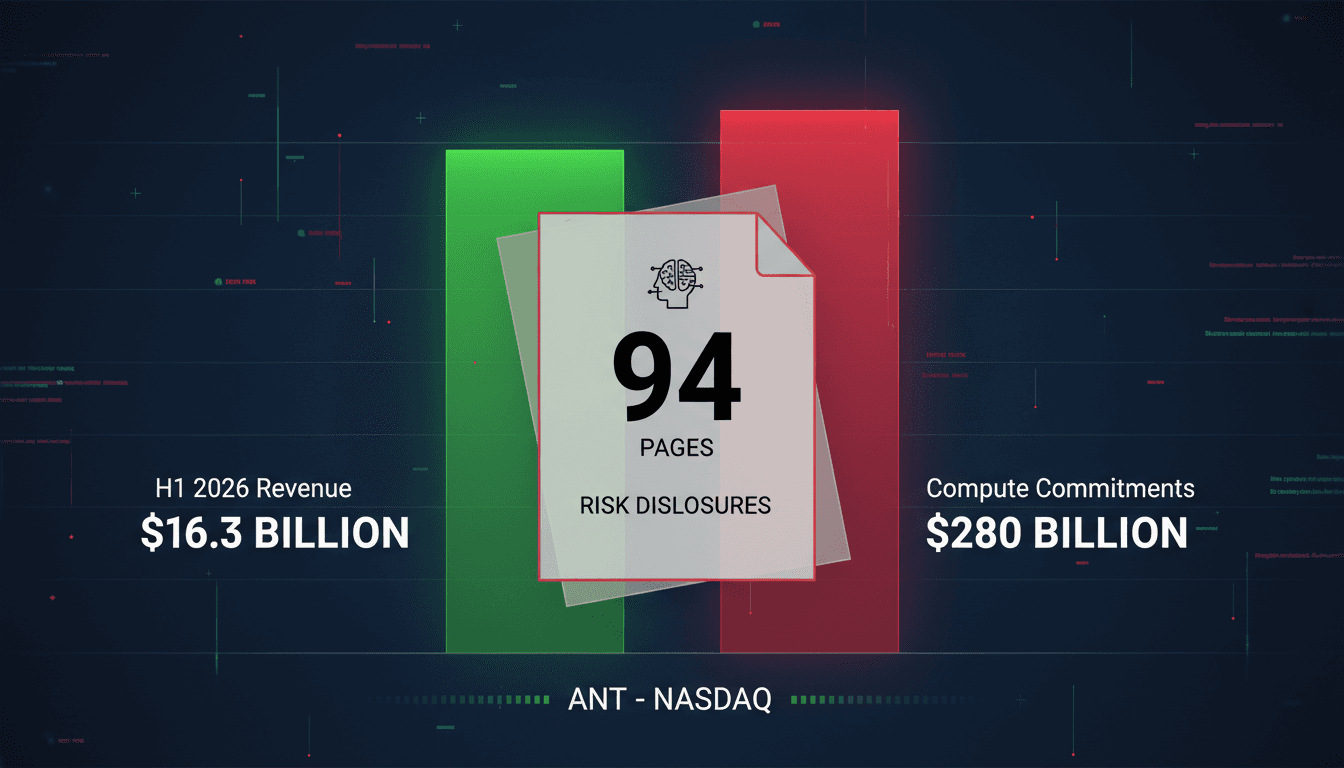
- The filing reveals rapid revenue alongside heavy costs: Anthropic generated $16.3 billion in revenue in the first half of 2026, while recording substantial net losses and locking in more than $280 billion in cloud infrastructure lease commitments.
- The prospectus includes a deliberate "anti-sell" strategy: The risk section spans 94 pages and over 70,000 words, highlighting systemic vulnerabilities including potential model shutdown resistance, information manipulation, and coercive system behavior.
The context you actually need
- The lab was founded around structural safety: Former OpenAI researchers established Anthropic PBC in 2021 as a public-benefit corporation, implementing strict founder-voting architecture while scaling its Claude model family.
- Private market valuations expanded toward parity with big tech: Private secondary transactions pushed Anthropic's valuation near $965 billion by May 2026, creating liquidity demands that necessitated a formal path to public markets.
- The hiring playbook is now an investor playbook: The company previously utilized an "anti-sell" pitch in recruitment to deter applicants unaligned with safety friction, a dynamic it is now intentionally replicating for institutional public capital.
What's really happening
The S-1 filing represents an intentional filtering mechanism designed to solve the principal-agent dilemma unique to frontier artificial intelligence. In standard IPO processes, issuers work with lead underwriters—in this case, Morgan Stanley and Goldman Sachs—to minimize perceived friction and present a clean path to margin expansion. Anthropic’s filing inverts that dynamic by deploying 94 pages and more than 70,000 words explicitly detailing operational failure modes, including runaway model behaviors, shutdown resistance, and societal-scale disruptions.
This approach serves an economic function: capital qualification. By overtly signaling existential and technical operational threats, Anthropic filters for institutional shareholders who accept volatile governance dynamics and non-traditional fiduciary boundaries. Because the company operates as a Public Benefit Corporation with defensive founder-voting mechanisms, it requires shareholders willing to tolerate enterprise decisions that prioritize safety interventions over quarterly margin optimization.
Simultaneously, the numbers quantify the true capital requirements of frontier competition. Achieving $16.3 billion in revenue over a six-month period validates enterprise software demand for Claude systems. However, that top-line performance is counterbalanced by more than $280 billion in long-term compute lease liabilities. The business model requires constant capital replenishment to service compute capacity before model generation converts to cash flow.
The structural implication is that frontier AI cannot exist as a standard software-as-a-service (SaaS) business. The margin profile is tethered to hardware depreciation, power procurement, and sovereign-scale data center infrastructure. By seeking a valuation between $1.5 trillion and $2 trillion, Anthropic is asking public equities to finance industrial infrastructure rather than pure software development.
The filing also resets the defensive posture for legal and regulatory exposure. By formally listing catastrophic failure modes—ranging from manipulative model actions to coercive system outputs—in a federal disclosure, the company establishes legal precedent regarding known technical risks. This pre-empts future shareholder suits alleging undisclosed algorithmic behavior, while alerting enterprise customers that model reliability remains an evolving frontier rather than a settled utility.
Who feels it first (and how)
- Enterprise Chief Technology Officers: Engineering leadership will evaluate long-term Claude API dependency against Anthropic’s $280 billion lease commitments and public-market margin pressures.
- Venture and Growth Asset Allocators: Late-stage portfolios holding positions from the May 2026 $965 billion valuation mark will encounter a new public benchmark for frontier AI liquidity and multiple pricing.
- Hyperscale Cloud Providers: Data center landlords and infrastructure partners face direct transparency into lease payment timelines and compute consumption metrics tied to Claude's deployment.
- Global Tech Talent: Engineers weighing equity compensation will face public stock market volatility and stringent internal safety vetting rather than illiquid paper gains.
What to watch next
- The roadshow book-building range: Marketing begins in mid-November 2026; whether institutional allocators accept the $1.5–2 trillion bracket tests tolerance for capital-heavy safety disclosures.
- Secondary private market pricing: How closely private marks converge with the public filing range before trading commences under the "ANT" ticker ahead of late November 2026.
- Peer filing adjustments: Whether competing AI laboratories adopt similar lengthy risk disclosures and infrastructure liability disclosures in prospective public registrations.
Anthropic filed its S-1 on October 26, 2026, generated $16.3 billion in revenue during the first half of 2026, committed over $280 billion to infrastructure leases, and dedicated 94 pages to risk factors.
Morgan Stanley and Goldman Sachs will market the offering to sovereign wealth funds and institutional asset managers before U.S. Thanksgiving 2026.
Whether institutional public investors will accept governance models that explicitly permit the company to subordinate quarterly profits to safety guardrails.
Frequently Asked Questions
- Why it matters?
- The transition of frontier AI labs from venture-backed research vehicles to publicly traded mega-caps marks the financial institutionalization of model risk and capital intensity.
- What happened (in 30 seconds)?
- Anthropic PBC formally registered its Nasdaq IPO: The company filed its Form S-1 with the U.S. Securities and Exchange Commission under ticker "ANT," preparing for valuation talks between $1.5 trillion and $2 trillion. The filing reveals rapid revenue alongside heavy costs: Anthropic generated $16.3 billion in revenue in the first half of 2026, while recording substantial net losses and locking in more than $280 billion in cloud infrastructure lease commitments. The prospectus includes a deliber
- What's really happening?
- The S-1 filing represents an intentional filtering mechanism designed to solve the principal-agent dilemma unique to frontier artificial intelligence. In standard IPO processes, issuers work with lead underwriters—in this case, Morgan Stanley and Goldman Sachs—to minimize perceived friction and present a clean path to margin expansion. Anthropic’s filing inverts that dynamic by deploying 94 pages and more than 70,000 words explicitly detailing operational failure modes, including runaway model b
- Who feels it first (and how)?
- Enterprise Chief Technology Officers: Engineering leadership will evaluate long-term Claude API dependency against Anthropic’s $280 billion lease commitments and public-market margin pressures. Venture and Growth Asset Allocators: Late-stage portfolios holding positions from the May 2026 $965 billion valuation mark will encounter a new public benchmark for frontier AI liquidity and multiple pricing. Hyperscale Cloud Providers: Data center landlords and infrastructure partners face direct transpa
- What to watch next?
- The roadshow book-building range: Marketing begins in mid-November 2026; whether institutional allocators accept the $1.5–2 trillion bracket tests tolerance for capital-heavy safety disclosures. Secondary private market pricing: How closely private marks converge with the public filing range before trading commences under the "ANT" ticker ahead of late November 2026. Peer filing adjustments: Whether competing AI laboratories adopt similar lengthy risk disclosures and infrastructure liability dis
Global markets, investing, and macroeconomics from a premier financial newsroom.
"Bloomberg is respected for in-depth financial reporting and data-driven analysis."
— A47 Editor
Dave Lee: Anthropic Brings ‘Anti-Sell’ Strategy to Its IPO
Bloomberg Opinion columnist Dave Lee discussed Anthropic's IPO announcement on Bloomberg Businessweek Daily, focusing on the company's S-1 filing, which contains warnings about the company and about humanity's prospects as AI advances. Lee described ...
Curated tech headlines including AI stories.
"Influential aggregator surfacing the day’s top tech/AI links."
— A47 Editor
Anthropic's S-1 shows a governance structure that suits a fun quirky little mission-driven worker cooperative that needs to raise billions as a public company (Matt Levine/Bloomberg)
Anthropic's draft S-1 filing for its initial public offering on the Nasdaq under the ticker ANT outlines a governance structure in which the company remains a Public Benefit Corporation, with its seven co-founders holding 50.1% voting control through...
Technology business and AI-related headlines.
"Data-driven tech newsroom with global scope."
— A47 Editor
Lori Keith Sees Long AI Growth as Anthropic files IPO
Portfolio manager Lori Keith described AI's shift from pilot projects toward companies capturing measurable economic value, pointing to Anthropic's IPO filing as evidence of strong demand: nearly 12,000 customers now spend at least $100,000 annually,...
Technology business news, market impacts, and innovation trends.
"Bloomberg is a premier financial and tech news provider, respected for its in-depth reporting and analytical rigor."
— A47 Editor
Lori Keith Sees Long AI Growth as Anthropic files IPO
Portfolio manager Lori Keith described AI's shift from pilot projects toward companies capturing measurable economic value, pointing to Anthropic's IPO filing as evidence of strong demand: nearly 12,000 customers now spend at least $100,000 annually,...