
Wider Attention Heads Improve Long-Context Retrieval at Fixed Parameter Budgets
Why it matters
Architectural design choices at fixed parameter budgets show that engineering attention head width, rather than simply increasing head count or overall model size, directly governs how effectively language models locate needle-in-a-haystack data across long context windows.
What happened (in 30 seconds)
- New research rethinks attention splits: On 23 October 2026, researchers Seiya Tokui, Shoichiro Yamaguchi, and Sosuke Kobayashi from Tokyo-based Preferred Networks published an empirical study examining how attention head dimensions influence long-context retrieval in language models.
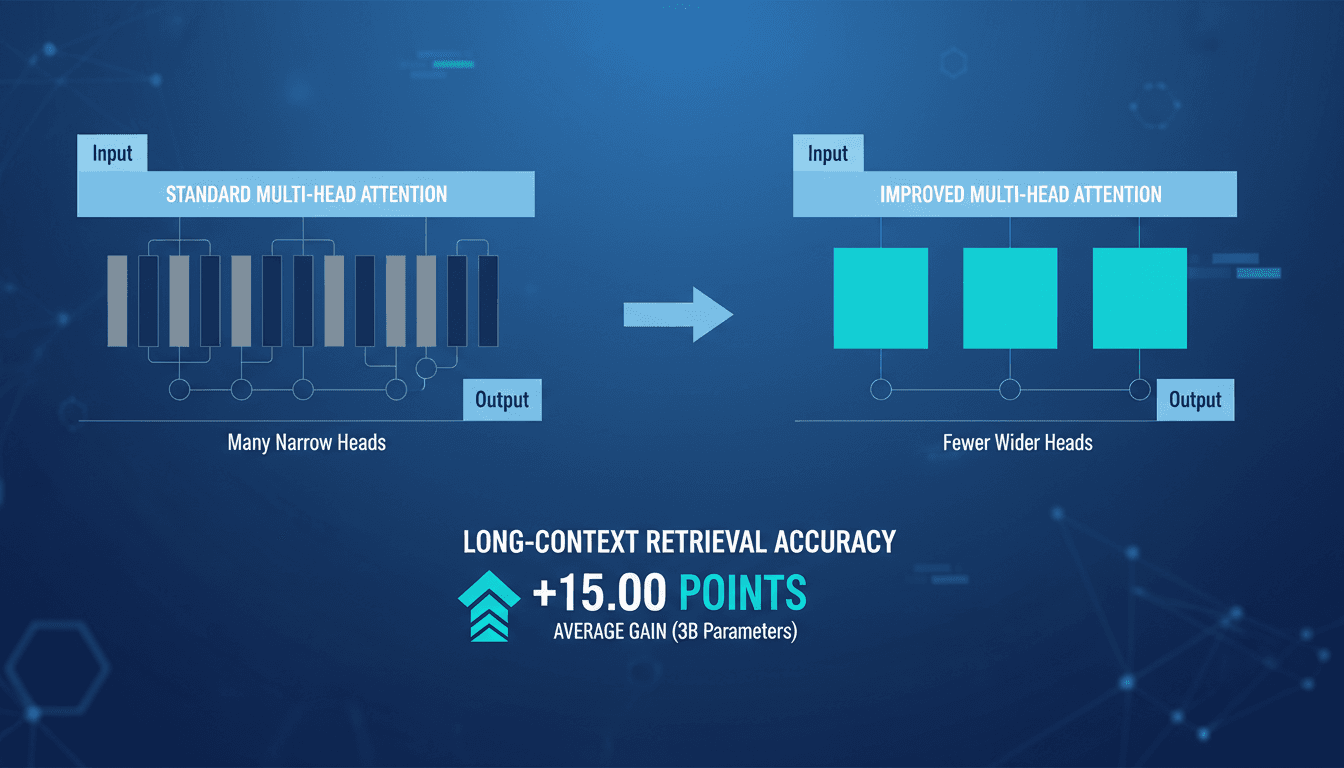
- Wider heads outperform narrow alternatives: Evaluating models at a 3-billion-parameter scale revealed that widening head dimension to d512 produces an average performance gain of 15.00 points on long-context retrieval benchmarks compared to the narrowest configurations.
- Short-context tasks remain unaffected: These retrieval gains occur while holding total projection widths, key-value (KV) cache size, and overall parameter budgets constant, leaving standard pretraining loss and short-context performance intact.
The context you actually need
- Retrieval heads drive long-context accuracy: Previous machine learning research demonstrated that multi-head attention relies on specific sub-circuits—dubbed "retrieval heads"—to copy, route, and synthesize information distributed across extended document contexts.
- The fixed-parameter trade-off: Transformer models operate within strict compute budgets; model architects traditionally had to choose between deploying many narrow heads or fewer wide heads across identical total projection widths.
- The KV-cache constraint: Serving enterprise-scale context windows typically strains hardware memory via the KV-cache, making architectural modifications that preserve cache footprint essential for practical production deployment.
What's really happening
The underlying constraint in scaling long-context artificial intelligence has rarely been just model size; it is the precision with which attention mechanisms address memory across thousands of sequence tokens. Standard multi-head attention partitions a model's hidden representation into multiple parallel heads. For years, the prevailing convention across foundational open-weight architectures favored dividing projection widths into a larger quantity of standard-sized heads (often dimension 64 or 128).
The empirical findings from Preferred Networks establish that this architectural division imposes an unnecessary penalty on long-context retrieval tasks. By holding total projection dimensions and the key-value cache size constant, the authors altered the internal geometry of the attention layer. Rather than spreading attention capacity across dozens of narrow heads, concentrating the exact same parameter budget into fewer, wider heads—scaling up to dimension 512—directly sharpens associative recall.
The mechanics behind this gain lie in how internal representations organize. When head dimensions expand, individual heads possess a higher-dimensional subspace to compute dot-product attention scores. This expanded representational capacity reduces semantic collisions when comparing query and key vectors across thousands of distracting tokens. Empirically, the authors demonstrated that models configured with wider heads naturally develop a significantly higher proportion of functional "retrieval heads"—the specific attention mechanisms responsible for locating and copying tokens across sequence gaps.
Crucially, ablation experiments in the paper revealed that these performance advantages persisted even when researchers froze the attention projection weights during continual pretraining runs. This behavior indicates that wider head allocations do not merely benefit the multi-head attention projections themselves; they structurally enhance the training dynamics of the model's surrounding token embeddings and multi-layer perceptron (MLP) blocks.
From an infrastructure perspective, this architectural adjustment alters the economic incentives of model design. Extending sequence lengths normally imposes steep inference costs, largely driven by linear expansions of the KV-cache. Because widening head dimension can be executed while maintaining identical total projection widths and identical KV-cache footprints, foundational model developers can extract superior information retrieval capabilities without incurring runtime memory overhead or degrading core pretraining perplexity on everyday, short-sequence benchmarks.
Who feels it first (and how)
- Foundation Model Architects: AI research and pretraining teams must recalibrate their layer dimension choices, as moving to wider heads (up to d512) offers performance margins on extended contexts at zero additional parameter cost.
- Enterprise Search and Legal-Tech Developers: Teams deploying retrieval-augmented generation (RAG) and long-document processing platforms gain higher extraction fidelity on complex documents without paying inference penalties.
- AI Infrastructure and Compute Planners: Cloud operators and hardware teams benefit from model architectures that do not require expanding KV-cache allocations to support longer usable context windows.
What to watch next
- Adoption in open-weight releases: Watch whether upcoming open-source model releases integrate d256 or d512 head dimensions as the default configuration in standard architectures.
- Validation at 70B+ parameter scales: Track whether independent labs replicate the 15.00-point performance margin on models scaled significantly beyond the 3-billion-parameter envelope tested in the initial paper.
- Hardware kernel compatibility: Monitor how specialized low-level attention kernels (such as FlashAttention implementations) update to optimize tensor throughput for non-standard, wider head shapes without latency trade-offs.
Allocating parameter budgets to wider head dimensions (up to d512) yields an average 15.00-point improvement in long-context retrieval at the 3-billion-parameter scale while keeping KV-cache size and pretraining loss unchanged.
Leading AI training labs will adopt wider head geometries in next-generation base models designed specifically for document analysis, code generation, and synthetic context benchmarks.
Whether the architectural benefit plateaus or reverses at dimensions beyond 512, and whether these specific advantages hold uniformly across mixture-of-experts (MoE) architectures.
Frequently Asked Questions
- Why it matters?
- Architectural design choices at fixed parameter budgets show that engineering attention head width, rather than simply increasing head count or overall model size, directly governs how effectively language models locate needle-in-a-haystack data across long context windows.
- What happened (in 30 seconds)?
- New research rethinks attention splits: On 23 October 2026, researchers Seiya Tokui, Shoichiro Yamaguchi, and Sosuke Kobayashi from Tokyo-based Preferred Networks published an empirical study examining how attention head dimensions influence long-context retrieval in language models. Wider heads outperform narrow alternatives: Evaluating models at a 3-billion-parameter scale revealed that widening head dimension to d512 produces an average performance gain of 15.00 points on long-context retriev
- What's really happening?
- The underlying constraint in scaling long-context artificial intelligence has rarely been just model size; it is the precision with which attention mechanisms address memory across thousands of sequence tokens. Standard multi-head attention partitions a model's hidden representation into multiple parallel heads. For years, the prevailing convention across foundational open-weight architectures favored dividing projection widths into a larger quantity of standard-sized heads (often dimension 64 o
- Who feels it first (and how)?
- Foundation Model Architects: AI research and pretraining teams must recalibrate their layer dimension choices, as moving to wider heads (up to d512) offers performance margins on extended contexts at zero additional parameter cost. Enterprise Search and Legal-Tech Developers: Teams deploying retrieval-augmented generation (RAG) and long-document processing platforms gain higher extraction fidelity on complex documents without paying inference penalties. AI Infrastructure and Compute Planners: Cl
- What to watch next?
- Adoption in open-weight releases: Watch whether upcoming open-source model releases integrate d256 or d512 head dimensions as the default configuration in standard architectures. Validation at 70B+ parameter scales: Track whether independent labs replicate the 15.00-point performance margin on models scaled significantly beyond the 3-billion-parameter envelope tested in the initial paper. Hardware kernel compatibility: Monitor how specialized low-level attention kernels (such as FlashAttention i
Machine Learning preprints from arXiv.
"Core ML theory and methods in daily preprints."
— A47 Editor
Head Dimension Matters in Language Models for Long-Context Retrieval
A new arXiv preprint in the cs.LG category, "Head Dimension Matters in Language Models for Long-Context Retrieval," reports that for fixed model sizes, wider attention heads improve long-context retrieval performance, while pretraining loss and short...
Computation and Language (NLP) preprints.
"Daily stream of NLP research papers and preprints."
— A47 Editor
Diagnosing and Mitigating Context Rot in Long-horizon Search
A new arXiv cs.CL preprint, "Diagnosing and Mitigating Context Rot in Long-horizon Search," examines how Large Language Models fail when deployed in long-horizon search tasks with extensive context. The study of four flagship models across three benc...
Computation and Language (NLP) preprints.
"Daily stream of NLP research papers and preprints."
— A47 Editor
Quantitative Generalization Bounds for Multi-Layer Transformers: A Few Long Strings can Beat Many Short Ones
A new arXiv cs.CL preprint, "Quantitative Generalization Bounds for Multi-Layer Transformers: A Few Long Strings can Beat Many Short Ones," offers a joint theoretical treatment of two axes of transformer generalization: in-distribution statistical ge...
Computation and Language (NLP) preprints.
"Daily stream of NLP research papers and preprints."
— A47 Editor
Rethinking Retrieval in the Long-Context Era: Training-Free Semantic Trees for Adaptive Context Construction
A new arXiv cs.CL preprint, "Rethinking Retrieval in the Long-Context Era: Training-Free Semantic Trees for Adaptive Context Construction," argues that when a full document already fits within a long-context model, selecting and organizing its eviden...
Computation and Language (NLP) preprints.
"Daily stream of NLP research papers and preprints."
— A47 Editor
Beyond Static and Linear: What Attention Constraints Best Fit Human Reading Times?
A preprint posted to arXiv's cs.CL recent listings, titled "Beyond Static and Linear: What Attention Constraints Best Fit Human Reading Times?", hypothesizes that adding memory constraints to transformer attention mechanisms can improve how well thes...