
Survey Maps Mathematical Foundations of SFT RLHF and DPO for LLM Alignment
Why it matters
Establishing rigorous mathematical foundations for alignment frameworks like RLHF and DPO stabilizes the predictable performance of generative models across enterprise and consumer deployments.
What happened (in 30 seconds)
* A unified tutorial was published: Nine researchers across five institutions released a systematic survey on arXiv covering mathematical foundations and algorithmic frameworks for large language model (LLM) alignment on 22 October 2026. * Core methods were formalized: The work unifies supervised fine-tuning (SFT), reinforcement learning from human feedback (RLHF), and direct preference optimization (DPO) under unified mathematical lenses. * Formal journal acceptance secured: The comprehensive study was accepted for publication in the *IEEE Signal Processing Magazine* Special Issue on the Mathematics of Deep Learning.
The context you actually need
* Post-2022 proliferation brought reliability challenges: The rapid expansion of large language models after 2022 revealed persistent difficulties in aligning raw model completions with human intentions, preferences, and safety boundaries. * Heuristics reached structural limits: Early industry alignment efforts depended heavily on trial-and-error fine-tuning recipes rather than formalized, provable optimization theory. * Classical theories provide the missing bridge: By framing LLM alignment through discrete choice models and inverse reinforcement learning, researchers can systematically model human preferences and predict algorithmic limitations.
What's really happening
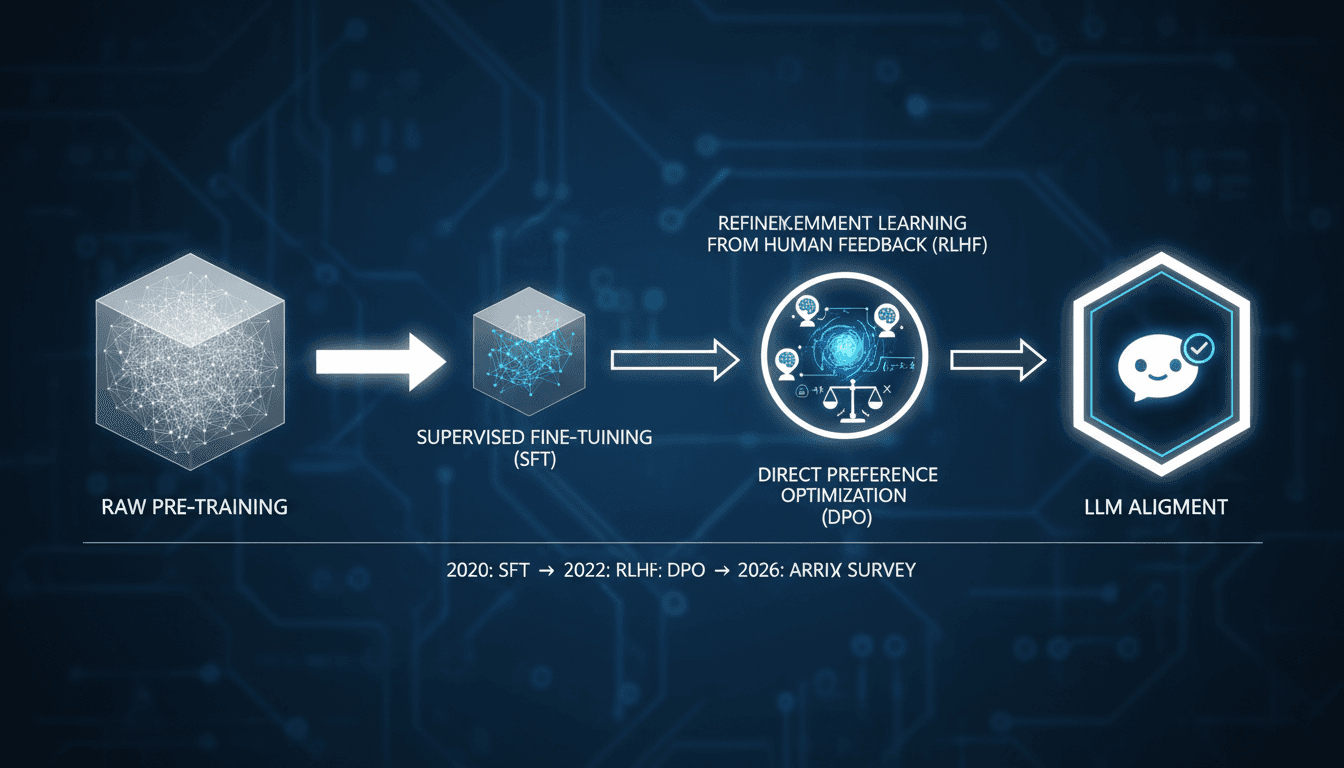
The alignment of large language models is transitioning from bespoke tuning recipes into formal optimization pipelines. When you interact with a production model, raw next-token prediction is rarely sufficient. Base models predict probability distributions over text; they do not inherently prioritize safety, compliance, or human intent. To resolve this, engineering pipelines combine supervised fine-tuning (SFT) with downstream preference alignment.
This paper establishes the exact mathematical apparatus tying these stages together. By linking modern alignment paradigms—namely reinforcement learning from human feedback (RLHF) and direct preference optimization (DPO)—to classical inverse reinforcement learning and discrete choice theory, the authors map out the exact trade-offs inherent in model steerability.
In standard RLHF, practitioners collect pairwise human preference data to fit a parametric reward model. This reward model then serves as the objective function for policy optimization algorithms like Proximal Policy Optimization (PPO). The underlying mechanism balances two competing incentives: maximizing the empirical reward score while minimizing policy divergence from the reference model via a Kullback-Leibler (KL) divergence penalty. Without this constraint, optimization policies exploit flaws in the reward model, yielding degenerate or repetitive completions.
Direct preference optimization simplifies this pipeline by mathematically bypassing explicit reward modeling. By deriving a closed-form substitution of the reward function directly within the objective function, DPO optimizes policy parameters using standard cross-entropy loss over preferred versus non-preferred pairs. The survey clarifies that while DPO lowers infrastructure complexity and eliminates the instability of training an auxiliary reward model, both RLHF and DPO ultimately share continuous mathematical roots within discrete choice modeling.
For developers and technical operators, this mathematical unification removes ambiguity from model tuning. Framing alignment as an explicit trade-off between reward maximization, policy drift, and algorithmic stability reveals why certain models fail when scaled. The survey equips engineering teams to diagnose failure modes using optimization theory rather than empirical guesswork.
Who feels it first (and how)
* Machine learning engineers: Teams training foundation models gain standardized theoretical frameworks to evaluate the trade-offs between two-stage RLHF pipelines and single-stage DPO workflows. * Enterprise deployment leads: Technical directors evaluating commercial and open-weight models can assess alignment stability and degradation boundaries using grounded optimization benchmarks. * AI researchers across institutions: Academic laboratories acquire a standardized reference connecting modern preference tuning directly to discrete choice and inverse reinforcement learning literature.
What to watch next
* IEEE formal publication release: The appearance of the survey in the *IEEE Signal Processing Magazine* Special Issue on the Mathematics of Deep Learning will formally expand circulation beyond arXiv. * Adoption of unified alignment architectures: Academic citations and technical implementations tracking whether labs converge on direct preference optimization variations or hybrid RLHF setups. * Refinement of discrete choice preference modeling: New algorithmic implementations addressing the structural limitations identified when human preferences violate standard discrete choice assumptions.
The survey was authored by 9 researchers from the University of Minnesota, EPFL, Texas A&M University, Google DeepMind, and Stanford University, covering SFT, RLHF, DPO, and inverse reinforcement learning.
The paper will become a standard tutorial citation across deep learning curricula and industrial alignment research following formal IEEE publication.
The extent to which upcoming enterprise foundation models will fully replace reward-model pipelines with direct preference optimization variations across large-scale commercial deployments.
Frequently Asked Questions
- Why it matters?
- Establishing rigorous mathematical foundations for alignment frameworks like RLHF and DPO stabilizes the predictable performance of generative models across enterprise and consumer deployments.
- What happened (in 30 seconds)?
- A unified tutorial was published: Nine researchers across five institutions released a systematic survey on arXiv covering mathematical foundations and algorithmic frameworks for large language model (LLM) alignment on 22 October 2026. Core methods were formalized: The work unifies supervised fine-tuning (SFT), reinforcement learning from human feedback (RLHF), and direct preference optimization (DPO) under unified mathematical lenses. Formal journal acceptance secured: The comprehensive study w
- What's really happening?
- The alignment of large language models is transitioning from bespoke tuning recipes into formal optimization pipelines. When you interact with a production model, raw next-token prediction is rarely sufficient. Base models predict probability distributions over text; they do not inherently prioritize safety, compliance, or human intent. To resolve this, engineering pipelines combine supervised fine-tuning (SFT) with downstream preference alignment. This paper establishes the exact mathematical
- Who feels it first (and how)?
- Machine learning engineers: Teams training foundation models gain standardized theoretical frameworks to evaluate the trade-offs between two-stage RLHF pipelines and single-stage DPO workflows. Enterprise deployment leads: Technical directors evaluating commercial and open-weight models can assess alignment stability and degradation boundaries using grounded optimization benchmarks. AI researchers across institutions: Academic laboratories acquire a standardized reference connecting modern prefe
- What to watch next?
- IEEE formal publication release: The appearance of the survey in the *IEEE Signal Processing Magazine* Special Issue on the Mathematics of Deep Learning will formally expand circulation beyond arXiv. Adoption of unified alignment architectures: Academic citations and technical implementations tracking whether labs converge on direct preference optimization variations or hybrid RLHF setups. Refinement of discrete choice preference modeling: New algorithmic implementations addressing the structura
Computation and Language (NLP) preprints.
"Daily stream of NLP research papers and preprints."
— A47 Editor
Jointly Modeling Preferences and Imperfect Decision-Making in Large Language Models
A new arXiv cs.CL preprint, "Jointly Modeling Preferences and Imperfect Decision-Making in Large Language Models," asks whether the preferences LLMs express in standard elicitation tasks predict how they behave strategically. The paper introduces the...
Machine Learning preprints from arXiv.
"Core ML theory and methods in daily preprints."
— A47 Editor
Aligning Large Language Models with Human Feedback: Mathematical Foundations and Algorithm Design
A new arXiv preprint in the cs.LG category, "Aligning Large Language Models with Human Feedback: Mathematical Foundations and Algorithm Design," offers a tutorial-style introduction to the mathematics and algorithms used to align LLMs with human inte...
Computation and Language (NLP) preprints.
"Daily stream of NLP research papers and preprints."
— A47 Editor
How Does Post-Training Shape LLM Value Preferences?
A preprint posted to arXiv's cs.CL listings examines how the value preferences that large language models learn during post-training are shaped by the opinion mixtures in their training corpora. Controlled experiments using corpora with different opi...
Computation and Language (NLP) preprints.
"Daily stream of NLP research papers and preprints."
— A47 Editor
Propensities Please: Exposing Alignment-Faking LLMs using Synthetic Document Finetuning
A preprint posted to arXiv's cs.CL listings, "Propensities Please: Exposing Alignment-Faking LLMs using Synthetic Document Finetuning," describes a method for revealing hidden misaligned behaviours in large language models. The authors use synthetic ...
Computation and Language (NLP) preprints.
"Daily stream of NLP research papers and preprints."
— A47 Editor
The Straight and Narrow: Do LLMs Possess an Internal Moral Path?
A new arXiv preprint in the cs.CL category, "The Straight and Narrow: Do LLMs Possess an Internal Moral Path?", examines whether large language models hold intrinsic moral representations rather than only surface-level safety guardrails. Using Moral ...
Computation and Language (NLP) preprints.
"Daily stream of NLP research papers and preprints."
— A47 Editor
Hierarchical Alignment: Block-Level LoRA-DPO for Preference Tuning in Large Language Models
A preprint posted to arXiv (cs.CL) introduces Hierarchical Alignment, a method that applies LoRA-based Direct Preference Optimization (DPO) to only a contiguous block of a language model's decoder layers, partitioned into Local, Intermediate, and Glo...
Computation and Language (NLP) preprints.
"Daily stream of NLP research papers and preprints."
— A47 Editor
GPDPO: Learning from Reward Conflicts via Group Pareto-Dominance Policy Optimization
Researchers posted an arXiv preprint in the cs.CL category introducing Group Pareto-Dominance Policy Optimization (GPDPO), a multi-reward reinforcement learning method for aligning large language models when reward signals conflict. The authors state...
Computation and Language (NLP) preprints.
"Daily stream of NLP research papers and preprints."
— A47 Editor
Distributional Alignment of LLMs and Its Generalization Properties
A new arXiv study (cs.CL) examines how large language models can be distributionally aligned to match human response distributions, a property important when LLMs simulate human behavior for surveys. Using two large-scale benchmarks, the researchers ...
Computation and Language (NLP) preprints.
"Daily stream of NLP research papers and preprints."
— A47 Editor
Better Reward Models Are Not Always Less Biased: Social Alignment Beyond Standard Reward Benchmarks
Researchers have extended reward model evaluation to bias, safety, morality, and ethical reasoning, reporting that strong performance on standard benchmarks can obscure important differences in social behavior. The arXiv cs.CL study finds that some m...