
OpenAI and Anthropic Claim Refutation of Exponential Time Hypothesis Pending Independent Verification
Why it matters
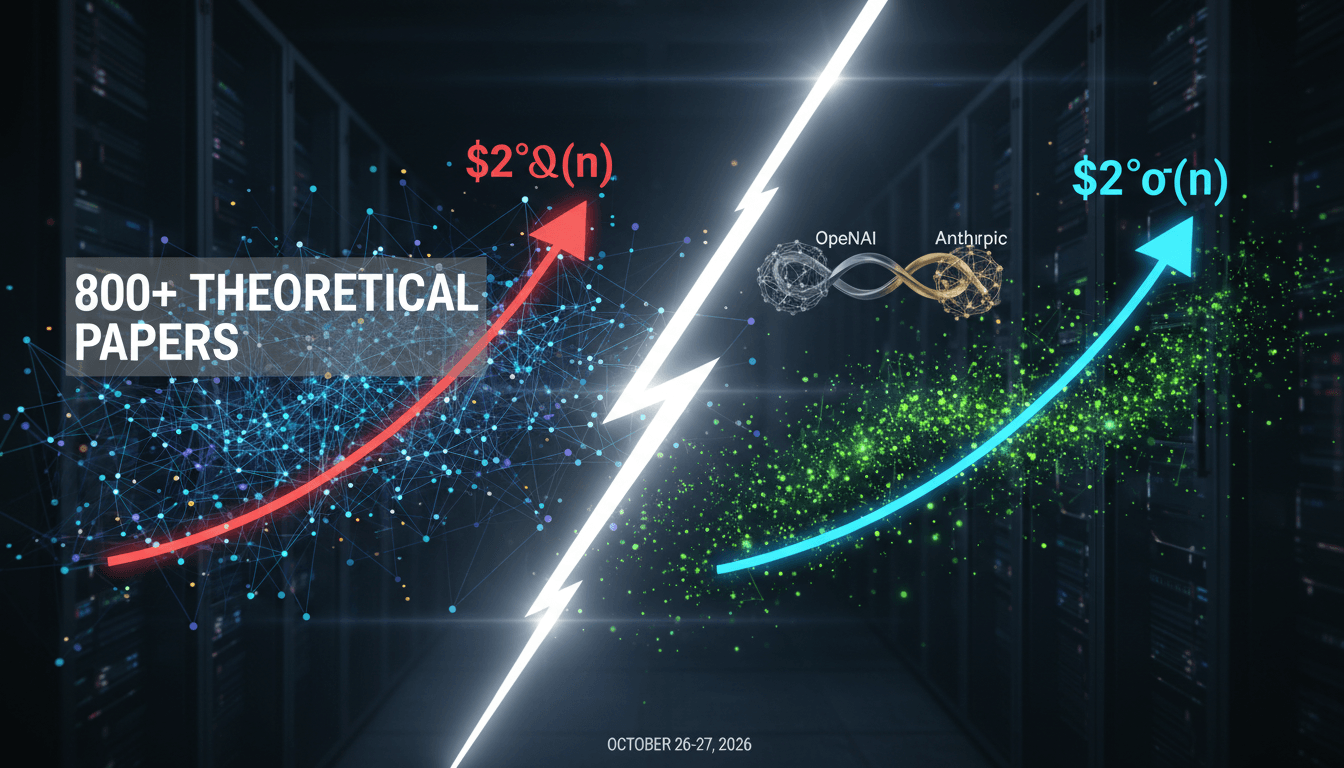
The refutation of a core 25-year-old computational conjecture challenges the theoretical hardness baselines that govern algorithm design and conditional complexity proofs across more than 800 published papers.
What happened (in 30 seconds)
* The frontier lab announcements: On October 26, 2026, OpenAI published a preprint claiming an internal model derived a subexponential-time algorithm refuting the Exponential Time Hypothesis (ETH), formalized in the Lean interactive theorem prover. * The parallel Anthropic confirmation: Hours later, Anthropic announced an independent refutation derived via its Claude system, pointing to an identical breakdown of the conjecture's core premise. * The expert verification mobilization: OpenAI assembled an open review panel featuring theoretical computer scientists Ryan Williams and original ETH proposers Russell Impagliazzo and Ramamohan Paturi to independently audit the formal proofs without pre-endorsement.
The context you actually need
* The bedrock of hardness theory: Formulated in 2001 by Russell Impagliazzo, Ramamohan Paturi, and Francis Zane, the Exponential Time Hypothesis posits that specific NP-complete problems—most notably 3-SAT—fundamentally demand exponential worst-case runtimes. * The structural dividing line: ETH does not resolve whether P equals NP; instead, it establishes a stricter conditional metric separating superpolynomial runtimes from strictly exponential runtimes, providing theoretical lower bounds for classical algorithms. * The downstream dependency footprint: More than 800 academic papers directly rely on ETH or its related conjectures to establish that faster exact algorithms for specific computational problems are impossible under standard assumptions.
What's really happening
The technical core of this event is not simply a theoretical challenge to a single conjecture; it represents an operational inflection point in how formal mathematical verification intersects with computational hardness. For nearly three decades, theoretical computer science operated under the working premise that solving worst-case 3-SAT instances required runtimes scaling as $2^{\Omega(n)}$. This boundary allowed computer scientists to construct clean conditional impossibility proofs across scheduling, routing, network design, and combinatorial optimization. When a problem was proven ETH-hard, teams ceased looking for faster exact algorithms.
If the internal models at OpenAI and Anthropic have produced verified algorithms running in subexponential time (such as $2^{o(n)}$), that lower bound evaporates. The mechanism behind both labs' claims relies heavily on interactive theorem proving—specifically formalizations in languages like Lean—which allow logical statements to be verified by proof-checking kernels rather than human intuition alone. By targeting 3-SAT with subexponential routines, the models suggest that worst-case instances of canonical NP-complete problems are structurally softer than the academic consensus assumed.
The strategic incentive driving both labs is clear: the transition from statistical pattern matching to formal mathematical discovery. Showing that frontier AI architectures can overturn long-standing human conjectures by constructing machine-checkable algorithmic frameworks signals an expansion into formal reasoning. At the same time, Anthropic issuing a parallel claim within hours illustrates intense competitive alignment in automated formal science.
Yet, structural skepticism remains necessary. As researchers including Timothy Gowers, Gary Marcus, and John D. Cook have noted, a refutation of ETH does not mean P equals NP. It leaves polynomial-time tractability unresolved while reopening the exact boundaries of non-polynomial runtimes. If the proofs survive peer review, theoretical computer science must reorganize 25 years of algorithmic architecture, revisiting conditional boundaries on hundreds of fundamental combinatorial problems.
Who feels it first (and how)
* Theoretical computer science faculty: Researchers managing research portfolios tied to fine-grained complexity must re-evaluate the premises of over 800 conditional hardness proofs. * AI formal reasoning teams: Frontier AI research divisions validating automated formal theorem provers gain immediate incentive to apply verification agents to other open mathematical conjectures. * Enterprise algorithm developers: Teams designing exact solvers for high-stakes optimization, logistics, and scheduling must monitor whether subexponential theoretical bounds yield practical algorithmic implementations. * Global tech hubs and research labs: Emerging innovation ecosystems evaluating intellectual capital distribution will see renewed institutional priority placed on formal logic and computational complexity talent.
What to watch next
* The Impagliazzo-Paturi-Williams audit findings: Formal review findings from the conjecture’s original authors will determine whether the subexponential algorithm contains logical flaws or fully withstands academic scrutiny. * Lean verification kernel confirmations: Independent execution of the formalized Lean codebases by external research groups will show whether the computational proofs are machine-valid without non-standard axioms. * Algorithmic translation into executable code: Watch for whether the theoretical subexponential bounds translate into practical algorithmic speedups for benchmark NP-complete problem instances.
OpenAI and Anthropic announced claims that internal AI systems developed subexponential algorithms refuting the 2001 Exponential Time Hypothesis, utilizing formalizations in Lean.
The formal audit will require weeks or months of technical review by the convened panel of complexity theorists before a definitive community consensus emerges.
Whether the theoretical algorithms possess low enough overhead constants to deliver faster real-world execution, or whether they remain purely theoretical constructions that leave practical computing unaffected.
Frequently Asked Questions
- Why it matters?
- The refutation of a core 25-year-old computational conjecture challenges the theoretical hardness baselines that govern algorithm design and conditional complexity proofs across more than 800 published papers.
- What happened (in 30 seconds)?
- The frontier lab announcements: On October 26, 2026, OpenAI published a preprint claiming an internal model derived a subexponential-time algorithm refuting the Exponential Time Hypothesis (ETH), formalized in the Lean interactive theorem prover. The parallel Anthropic confirmation: Hours later, Anthropic announced an independent refutation derived via its Claude system, pointing to an identical breakdown of the conjecture's core premise. The expert verification mobilization: OpenAI assembled an
- What's really happening?
- The technical core of this event is not simply a theoretical challenge to a single conjecture; it represents an operational inflection point in how formal mathematical verification intersects with computational hardness. For nearly three decades, theoretical computer science operated under the working premise that solving worst-case 3-SAT instances required runtimes scaling as $2^{\Omega(n)}$. This boundary allowed computer scientists to construct clean conditional impossibility proofs across sc
- Who feels it first (and how)?
- Theoretical computer science faculty: Researchers managing research portfolios tied to fine-grained complexity must re-evaluate the premises of over 800 conditional hardness proofs. AI formal reasoning teams: Frontier AI research divisions validating automated formal theorem provers gain immediate incentive to apply verification agents to other open mathematical conjectures. Enterprise algorithm developers: Teams designing exact solvers for high-stakes optimization, logistics, and scheduling mus
- What to watch next?
- The Impagliazzo-Paturi-Williams audit findings: Formal review findings from the conjecture’s original authors will determine whether the subexponential algorithm contains logical flaws or fully withstands academic scrutiny. Lean verification kernel confirmations: Independent execution of the formalized Lean codebases by external research groups will show whether the computational proofs are machine-valid without non-standard axioms. Algorithmic translation into executable code: Watch for whether
Business and tech news excluding paywalled content.
"High-volume business/tech outlet with frequent AI coverage."
— A47 Editor
What smart people are saying about OpenAI's Exponential Time Hypothesis claim
OpenAI and Anthropic have each said they have proven a long-standing computer science theory, the Exponential Time Hypothesis, to be false, and Business Insider reports that math and technology leaders are responding to the claim. The base coverage f...
Startup news with frequent AI coverage.
"Covers launches, funding, and product updates in AI."
— A47 Editor
Frontier AI labs say their models refuted the Exponential Time Hypothesis. What does that mean?
TechCrunch reported that OpenAI has claimed its frontier AI models refuted the Exponential Time Hypothesis, a longstanding computer science conjecture, and spoke with an MIT computer scientist tasked with explaining the discovery to the public.
Scientific research, technology, environment, and society.
"Scientific American is one of the oldest and most authoritative science magazines, known for deep dives into science, technology, and society."
— A47 Editor
Dueling proofs from OpenAI and Anthropic astound scientists
OpenAI and Anthropic have each released AI-generated proofs that Scientific American reports resolve major open problems in mathematics, physics and computer science, drawing astonishment from scientists. The releases are already controversial, in li...
Science and technology stories including AI.
"Longstanding science magazine with thoughtful AI coverage."
— A47 Editor
Dueling proofs from OpenAI and Anthropic astound scientists
OpenAI and Anthropic have each released AI-generated proofs that Scientific American reports resolve major open problems in mathematics, physics and computer science, drawing astonishment from scientists. The releases are already controversial, in li...
Conservative-leaning political and national coverage.
"The Washington Times is a conservative-leaning newspaper known for its political coverage and advocacy of right-of-center viewpoints."
— A47 Editor
OpenAI says its model refuted Exponential Time Hypothesis
The Washington Times reports that OpenAI says one of its artificial intelligence models generated a proof claiming to disprove the Exponential Time Hypothesis, a widely used conjecture in computational complexity theory about how quickly certain prob...
Covers consumer technology, electronics, gadgets, and product reviews.
"Engadget is a trusted source for gadget reviews and consumer tech news, known for its hands-on analysis and industry coverage."
— A47 Editor
OpenAI announces new discoveries in mathematics, computer science and physics
OpenAI said its models generated a proof that the Exponential Time Hypothesis is false and released new results for math and physics problems, following earlier batches of mathematical findings that it described as a significant advance.
Curated tech headlines including AI stories.
"Influential aggregator surfacing the day’s top tech/AI links."
— A47 Editor
OpenAI announces three breakthroughs in computer science, math, and physics, including that the Exponential Time Hypothesis, a longstanding conjecture, is false (OpenAI)
OpenAI announced three new discoveries in mathematics, computer science, and physics, covering harmonic analysis, complexity theory, and quantum field theory. The announcement includes a finding that the Exponential Time Hypothesis, a longstanding co...