
Elvis Presley Rights Holders Sue Anthropic Over Alleged Unauthorized AI Training on 274 Songs
Why it matters
The legal action tests the limits of fair use in artificial intelligence training, signaling that catalog owners will aggressively enforce statutory penalties against foundational model developers that ingest creative intellectual property without prior licensing agreements.
What happened (in 30 seconds)
- The formal complaint: On October 23, 2026, rights holders representing Elvis Presley’s catalog—including ABG EPE IP LLC, Raleigh Music Publishing, and Abilene Music—filed a copyright infringement lawsuit against Anthropic in the US District Court for the Northern District of California (case 5:26-cv-12473).
- The core allegations: The plaintiffs allege Anthropic scraped and stored lyrics from 274 Presley compositions without authorization, fed them into training runs for its Claude chatbot, stripped copyright management information, and enabled the generation of derivative outputs.
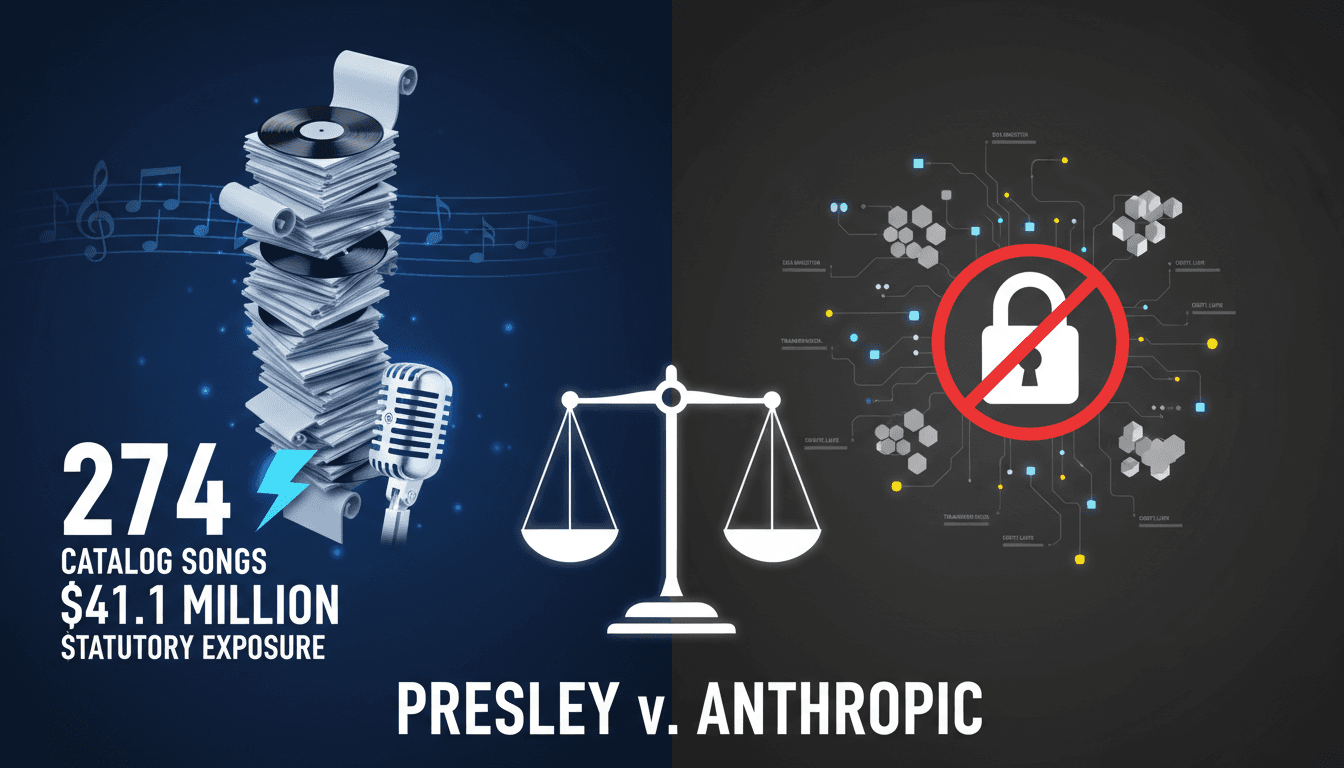
- The financial demand: The lawsuit seeks statutory damages exceeding $41 million (specifically cited at over $41.1 million, with claims scaling up to $48.6 million including Digital Millennium Copyright Act violations), while Anthropic has stated it disagrees with the claims and will defend the case.
The context you actually need
- A pattern of music litigation: This action adds to existing lawsuits against Anthropic lodged in the same federal district court by Concord Music Group, Universal Music Group, BMG Rights Management, and Reservoir over lyric scraping for Claude.
- The $1.5 billion benchmark: The filing follows Anthropic's $1.5 billion settlement approved in July 2026 resolving copyright claims brought by authors, proving that intellectual property owners have concrete legal leverage to extract significant settlements from foundational model creators.
- The regulatory boundary: The dispute centers on whether ingestion of protected text constitutes transformative fair use under US copyright law or unauthorized reproduction and commercial exploitation of legacy cultural assets.
What's really happening
The economic friction between frontier artificial intelligence labs and legacy intellectual property holders has shifted from abstract copyright debates into a calculated asset-pricing negotiation. In case 5:26-cv-12473, the strategy deployed by Authentic Brands Group’s subsidiary ABG EPE IP LLC, along with Raleigh Music Publishing and Abilene Music, demonstrates that rights managers view unlicensed training as actionable infringement rather than permissible fair use.
At the core of the complaint is the ingestion and storage of 274 specific musical compositions. Under Title 17 of the United States Code, statutory damages for willful infringement can reach up to $150,000 per copyrighted work. By documenting 274 distinct song compositions, the plaintiffs establish a base statutory exposure of $41.1 million. The inclusion of Digital Millennium Copyright Act (DMCA) claims—specifically concerning the removal of copyright management information such as songwriter credits and metadata—allows rights holders to seek additional statutory assessments per violation, pushing the total theoretical liability beyond $48.6 million.
This pressure applies direct economic strain to Anthropic’s operating model. AI developers initially gathered training data from open web crawls under the assumption that computational pattern extraction qualified as non-infringing transformative fair use. However, Anthropic's July 2026 approval of a $1.5 billion settlement with authors fundamentally altered market expectations. That transaction demonstrated that litigation risk carries an identifiable dollar value, creating an economic precedent for legacy entertainment catalogs to assert claims rather than remain passive.
For enterprise operators using Claude, the structural implication centers on dataset provenance and downstream compliance. When rights holders claim an AI system reproduces or closely mimics protected lyrics without attribution, corporate users face potential legal contamination of proprietary outputs. Anthropic has stated it disagrees with the allegations and intends to contest them in court, meaning the Northern District of California will establish whether feeding lyrics into neural network weights breaches exclusive reproduction and distribution rights. As catalog owners treat every unmonetized training run as an unauthorized distribution event, frontier labs face an inescapable commercial trade-off: litigate high-exposure copyright disputes to defense verdicts, or negotiate retroactive enterprise licensing agreements that permanently raise the unit economics of AI inference and deployment.
Who feels it first (and how)
- Enterprise Chief Technology and Legal Officers: Organizations building on top of Claude must monitor training data provenance to ensure their commercial applications do not inherit downstream intellectual property liability or sudden model deprecation.
- Intellectual Property and Catalog Investment Funds: Institutional owners of music, publishing, and film archives gain verified legal blueprints to value their historical assets as non-consensual AI training inputs, creating new revenue recovery pipelines.
- Generative AI Foundation Model Developers: Engineering teams face stricter data filtration requirements, forcing higher pre-training operational expenditures to scrub commercial song catalogs and protected text from raw web crawls.
- Music Publishers and Songwriters: Content creators see legal confirmation that unauthorized use of their lyric databases for automated synthetic text generation will be challenged under federal copyright statutes.
What to watch next
- Anthropic's motion to dismiss or answer: The defense filing will reveal whether Anthropic relies entirely on fair use doctrine or disputes the factual claim that 274 specific Presley works were ingested and reproduced.
- Consolidation with existing music publisher suits: Watch if the Northern District of California merges this case with pending actions from Universal Music Group and Concord Music Group, which would centralize music industry leverage into a single coordinated trial.
- Inference output filtering updates: Look for immediate backend guardrails deployed by Anthropic to suppress verbatim or near-verbatim generation of historical rock and roll lyrics when queried by end users.
On October 23, 2026, rights owners for 274 Elvis Presley songs filed an infringement lawsuit against Anthropic in the Northern District of California seeking statutory damages over $41 million under US copyright law and the DMCA; Anthropic has formally confirmed it disputes the claims and will defend the suit.
The litigation will follow the procedural trajectory of earlier publishing disputes, using discovery into Anthropic’s training archives to pressure the developer toward a structured commercial licensing agreement or cash settlement.
Whether federal courts will classify the intermediate storage of lyrics during neural network training as fair use, or rule that the technical extraction of text without metadata constitutes an incurable violation of the DMCA.
Frequently Asked Questions
- Why it matters?
- The legal action tests the limits of fair use in artificial intelligence training, signaling that catalog owners will aggressively enforce statutory penalties against foundational model developers that ingest creative intellectual property without prior licensing agreements.
- What happened (in 30 seconds)?
- The formal complaint: On October 23, 2026, rights holders representing Elvis Presley’s catalog—including ABG EPE IP LLC, Raleigh Music Publishing, and Abilene Music—filed a copyright infringement lawsuit against Anthropic in the US District Court for the Northern District of California (case 5:26-cv-12473). The core allegations: The plaintiffs allege Anthropic scraped and stored lyrics from 274 Presley compositions without authorization, fed them into training runs for its Claude chatbot, stripp
- What's really happening?
- The economic friction between frontier artificial intelligence labs and legacy intellectual property holders has shifted from abstract copyright debates into a calculated asset-pricing negotiation. In case 5:26-cv-12473, the strategy deployed by Authentic Brands Group’s subsidiary ABG EPE IP LLC, along with Raleigh Music Publishing and Abilene Music, demonstrates that rights managers view unlicensed training as actionable infringement rather than permissible fair use. At the core of the complai
- Who feels it first (and how)?
- Enterprise Chief Technology and Legal Officers: Organizations building on top of Claude must monitor training data provenance to ensure their commercial applications do not inherit downstream intellectual property liability or sudden model deprecation. Intellectual Property and Catalog Investment Funds: Institutional owners of music, publishing, and film archives gain verified legal blueprints to value their historical assets as non-consensual AI training inputs, creating new revenue recovery pi
- What to watch next?
- Anthropic's motion to dismiss or answer: The defense filing will reveal whether Anthropic relies entirely on fair use doctrine or disputes the factual claim that 274 specific Presley works were ingested and reproduced. Consolidation with existing music publisher suits: Watch if the Northern District of California merges this case with pending actions from Universal Music Group and Concord Music Group, which would centralize music industry leverage into a single coordinated trial. Inference outpu
English-language digital publication covering business, politics, technology, and current affairs.
"The Arabian Post mixes original and syndicated-style coverage with a broad regional and global business-news orientation."
— A47 Editor
Elvis Presley rights holders pursue Anthropic over copyright infringement
Music rights holders for Elvis Presley have filed a multimillion-dollar lawsuit in the US District Court for the Northern District of California against AI company Anthropic, alleging it used 274 copyrighted songs without permission to train its Clau...
Arts, film, music, television, and cultural events.
"BBC News is widely regarded as a reputable international news organization, known for its impartial tone and public service mandate."
— A47 Editor
Owners of Elvis music rights sue Anthropic for copyright violations
Owners of Elvis Presley's music rights have filed a lawsuit against AI company Anthropic, accusing it of copyright violations for using hundreds of the rock-and-roll star's songs to train its Claude AI model, according to BBC News.
Consumer technology news with AI coverage.
"Gadget and tech site reporting on AI in products."
— A47 Editor
Elvis Presley's estate is suing Anthropic over copyright infringement
Elvis Presley's estate is suing AI company Anthropic over alleged copyright infringement, centering on claims that the company used Presley's music to train its AI models without permission. The case is the latest in a series of AI copyright disputes...
Covers consumer technology, electronics, gadgets, and product reviews.
"Engadget is a trusted source for gadget reviews and consumer tech news, known for its hands-on analysis and industry coverage."
— A47 Editor
Elvis Presley's estate is suing Anthropic over copyright infringement
Elvis Presley's estate is suing AI company Anthropic over alleged copyright infringement, centering on claims that the company used Presley's music to train its AI models without permission. The case is the latest in a series of AI copyright disputes...
Curated tech headlines including AI stories.
"Influential aggregator surfacing the day’s top tech/AI links."
— A47 Editor
Elvis Presley's rightsholders sue Anthropic over 274 songs allegedly used to train its models, seeking $41M+; Anthropic says it disagrees and will defend itself (Derrick Bryson Taylor/New York Times)
Elvis Presley's rightsholders have sued AI company Anthropic, alleging it used 274 Presley songs, including "Can't Help Falling in Love," to train its AI models without permission, and seeking more than $41 million. Anthropic says it disagrees with t...
California news and regional developments.
"The Los Angeles Times is a major West Coast newspaper offering in-depth reporting with a liberal editorial tone and strong regional focus."
— A47 Editor
Elvis Presley catalog owners sue Anthropic alleging copyright infringement
Owners of the rights to 274 Elvis Presley songs, including "Don't Be Cruel" and "All Shook Up," have sued AI company Anthropic, alleging it illegally used the recordings to train its AI tool Claude. Anthropic has denied the claims, according to the L...