
China STAR50 Index Falls 40 Percent Erasing 480 Billion Dollars in AI Sector Value
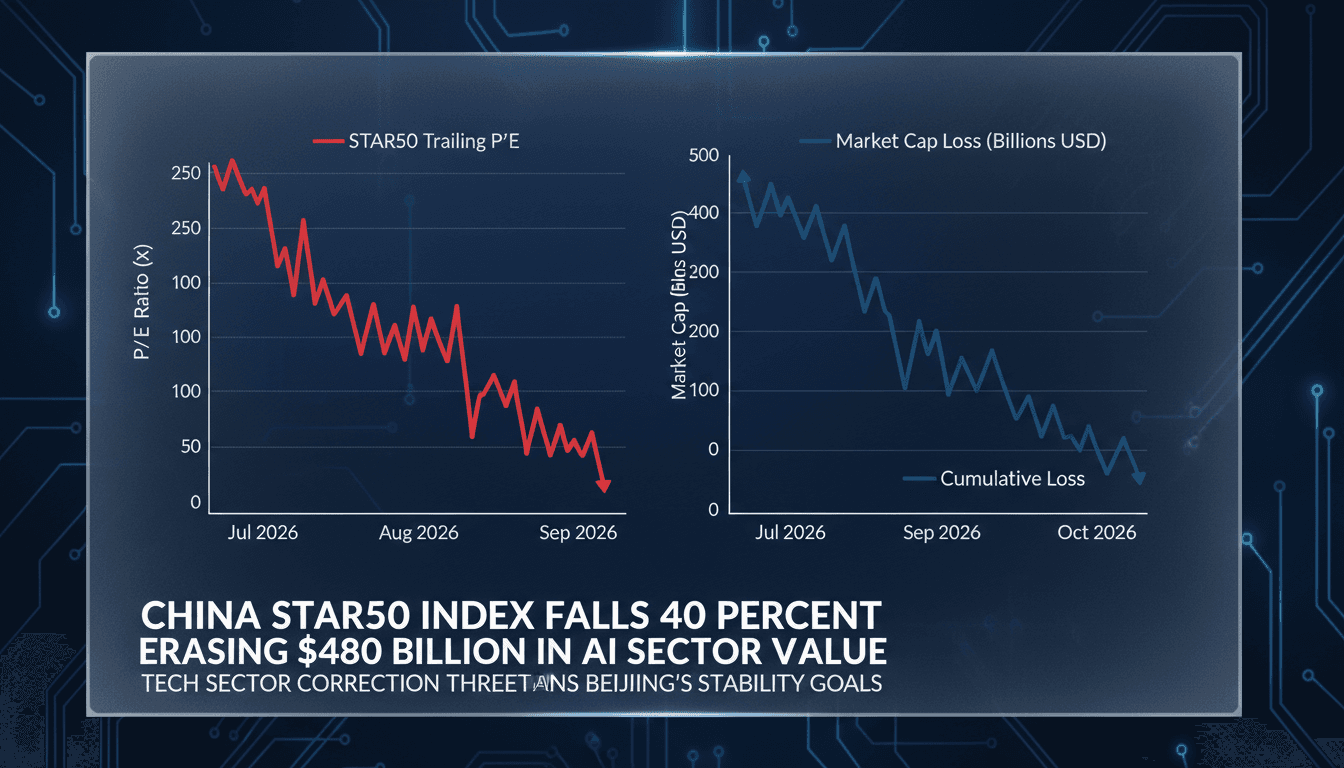
Why it matters
The collapse of the STAR50’s speculative premium dismantles cross-border valuation assumptions for generative hardware and tests whether policy-directed liquidity can sustain long-term technological self-reliance.
What happened (in 30 seconds)
* The STAR50 plunged 40%: In less than four months from its July peak, mainland China’s benchmark for AI and semiconductor equities shed roughly $480 billion in equity value. * Flagship names were halved: Shares of robotics firm Unitree fell 50% from their August debut, while chipmakers MetaX Integrated Circuits and Moore Threads dropped 50% following prior multi-hundred-percent runs. * The broader market felt the drag: With tech equities accounting for 42% of market capitalization, the benchmark CSI300 dropped approximately 20% from its June high.
The context you actually need
* A state-backed liquidity pipeline: Following stimulus packages rolled out two years prior, policy incentives channeled household savings into mainland equities to finance domestic chip sovereignty amid heightened U.S.-China trade frictions. * Extreme valuation disconnects: At its mid-2026 apex, the STAR50 traded near 250 times trailing earnings—a multiple substantially higher than international peers on the Nasdaq 100. * Export-control anxieties: The selling accelerated as investors weighed impending tax obligations alongside operational threats stemming from potential expanded U.S. restrictions on Chinese infrastructure components in data centers.
What's really happening
The unwind across China’s tech board reflects a failure of market architecture to preserve a policy-favored "slow bull" regime against the momentum of speculative retail capital. Over the preceding two years, policy architecture encouraged domestic retail depositors to move capital off balance sheets and into equity-financed technology developers, attempting to insulate local supply chains like CXMT, Moore Threads, and MetaX from foreign export curbs. However, domestic equity markets lacked the structural depth and institutional float required to absorb these retail inflows steadily, converting an intentional structural industrial policy into an overheating trading loop.
When the STAR50 climbed to 250 times trailing earnings, it priced in uninhibited top-line expansion across data center silicon and optical component manufacturing. Reality broke that momentum along three distinct friction points. First, optical component manufacturers experienced enterprise selling, plunging approximately 60% as cash-flow timelines clashed with baseline earnings realities. Second, market participants faced seasonal tax liabilities, requiring balance-sheet liquidation from overextended positions. Third, foreign regulatory exposure loomed over high-density computing; speculative valuations could not withstand the rising probability of widened U.S. trade curbs targeted at Chinese data center hardware.
Because the broader tech complex accounted for 42% of total domestic market capitalization, the breakdown in high-beta names rapidly contaminated core equities. Retail investors, who entered late after MetaX surged 700% and Moore Threads gained 400%, absorbed the direct impact of the drawdowns. As retail trading desks transitioned from chasing thematic momentum to executing capital preservation, sell volumes cascaded into defensive positioning.
Even after surrendering $480 billion in value, the STAR50 trades at approximately 100 times trailing earnings. This remaining premium indicates that the market has merely transitioned from irrational excess to an uneasy holding pattern, leaving the China Securities Regulatory Commission to negotiate stability controls with funds while primary-market equity financing slows across the sector.
Who feels it first (and how)
* Mainland retail investors: Portfolios heavily concentrated in state-promoted semiconductor themes face capital destruction, prompting an active flight toward defensive, low-yield instruments. * Early-stage tech founders: Late-stage hardware startups planning IPO exits on the STAR board face protracted listing delays and reduced equity valuations. * Global institutional allocators: Emerging market funds must reconcile exposure to regional tech indices as multiples on the STAR50 adjust toward global benchmarks. * Hardware supply chains: Semiconductor and optical component makers lose access to cheap domestic secondary-equity financing, increasing their reliance on state grants or internal balance sheets.
What to watch next
* CSRC market intervention rules: Watch for new administrative guidelines or liquidity measures from the China Securities Regulatory Commission targeting price volatility and short-term speculation. * U.S. data center restrictions: Track formal policy releases from Washington regarding equipment bans on Chinese networking and processing hardware, which will define terminal cash-flow expectations. * STAR50 price-to-earnings consolidation: Observe whether trailing multiples break below the 100x threshold to converge with broader semiconductor indices like the CSI300 or Nasdaq 100.
The STAR50 shed approximately 40% of its value from its July peak through October 2026, wiping out $480 billion in capitalization and reducing index multiples from 250x to roughly 100x trailing earnings.
Initial public offerings and secondary share issuances for mainland semiconductor and robotics startups will stall as regulators review volatility controls.
Whether domestic earnings growth from enterprise AI deployment can recover quickly enough to support current 100x earnings multiples without additional policy-driven stimulus.
Frequently Asked Questions
- Why it matters?
- The collapse of the STAR50’s speculative premium dismantles cross-border valuation assumptions for generative hardware and tests whether policy-directed liquidity can sustain long-term technological self-reliance.
- What happened (in 30 seconds)?
- The STAR50 plunged 40%: In less than four months from its July peak, mainland China’s benchmark for AI and semiconductor equities shed roughly $480 billion in equity value. Flagship names were halved: Shares of robotics firm Unitree fell 50% from their August debut, while chipmakers MetaX Integrated Circuits and Moore Threads dropped 50% following prior multi-hundred-percent runs. The broader market felt the drag: With tech equities accounting for 42% of market capitalization, the benchmark CSI3
- What's really happening?
- The unwind across China’s tech board reflects a failure of market architecture to preserve a policy-favored "slow bull" regime against the momentum of speculative retail capital. Over the preceding two years, policy architecture encouraged domestic retail depositors to move capital off balance sheets and into equity-financed technology developers, attempting to insulate local supply chains like CXMT, Moore Threads, and MetaX from foreign export curbs. However, domestic equity markets lacked the
- Who feels it first (and how)?
- Mainland retail investors: Portfolios heavily concentrated in state-promoted semiconductor themes face capital destruction, prompting an active flight toward defensive, low-yield instruments. Early-stage tech founders: Late-stage hardware startups planning IPO exits on the STAR board face protracted listing delays and reduced equity valuations. Global institutional allocators: Emerging market funds must reconcile exposure to regional tech indices as multiples on the STAR50 adjust toward global b
- What to watch next?
- CSRC market intervention rules: Watch for new administrative guidelines or liquidity measures from the China Securities Regulatory Commission targeting price volatility and short-term speculation. U.S. data center restrictions: Track formal policy releases from Washington regarding equipment bans on Chinese networking and processing hardware, which will define terminal cash-flow expectations. STAR50 price-to-earnings consolidation: Observe whether trailing multiples break below the 100x threshol
Macro commentary, policy analysis, growth/inflation themes, and global outlooks.
"Contextual macro coverage that complements day-to-day market headlines."
— A47 Editor
In China, the AI bubble has already burst
The base report from Investing.com, titled "In China, the AI bubble has already burst," carries a negative sentiment and is categorized under markets, focusing on the perceived collapse of an artificial intelligence bubble in China.
News and features on AI from The Guardian.
"Progressive-leaning international outlet with critical AI coverage."
— A47 Editor
Chinese markets lose trillions as race for AI supremacy with US takes its toll
Trillions of dollars have been wiped from China's stock markets in recent months amid rising anxiety over the future of artificial intelligence, as Beijing competes with the United States for dominance in the sector. The STAR 50 Index, which tracks t...
Tech culture, product news, and critical takes on the tech industry's social impact.
"The Guardian's tech coverage blends mainstream news, critical analysis, and cultural commentary on emerging technologies and digital trends."
— A47 Editor
Chinese markets lose trillions as race for AI supremacy with US takes its toll
Trillions of dollars have been wiped from China's stock markets in recent months amid rising anxiety over the future of artificial intelligence, as Beijing competes with the United States for dominance in the sector. The STAR 50 Index, which tracks t...
International coverage from The Guardian's global desks.
"The Guardian is known for its progressive editorial stance and in-depth analysis."
— A47 Editor
Chinese markets lose trillions as race for AI supremacy with US takes its toll
Trillions of dollars have been wiped from China's stock markets in recent months amid rising anxiety over the future of artificial intelligence, as Beijing competes with the United States for dominance in the sector. The STAR 50 Index, which tracks t...
Curated tech headlines including AI stories.
"Influential aggregator surfacing the day’s top tech/AI links."
— A47 Editor
China's Star 50 index of AI and chip leaders is down by 40% in under four months, losing ~$480B in market value; chipmaker CXMT is down ~25% in the past month (Reuters)
China's Star 50 index, which tracks leading AI and chip companies, has fallen about 40% in under four months, erasing roughly $480 billion in market value, according to Reuters. Chipmaker CXMT has dropped about 25% over the past month as valuations c...