
SAYO Framework Uses Region-Level Visual Attention Rewards to Strengthen Grounded Reasoning in Multimodal LLMs
Why it matters
Fixing the mathematical disconnect between language reasoning and spatial focus determines whether multimodal systems can reliably automate complex document analysis, visual auditing, and spatial workflows at scale.
What happened (in 30 seconds)
- A core vulnerability exposed: Researchers Siqu Ou, Tianrui Wan, Zhiyuan Zhao, Junyu Gao, and Xuelong Li released findings showing that multimodal large language models (MLLMs) regularly suffer from weak visual focus, where initial gaze misalignments compound errors across multi-step chains of thought.
- The SAYO architecture introduced: The team designed SAYO, a reinforcement learning framework that rewards region-level visual attention to align training incentives with accurate, step-by-step spatial verification.
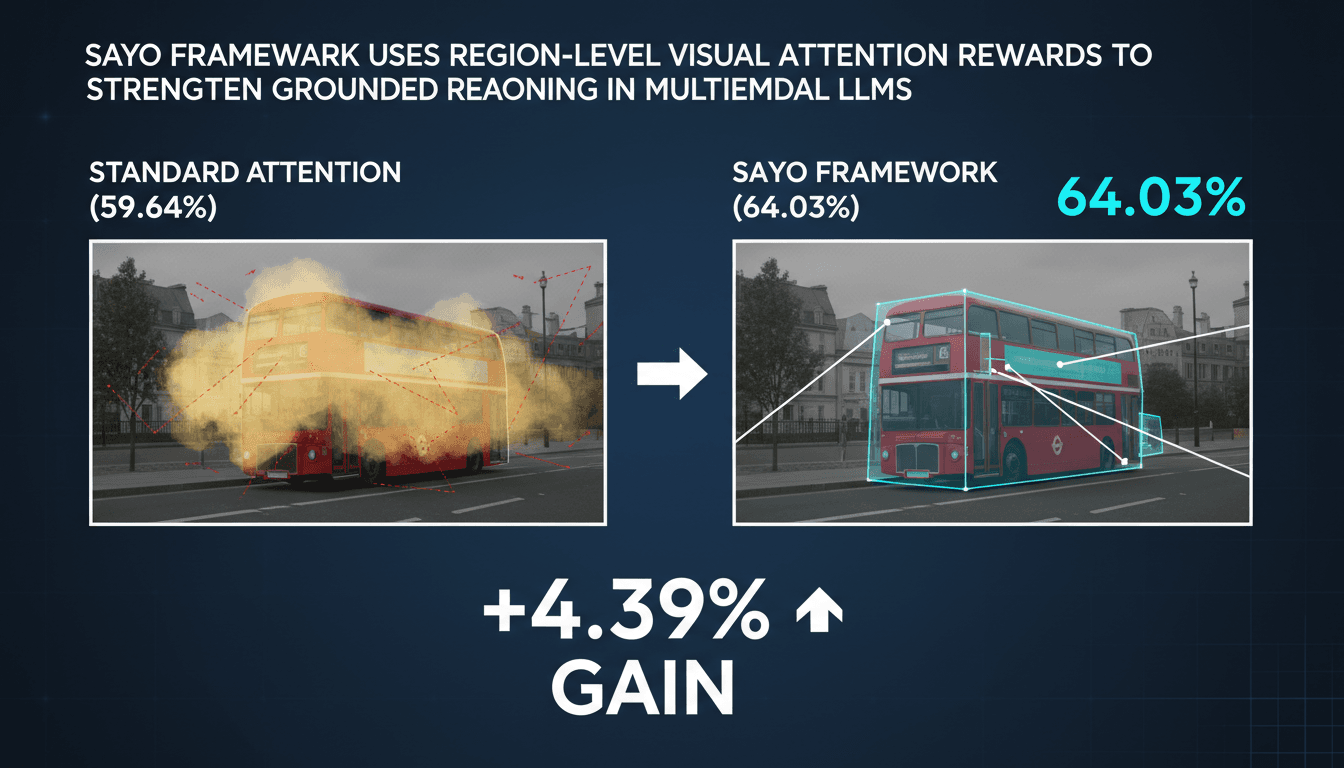
- Quantifiable benchmark gains: Tested on benchmarks including MathVision, ChartQA, M3CoT, MMERealWorld, and V*Bench, the SAYO-Qwen-8B implementation scored an average of 64.03, outpacing the base Qwen3-VL-8B score of 59.64.
The context you actually need
- Chain-of-thought optimization has ignored visual credit: Standard MLLM training optimizes linguistic token sequences without verifying if the underlying visual encoder attends to the correct image coordinates during each reasoning phase.
- Early mistakes create cascading errors: When an MLLM anchors to the wrong region of an image on step one, subsequent reasoning tokens attempt to rationalize that error, leading to downstream hallucinations.
- Peer-reviewed validation: Following its February 9, 2026 debut on arXiv, the study was presented at EMNLP 2026 in Budapest, Hungary, demonstrating generalization without requiring domain-specific fine-tuning data.
What's really happening
The operational limit of multimodal intelligence has rarely been a shortage of parameters; it is a structural failure of credit assignment. When an MLLM performs chain-of-thought reasoning across complex visual inputs—such as charts, diagrams, or dense real-world imagery—it generates language tokens sequentially. However, conventional training treats visual inputs as passive contextual embeddings. If an attention head misidentifies a critical bounding box or numerical label in step one, the system receives no intermediate penalty as long as the generated text looks plausibly coherent. This causes compounding failure: text logic proceeds forward while visual attention wanders aimlessly across irrelevant pixels.
The SAYO framework restructures this operational incentive through reinforcement learning. By calculating a region-level visual attention reward, the model evaluates whether the visual gaze is locked onto the precise coordinates corresponding to the current reasoning step. When the model formulates a intermediate deduction about an isolated visual marker, the optimization function rewards attention maps that tightly overlap with the relevant spatial region.
This approach targets the root cause of vision-language drift. Prior methods attempted to solve visual reasoning failures by feeding models larger volumes of specialized supervised instruction data. Yet supervised fine-tuning often encourages models to memorize statistical correlations between question phrasing and answer templates, rather than training the system to inspect the source material directly.
The empirical benchmark results validate the incentive shift. Moving the average score from 59.64 to 64.03 across diverse evaluators—including ChartQA and MathVision—demonstrates that spatial reinforcement learning equips 8-billion-parameter models to outperform larger base weights on complex visual deduction tasks. Because SAYO reinforces the visual attention policy itself, the model acquires generalizable cross-domain reasoning capabilities without depending on custom, task-specific datasets.
For engineering organizations, this dynamic shifts deployment economics. Teams running vision-language models no longer need to accept trade-offs between parameter bloat and spatial precision. Incorporating region-level reinforcement learning into post-training pipelines allows smaller, cost-efficient open-weight models to anchor their intermediate logic directly to physical image regions, curtailing compounding hallucinations before final outputs are generated.
Who feels it first (and how)
- Computer vision and ML engineers: Teams maintaining multimodal agents gain an architectural mechanism to penalize hallucination at the attention layer, reducing reliance on expensive brute-force prompt engineering.
- Document intelligence teams: Financial, technical, and data analysts relying on automated ChartQA and MathVision parsing see immediate accuracy improvements across complex, multi-variable visual data.
- Infrastructure cost allocators: Engineering leads can achieve superior reasoning metrics with optimized 8-billion-parameter models, bypassing the operational expenditure required to deploy massively oversized vision models.
What to watch next
- Broader open-weight adoption: Watch whether independent open-weight labs integrate region-level visual reward functions into subsequent post-training releases to lower error rates.
- Latency impact on production pipelines: Monitor inference speed benchmarks to verify if enforcing region-level attention policies introduces runtime overhead during complex chain-of-thought operations.
SAYO-Qwen-8B achieved an average benchmark score of 64.03 compared to 59.64 for the base Qwen3-VL-8B across standard visual reasoning benchmarks, earning presentation at EMNLP 2026.
Reinforcement learning tied to spatial grounding will become a standard post-training method across commercial and open-weight multimodal model pipelines.
Whether region-level visual reward architectures scale efficiently to high-resolution video streams or dynamic temporal processing environments without extensive compute overhead.
Frequently Asked Questions
- Why it matters?
- Fixing the mathematical disconnect between language reasoning and spatial focus determines whether multimodal systems can reliably automate complex document analysis, visual auditing, and spatial workflows at scale.
- What happened (in 30 seconds)?
- A core vulnerability exposed: Researchers Siqu Ou, Tianrui Wan, Zhiyuan Zhao, Junyu Gao, and Xuelong Li released findings showing that multimodal large language models (MLLMs) regularly suffer from weak visual focus, where initial gaze misalignments compound errors across multi-step chains of thought. The SAYO architecture introduced: The team designed SAYO, a reinforcement learning framework that rewards region-level visual attention to align training incentives with accurate, step-by-step spat
- What's really happening?
- The operational limit of multimodal intelligence has rarely been a shortage of parameters; it is a structural failure of credit assignment. When an MLLM performs chain-of-thought reasoning across complex visual inputs—such as charts, diagrams, or dense real-world imagery—it generates language tokens sequentially. However, conventional training treats visual inputs as passive contextual embeddings. If an attention head misidentifies a critical bounding box or numerical label in step one, the syst
- Who feels it first (and how)?
- Computer vision and ML engineers: Teams maintaining multimodal agents gain an architectural mechanism to penalize hallucination at the attention layer, reducing reliance on expensive brute-force prompt engineering. Document intelligence teams: Financial, technical, and data analysts relying on automated ChartQA and MathVision parsing see immediate accuracy improvements across complex, multi-variable visual data. Infrastructure cost allocators: Engineering leads can achieve superior reasoning met
- What to watch next?
- Broader open-weight adoption: Watch whether independent open-weight labs integrate region-level visual reward functions into subsequent post-training releases to lower error rates. Latency impact on production pipelines: Monitor inference speed benchmarks to verify if enforcing region-level attention policies introduces runtime overhead during complex chain-of-thought operations.
Computer Vision and Pattern Recognition preprints.
"Daily stream of vision research papers and preprints."
— A47 Editor
Do MLLMs Really See It: Reinforcing Visual Attention in Multimodal LLMs
Researchers posted an arXiv preprint in the cs.CV category, "Do MLLMs Really See It: Reinforcing Visual Attention in Multimodal LLMs," describing how current multimodal large language models often exhibit weak visual focus, with early visual misalign...
Machine Learning preprints from arXiv.
"Core ML theory and methods in daily preprints."
— A47 Editor
Attention-space Contrastive Guidance for Efficient Hallucination Mitigation in LVLMs
Researchers posted an arXiv preprint in the cs.LG category introducing Attention-space Contrastive Guidance (ACG), a training-free, single-pass method that aims to reduce hallucinations in large vision-language models (LVLMs) by steering generation t...
Computation and Language (NLP) preprints.
"Daily stream of NLP research papers and preprints."
— A47 Editor
What MLLMs Learn about When they Learn about Multimodal Reasoning
The arXiv cs.CL paper "What MLLMs Learn about When they Learn about Multimodal Reasoning" introduces MathLens, a benchmark of textbook-style geometry problems that decomposes multimodal model performance into perception, reasoning, and multimodal-spe...
Computation and Language (NLP) preprints.
"Daily stream of NLP research papers and preprints."
— A47 Editor
A Broader Look into MLLM's Retrieval Heads
A new arXiv study (cs.CL) examines retrieval heads, a sparse set of attention heads in Multimodal Large Language Models that transfer relevant information from long inputs to the output. The authors extend prior analyses, which were limited to certai...