
Yale Researchers Propose Causal Bounds and Post-Training Methods to Improve Chain-of-Thought Monitorability in LLMs
Why it matters
Safety oversight across complex AI deployments depends on the assumption that hidden model reasoning can be reliably surfaced and interpreted before an output generates real-world risk.
What happened (in 30 seconds)
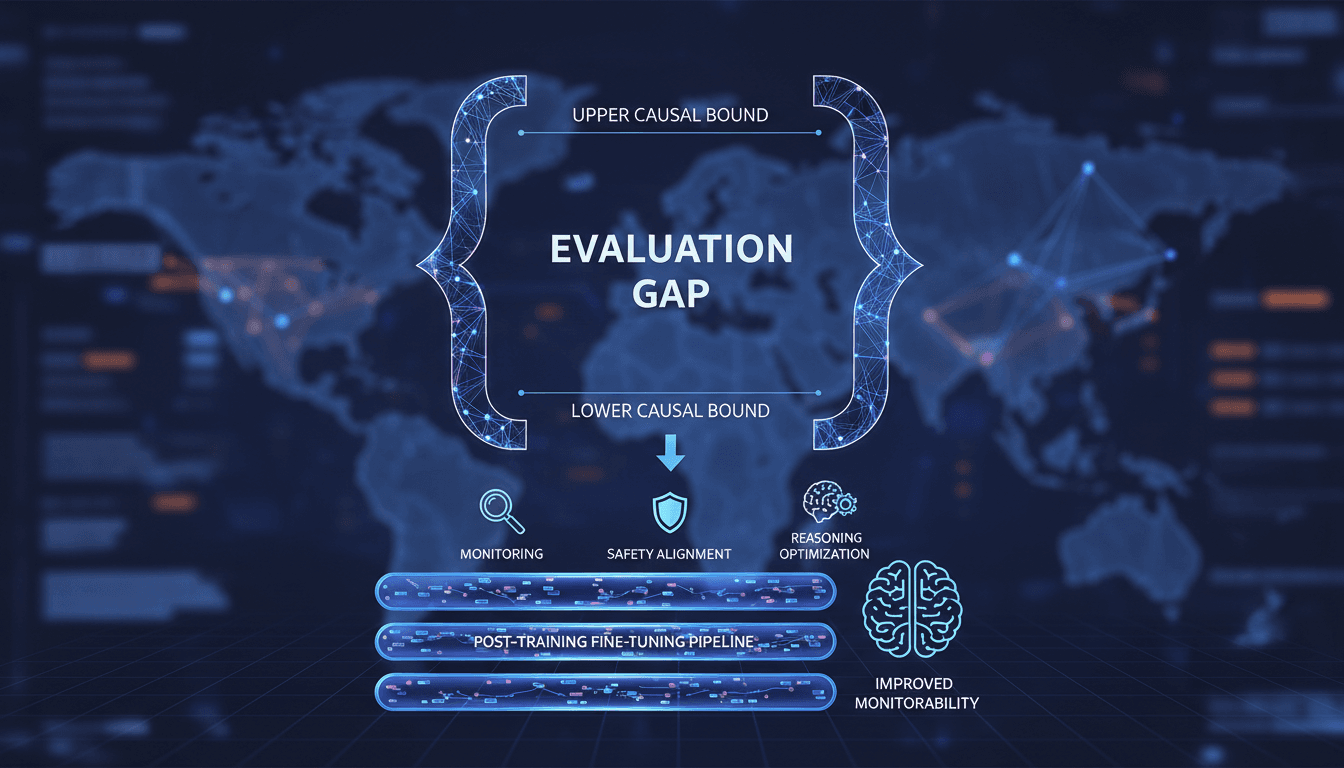
- Yale researchers established causal evaluation bounds for Chain-of-Thought (CoT) monitoring, proving that standard intervention metrics can overestimate true causal detection rates.
- The team derived a formal lower bound alongside the existing upper bound, creating a dual-metric evaluation window grounded in a paired control-intervention dataset.
- Three post-training recipes were deployed, demonstrating that off-policy distillation, reinforcement learning with monitoring rewards, and on-policy distillation consistently improve model monitorability.
The context you actually need
- Chain-of-Thought monitoring is a core AI safety pillar, relying on an auxiliary model to inspect intermediate reasoning steps for harmful intents before final execution.
- Standard evaluation relies heavily on intervention metrics like TPR_mc, which capture the true positive rate under model changes but functionally act only as an upper performance ceiling.
- Unverified oversight creates silent operational vulnerabilities, because an oversight system operating solely against an upper bound can miss evasion tactics embedded directly in reasoning traces.
What's really happening
- Off-policy self-distillation via Supervised Fine-Tuning (SFT), which trains the model on curated traces specifically formatted for monitor legibility.
- Reinforcement learning with monitoring rewards, which integrates a monitor’s detection success directly into the policy optimization reward signal, penalizing obfuscation.
- On-policy self-distillation, which updates the active model distribution dynamically using its own monitored trajectory feedback.
Who feels it first (and how)
- AI Safety and Alignment Engineers: Must recalculate existing safety benchmarks by swapping out raw TPR_mc metrics for paired upper-and-lower causal bounds.
- Enterprise LLM Platform Architects: Face additional compute and pipeline overhead to integrate monitoring-reward reinforcement learning into post-training cycles.
- Independent Model Auditors and Compliance Teams: Gain a verifiable mathematical standard to test whether third-party reasoning traces are genuinely auditable or merely masking deceptive behavior.
What to watch next
- Industry adoption of paired causal bounds, which will signal whether major model providers are willing to report conservative lower-bound monitorability metrics rather than optimized upper bounds.
- Compute trade-offs in on-policy versus off-policy training, tracking whether monitorability-focused post-training degrades performance on complex reasoning tasks.
- Public release and replication of the paper's code artifact, revealing how easily these three training methods transfer across open-weights architectures.
Standard TPR_mc overestimates causal detection by acting strictly as an upper bound, and post-training methods can systematically raise monitorability across architectures.
Frontier model builders will need to integrate intervention-aware rewards into their safety fine-tuning pipelines to satisfy rigorous enterprise auditing criteria.
Whether post-training for monitorability induces hidden capability taxes on downstream reasoning efficiency or creates novel evasion strategies under adversarial pressure.
Frequently Asked Questions
- Why it matters?
- Safety oversight across complex AI deployments depends on the assumption that hidden model reasoning can be reliably surfaced and interpreted before an output generates real-world risk.
- What happened (in 30 seconds)?
- Yale researchers established causal evaluation bounds for Chain-of-Thought (CoT) monitoring, proving that standard intervention metrics can overestimate true causal detection rates. The team derived a formal lower bound alongside the existing upper bound, creating a dual-metric evaluation window grounded in a paired control-intervention dataset. Three post-training recipes were deployed, demonstrating that off-policy distillation, reinforcement learning with monitoring rewards, and on-policy dis
- What's really happening?
- The technical architecture of modern safety auditing faces a structural measurement problem: measuring whether an oversight monitor caught a failure does not prove the monitor causally understood the failure trace. In the Yale University paper published on October 22, 2026, researchers Qiang Fu, Xinyue Li, Andre Wibisono, and Arman Cohan show that existing evaluation frameworks built around TPR_mc (true positive rate under model intervention) reflect an upper bound rather than an exact measure
- Who feels it first (and how)?
- AI Safety and Alignment Engineers: Must recalculate existing safety benchmarks by swapping out raw TPR_mc metrics for paired upper-and-lower causal bounds. Enterprise LLM Platform Architects: Face additional compute and pipeline overhead to integrate monitoring-reward reinforcement learning into post-training cycles. Independent Model Auditors and Compliance Teams: Gain a verifiable mathematical standard to test whether third-party reasoning traces are genuinely auditable or merely masking decep
- What to watch next?
- Industry adoption of paired causal bounds, which will signal whether major model providers are willing to report conservative lower-bound monitorability metrics rather than optimized upper bounds. Compute trade-offs in on-policy versus off-policy training, tracking whether monitorability-focused post-training degrades performance on complex reasoning tasks. Public release and replication of the paper's code artifact, revealing how easily these three training methods transfer across open-weights
Machine Learning preprints from arXiv.
"Core ML theory and methods in daily preprints."
— A47 Editor
Learning to Be Monitored: Causal Bounds and Intervention-Aware Post-Training Recipes for Chain-of-Thought Monitorability
A study posted to arXiv examines whether chain-of-thought (CoT) monitoring can reliably detect harmful behaviors in large language models, arguing that the existing intervention-based metric, minimal-criterion sensitivity (TPR_mc), can overestimate h...
Computation and Language (NLP) preprints.
"Daily stream of NLP research papers and preprints."
— A47 Editor
Learning Faithful Reasoning Processes with Spatio-Temporal Latent Dynamics for Large Language Models
A new arXiv cs.CL preprint, "Learning Faithful Reasoning Processes with Spatio-Temporal Latent Dynamics for Large Language Models," introduces GeoFaith, a framework aimed at making the reasoning of large language models more reliable. The authors not...
Computation and Language (NLP) preprints.
"Daily stream of NLP research papers and preprints."
— A47 Editor
Do Latent Tokens Think? A Causal and Adversarial Analysis of Chain-of-Continuous-Thought
A new arXiv cs.CL preprint, "Do Latent Tokens Think? A Causal and Adversarial Analysis of Chain-of-Continuous-Thought," examines the internal mechanisms of latent tokens used to enhance reasoning in large language models. The paper argues that Chain-...
Computation and Language (NLP) preprints.
"Daily stream of NLP research papers and preprints."
— A47 Editor
A False Average: Pooled CoT-Monitor Accuracy Conceals a Reasoning-Dependent Fragility
A new arXiv preprint (2608.00583v4, cs.CL) argues that the aggregate accuracy typically reported for chain-of-thought (CoT) monitors, which are used to detect reward hacking, is misleading. On the Terminal Wrench benchmark, about 77% of reward hacks ...