
DATC Introduces Direction-Aware Token Credit Assignment to Refine GRPO for LLM Alignment
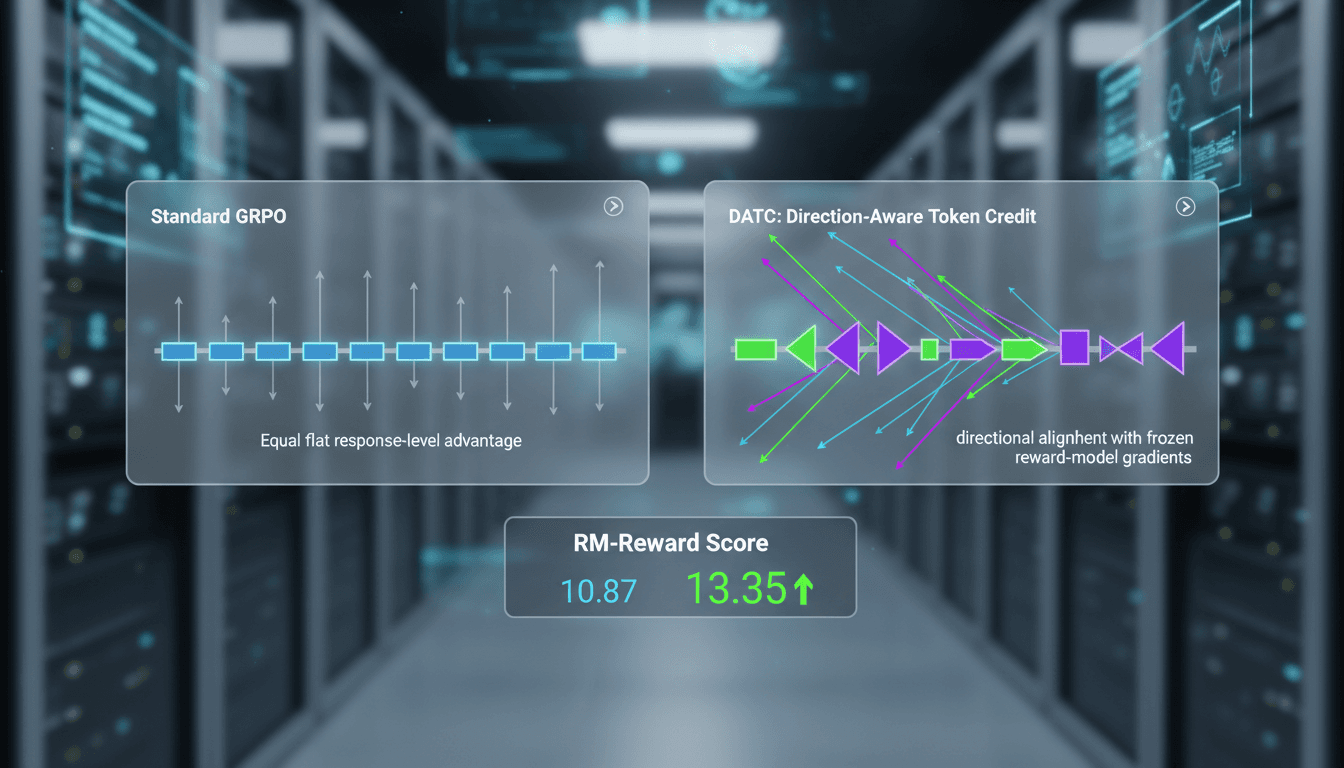
Why it matters
By breaking sequence-level reward signals down to individual tokens via reward-model gradients, alignment pipelines can eliminate noisy optimization updates without abandoning the architectural simplicity of Group Relative Policy Optimization (GRPO).
What happened (in 30 seconds)
- A multi-institution research team unveiled DATC, a preprint detailing Direction-Aware Token Credit Assignment designed to refine token-level policy updates during reinforcement learning alignment.
- The method maps frozen reward-model gradients directly into policy logit space, isolating directional alignment to modulate shared advantages across generated sequences while preserving their sign and mean.
- Empirical evaluations across Qwen3-14B and Llama-3.1-8B demonstrated consistent gains, with DATC surpassing baseline GRPO across RM-Reward, AlpacaEval, Arena-Hard, and MT-Bench benchmarks.
The context you actually need
- GRPO traditionally applies a single response-level advantage across every token, indiscriminately reinforcing or suppressing individual words regardless of their specific role in generating a high or low reward.
- Credit assignment remains a fundamental inefficiency in RL post-training, where the lack of localized attribution forces models to ingest substantial gradient noise during iterative policy optimization.
- Prior attempts to isolate per-token credit introduced massive structural overhead, whereas DATC constrains runtime impact to an observed 5.7% to 9.1% increase in end-to-end GPU time.
What's really happening
The core challenge in aligning large language models with reinforcement learning has always been spatial resolution. When an alignment pipeline evaluates a model's completion, the scoring mechanism—a reward model—returns a scalar score for the entire generated sequence. Under standard Group Relative Policy Optimization (GRPO), that single score produces a shared response-level advantage value. Every token generated along that trajectory receives the exact same reinforcement signal. If an otherwise high-quality technical explanation contains a hallucinated entity midway through, standard GRPO still assigns positive reinforcement to the faulty token simply because the overall sequence scored above the reference group mean.
Direction-Aware Token Credit Assignment (DATC), published by researchers across Nanjing University, National University of Singapore, Tsinghua University, and Nanyang Technological University, directly addresses this structural inefficiency using a work-based physics formulation. Instead of treating every token uniformly, DATC computes a directional credit score for each token position. It achieves this by taking the frozen reward model's input gradient, projecting that vector into the policy model's logit space, and calculating its inner product with the gradient of the sampled-action score.
This inner product reveals directional alignment: it identifies whether the policy's update step at that specific token actually moves in the direction that increases the reward model's scalar output. Tokens aligned with the gradient direction receive enhanced weight, while misaligned tokens have their influence dampened. Crucially, DATC normalizes these calculated weights so that the original sign and sequence-level mean of the response advantage remain preserved. It avoids destabilizing the broader policy trajectory while sharpening the local update step.
The empirical data highlights the efficiency of this trade-off. On Qwen3-14B-Base, DATC (configured with hyperparameter λ=4) achieved an RM-Reward score of 13.35, compared to 10.87 for standard GRPO. Similar margins emerged across Llama-3.1-8B, spanning both base and instruct variations on multi-turn and open-ended benchmarks including AlpacaEval, Arena-Hard, and MT-Bench. Ablation studies confirmed that directional alignment is the active mechanism: shuffling the assigned token weights or stripping the inner-product direction degraded performance back to baseline levels.
From an infrastructure perspective, this architectural intervention requires no changes to the underlying model weights or inference execution. The computational cost is strictly confined to the backward pass during post-training, adding between 5.7% and 9.1% to end-to-end GPU time. For engineering teams optimizing the margin between compute expenditure and post-training benchmark returns, this shifts the cost-benefit equation toward granular, gradient-informed credit assignment.
Who feels it first (and how)
- Foundation Model Alignment Engineers: Teams currently running standard GRPO or PPO pipelines will evaluate whether integrating gradient-projection backward passes justifies a sub-10% increase in cluster training time.
- AI Infrastructure and Compute Budget Holders: Operational leaders must weigh the trade-off of an additional 5.7% to 9.1% end-to-end GPU time against the downstream engineering hours saved by reducing trial-and-error policy drift.
- Open-Source Fine-Tuning Maintainers: Developers managing community post-training frameworks who look to adopt incremental academic improvements that do not require proprietary architectural modifications.
What to watch next
- Third-Party Open-Source Implementation: Independent reproduction in open-source alignment suites (such as TRL or DeepSpeed-Chat) will determine whether DATC's gains hold outside the authors' experimental harness.
- Scaling to Frontier Model Sizes: Monitoring whether the 5.7% to 9.1% GPU overhead scales linearly or steepens when applied to dense models exceeding 70 billion parameters.
- Citation and Derivative Frameworks: Tracking whether follow-up preprint literature adopts reward-gradient projection as a default component in next-generation credit assignment.
DATC modulates response-level advantages by projecting reward-model gradients into logit space, outperforming baseline GRPO across Qwen3-14B and Llama-3.1-8B models across four standard benchmarks with a 5.7% to 9.1% end-to-end GPU time penalty.
The method will appeal primarily to teams already constrained by alignment data quality, where extracting precise signal per generated response is more cost-effective than expanding synthetic training sets.
Whether the directional inner-product calculations remain stable across diverse, multi-reward configurations or uncalibrated reward models that produce erratic input gradients.
Frequently Asked Questions
- Why it matters?
- By breaking sequence-level reward signals down to individual tokens via reward-model gradients, alignment pipelines can eliminate noisy optimization updates without abandoning the architectural simplicity of Group Relative Policy Optimization (GRPO).
- What happened (in 30 seconds)?
- A multi-institution research team unveiled DATC, a preprint detailing Direction-Aware Token Credit Assignment designed to refine token-level policy updates during reinforcement learning alignment. The method maps frozen reward-model gradients directly into policy logit space, isolating directional alignment to modulate shared advantages across generated sequences while preserving their sign and mean. Empirical evaluations across Qwen3-14B and Llama-3.1-8B demonstrated consistent gains, with DATC
- What's really happening?
- The core challenge in aligning large language models with reinforcement learning has always been spatial resolution. When an alignment pipeline evaluates a model's completion, the scoring mechanism—a reward model—returns a scalar score for the entire generated sequence. Under standard Group Relative Policy Optimization (GRPO), that single score produces a shared response-level advantage value. Every token generated along that trajectory receives the exact same reinforcement signal. If an otherwi
- Who feels it first (and how)?
- Foundation Model Alignment Engineers: Teams currently running standard GRPO or PPO pipelines will evaluate whether integrating gradient-projection backward passes justifies a sub-10% increase in cluster training time. AI Infrastructure and Compute Budget Holders: Operational leaders must weigh the trade-off of an additional 5.7% to 9.1% end-to-end GPU time against the downstream engineering hours saved by reducing trial-and-error policy drift. Open-Source Fine-Tuning Maintainers: Developers mana
- What to watch next?
- Third-Party Open-Source Implementation: Independent reproduction in open-source alignment suites (such as TRL or DeepSpeed-Chat) will determine whether DATC's gains hold outside the authors' experimental harness. Scaling to Frontier Model Sizes: Monitoring whether the 5.7% to 9.1% GPU overhead scales linearly or steepens when applied to dense models exceeding 70 billion parameters. Citation and Derivative Frameworks: Tracking whether follow-up preprint literature adopts reward-gradient projectio
Computation and Language (NLP) preprints.
"Daily stream of NLP research papers and preprints."
— A47 Editor
DTCA: Denoising Token Credit Assignment for Reinforcement Learning in Diffusion Language Models
Researchers posted an arXiv cs.CL preprint introducing Denoising Token Credit Assignment (DTCA), a framework for token-level credit assignment in reinforcement learning for diffusion language models (DLMs). DTCA estimates each token's contribution by...
Machine Learning preprints from arXiv.
"Core ML theory and methods in daily preprints."
— A47 Editor
Direction-Aware Token Credit Assignment with Reward-Model Gradients
Researchers posted an arXiv cs.LG preprint introducing Direction-Aware Token Credit Assignment (DATC), a method that addresses how strongly each token should contribute to learning under GRPO, which assigns a single response-level advantage to all to...
Computation and Language (NLP) preprints.
"Daily stream of NLP research papers and preprints."
— A47 Editor
Correlation-Aware Exploration for Long-Trace Reasoning
A new arXiv preprint in the cs.CL category introduces Info-GRPO, an information-theoretic framework for Group Relative Policy Optimization (GRPO) aimed at long-trace reasoning models. The paper states that GRPO-trained reasoning models now produce ch...