
Burry Positions AMD and Broadcom as Beneficiaries of Possible Nvidia Share Erosion After Huang Exit
Why it matters
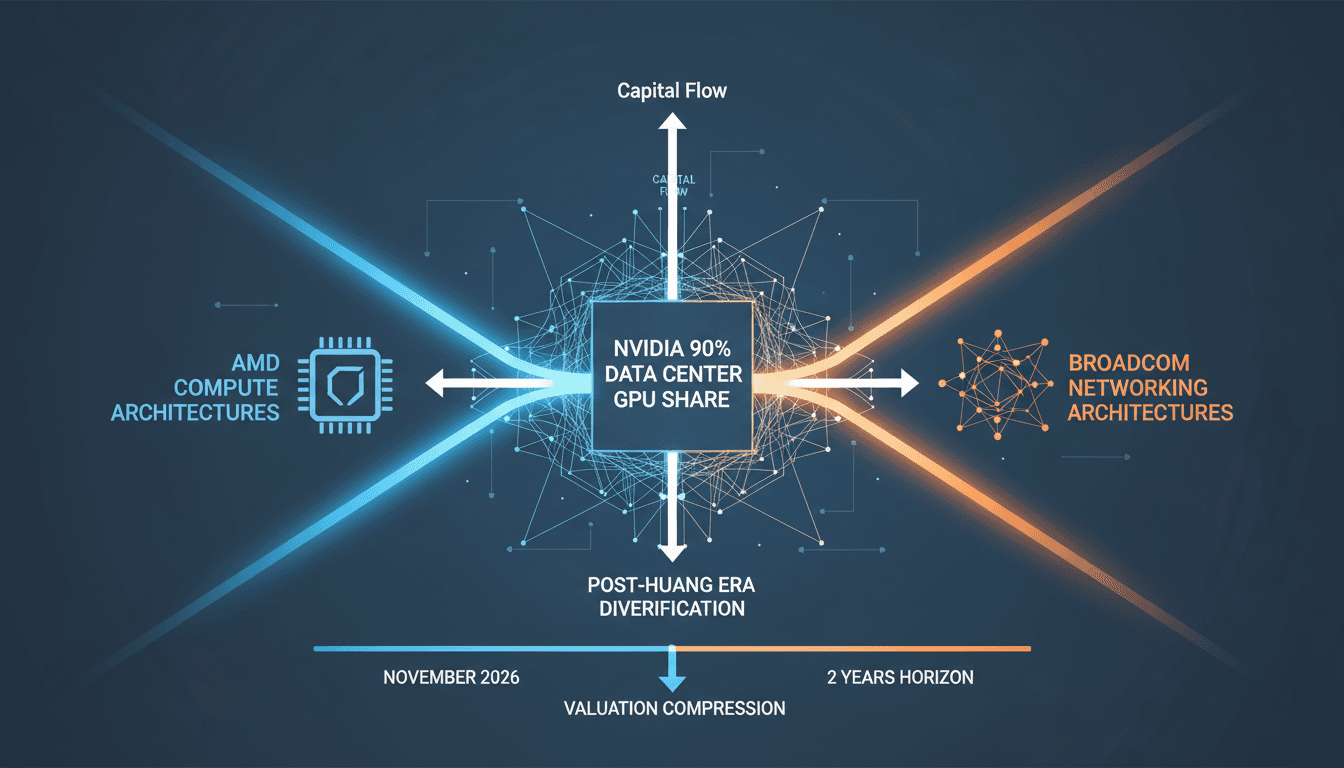
A sudden shift at the top of a company controlling 90% of the high-powered AI data center GPU market threatens to break single-supplier lock-in and redistribute enterprise capital expenditures toward alternative chipmakers.
What happened (in 30 seconds)
- A sudden leadership departure: Jensen Huang resigned as Nvidia CEO on November 12, 2026, amid board scrutiny and personal allegations, leaving Chief Financial Officer Colette Kress in place as interim leader.
- Burry scales his short positions: Investor Michael Burry doubled put positions on the Nasdaq 100 and expanded puts on the VanEck Semiconductor ETF (SMH) expiring in 2027, anticipating multiple contraction across tech valuations.
- Competitors identified as structural beneficiaries: Burry publicly flagged Advanced Micro Devices (AMD) and Broadcom (AVGO) as the primary contenders poised to capture enterprise market share if Nvidia's ecosystem control deteriorates.
The context you actually need
- The 90% choke point: Nvidia established an estimated 90% share of the high-powered AI data center GPU sector by integrating proprietary architecture, enterprise software, and direct customer financing arrangements.
- Selective ETF short positioning: Burry explicitly chose to short the VanEck Semiconductor ETF (SMH) over the iShares Semiconductor ETF (SOXX) because SOXX maintains higher relative weightings in AMD and Broadcom.
- Persistent valuation skepticism: Prior to Huang's exit, Burry had already deployed capital against semiconductor valuations, citing stretched earnings multiples, high margin baselines, and capital-spending sustainability concerns across the tech sector.
What's really happening
The core mechanism stabilizing Nvidia’s 90% market dominance was not merely silicon performance, but an executive-driven ecosystem built on proprietary architectures, bundled software, and tightly managed customer financing. Jensen Huang acted as the central architect of these bilateral enterprise commitments. When a founder-led operational structure loses its central figure under abrupt circumstances, the contractual, financial, and relational glue holding enterprise buyers to a single proprietary pipeline begins to loosen.
Enterprise hyperscalers and data center operators face clear economic incentives to eliminate single-supplier risk. Operating under multi-billion-dollar capital allocation plans, these buyers have spent years seeking viable alternatives to Nvidia to lower procurement costs, escape gross-margin extraction, and avoid delivery bottlenecks. However, switching costs remained high due to architectural lock-in and Huang's coordinated ecosystem delivery. With interim leadership under CFO Colette Kress now focused on internal stability and governance scrutiny, enterprise procurement teams are incentivized to accelerate qualification cycles for secondary and tertiary suppliers.
This dynamic explains Michael Burry’s bifurcated trading posture. By expanding put options against the tech-heavy Nasdaq 100 and the VanEck Semiconductor ETF (SMH)—which holds heavy Nvidia exposure—Burry is positioning for broad valuation compression across semiconductor multiples through 2027. Concurrently, his deliberate avoidance of shorting the SOXX ETF reflects an expectation of capital rotation: AMD and Broadcom are direct operational hedges.
AMD provides direct, drop-in accelerator alternatives for compute clusters, while Broadcom dominates the specialized networking silicon, interconnects, and custom ASIC development required when hyperscalers build their own in-house AI chips. If Nvidia's operational momentum slows and its gross margins contract from historic highs, the enterprise capital currently dedicated to Nvidia's hardware stack does not necessarily evaporate. Instead, procurement directors redirect incremental capital toward AMD's compute platforms and Broadcom's networking infrastructure.
Ultimately, this transition signals a potential migration from an integrated, single-vendor hardware monopoly toward a standardized, multi-vendor enterprise supply chain. While Nvidia maintains near-term hardware superiority, the institutional leverage has begun shifting back to enterprise buyers and adjacent chip designers equipped to absorb displaced demand.
Who feels it first (and how)
- Enterprise Chief Technology Officers: Infrastructure leaders who previously faced multi-quarter hardware backorders gain immediate leverage to renegotiate purchase contracts and accelerate multi-vendor qualification programs.
- Semiconductor Equity Analysts: Fund managers re-evaluating enterprise pricing power must reweight portfolios away from single-stock dominance toward custom silicon and networking providers like Broadcom and AMD.
- Hardware Procurement Directors: Data center purchasing heads must balance near-term deployment delays under Nvidia's interim leadership against long-term vendor diversification strategies.
- Institutional ETF Allocators: Portfolio managers tracking chip benchmarks face immediate tracking divergence between Nvidia-heavy vehicles (SMH) and diversified baskets containing higher Broadcom and AMD allocations (SOXX).
What to watch next
- Interim guidance on customer financing: Watch whether Nvidia adjusts the structure of its enterprise financing programs and margin targets during Colette Kress’s initial quarterly briefings, which will signal whether ecosystem lock-in is softening.
- Hyperscaler procurement disclosures: Track upcoming capital expenditure reports from major cloud providers for capital shifts toward custom silicon co-developed with Broadcom or expanded deployments of AMD accelerators.
- Derivative positioning on semiconductor ETFs: Monitor open interest and volume disparities between SMH and SOXX put contracts expiring in 2027 to observe whether institutional capital follows Burry’s rotation thesis.
Jensen Huang resigned on November 12, 2026; Colette Kress assumed interim leadership; Michael Burry expanded Nasdaq 100 and SMH puts while explicitly naming AMD and Broadcom as market share beneficiaries.
Enterprise hyperscalers will leverage the leadership disruption to demand pricing concessions or diversify their hardware suppliers to mitigate operational dependency on a single executive structure.
Whether AMD and Broadcom possess the immediate supply chain capacity to capture substantial portions of Nvidia's estimated 90% GPU market share before Nvidia selects a permanent chief executive.
Frequently Asked Questions
- Why it matters?
- A sudden shift at the top of a company controlling 90% of the high-powered AI data center GPU market threatens to break single-supplier lock-in and redistribute enterprise capital expenditures toward alternative chipmakers.
- What happened (in 30 seconds)?
- A sudden leadership departure: Jensen Huang resigned as Nvidia CEO on November 12, 2026, amid board scrutiny and personal allegations, leaving Chief Financial Officer Colette Kress in place as interim leader. Burry scales his short positions: Investor Michael Burry doubled put positions on the Nasdaq 100 and expanded puts on the VanEck Semiconductor ETF (SMH) expiring in 2027, anticipating multiple contraction across tech valuations. Competitors identified as structural beneficiaries: Burry publ
- What's really happening?
- The core mechanism stabilizing Nvidia’s 90% market dominance was not merely silicon performance, but an executive-driven ecosystem built on proprietary architectures, bundled software, and tightly managed customer financing. Jensen Huang acted as the central architect of these bilateral enterprise commitments. When a founder-led operational structure loses its central figure under abrupt circumstances, the contractual, financial, and relational glue holding enterprise buyers to a single propriet
- Who feels it first (and how)?
- Enterprise Chief Technology Officers: Infrastructure leaders who previously faced multi-quarter hardware backorders gain immediate leverage to renegotiate purchase contracts and accelerate multi-vendor qualification programs. Semiconductor Equity Analysts: Fund managers re-evaluating enterprise pricing power must reweight portfolios away from single-stock dominance toward custom silicon and networking providers like Broadcom and AMD. Hardware Procurement Directors: Data center purchasing heads m
- What to watch next?
- Interim guidance on customer financing: Watch whether Nvidia adjusts the structure of its enterprise financing programs and margin targets during Colette Kress’s initial quarterly briefings, which will signal whether ecosystem lock-in is softening. Hyperscaler procurement disclosures: Track upcoming capital expenditure reports from major cloud providers for capital shifts toward custom silicon co-developed with Broadcom or expanded deployments of AMD accelerators. Derivative positioning on semic
Stock market news, investing ideas, and trading analysis.
"TheStreet provides market news and retail-investor-focused analysis."
— A47 Editor
Michael Burry sees 2 chip winners in Nvidia’s shake-up
Michael Burry is adding to his bearish semiconductor bets following Jensen Huang's resignation as Nvidia's CEO, president and board member with immediate effect, after an internal board-led investigation tied to reports citing a New York Times accoun...
Global markets, investing, and macroeconomics from a premier financial newsroom.
"Bloomberg is respected for in-depth financial reporting and data-driven analysis."
— A47 Editor
How Wall Street Is Bracing For the Post-Jensen Huang Nvidia Era
Nvidia co-founder and CEO Jensen Huang has resigned as CEO, president and board member with immediate effect, following an internal board-led investigation and reports, citing a New York Times account and U.S. intelligence assessments, that he had a ...
Markets desk coverage, trading insights, and investor updates.
"WSJ’s markets reporting provides in-depth analysis and context for investors."
— A47 Editor
Jensen Huang’s Exit Will Test AI’s Stocks, and Great-Man Theory
Nvidia co-founder and CEO Jensen Huang has resigned as CEO, president and board member with immediate effect, following an internal board-led investigation and reports, citing a New York Times account and U.S. intelligence assessments, of a romantic ...
Markets desk coverage, trading insights, and investor updates.
"WSJ’s markets reporting provides in-depth analysis and context for investors."
— A47 Editor
Nvidia Shareholders Won’t Miss Jensen Huang for Long
The Wall Street Journal reports that Nvidia's shareholders may not suffer long from the departure of CEO Jensen Huang, arguing that steadier leadership could better suit the AI chip company as it enters a new phase. The development follows an interna...
Technology business news, market impacts, and innovation trends.
"Bloomberg is a premier financial and tech news provider, respected for its in-depth reporting and analytical rigor."
— A47 Editor
Nvidia Shake-Up is a Buying Opportunity: Analyst
Nvidia faces a leadership shake-up as investors weigh what the departure of CEO Jensen Huang could mean for the company's AI dominance; analyst Antoine Chkaiban of New Street Technology Infrastructure argues that Nvidia's software ecosystem, engineer...
Technology business and AI-related headlines.
"Data-driven tech newsroom with global scope."
— A47 Editor
Nvidia Shake-Up Is a Buying Opportunity, Says Analyst Chkaiban
Nvidia faces a leadership shake-up as investors weigh what the departure of CEO Jensen Huang could mean for the company's AI dominance; analyst Antoine Chkaiban of New Street Technology Infrastructure argues that Nvidia's software ecosystem, engineer...
Business and tech news excluding paywalled content.
"High-volume business/tech outlet with frequent AI coverage."
— A47 Editor
'Get out' of Nvidia stock, Michael Burry says
Michael Burry, known for "The Big Short," urged investors to "get out" of Nvidia stock, arguing that CEO Jensen Huang's departure could slow the chipmaker's growth and compress its profit margins. The commentary follows a board-level review of Huang ...
Markets desk coverage, trading insights, and investor updates.
"WSJ’s markets reporting provides in-depth analysis and context for investors."
— A47 Editor
Stock Market News, Nov. 12, 2026: Chip Giant’s Stock Falls 4% After Jensen Huang Exit
Nvidia shares fell about 4% after co-founder and CEO Jensen Huang resigned as CEO, president and board member, effective immediately, following reports of extramarital relationships, including one with Alice Huang, a Chinese businesswoman U.S. intell...