
European Tech Equities Post Steepest Weekly Decline Since March as AI Positions Unwind After Anthropic IPO
Why it matters
The sudden retreat across semiconductor equipment suppliers shows how concentrated infrastructure bets face valuation limits when headline public listings fail to produce fresh buy-side momentum.
What happened (in 30 seconds)
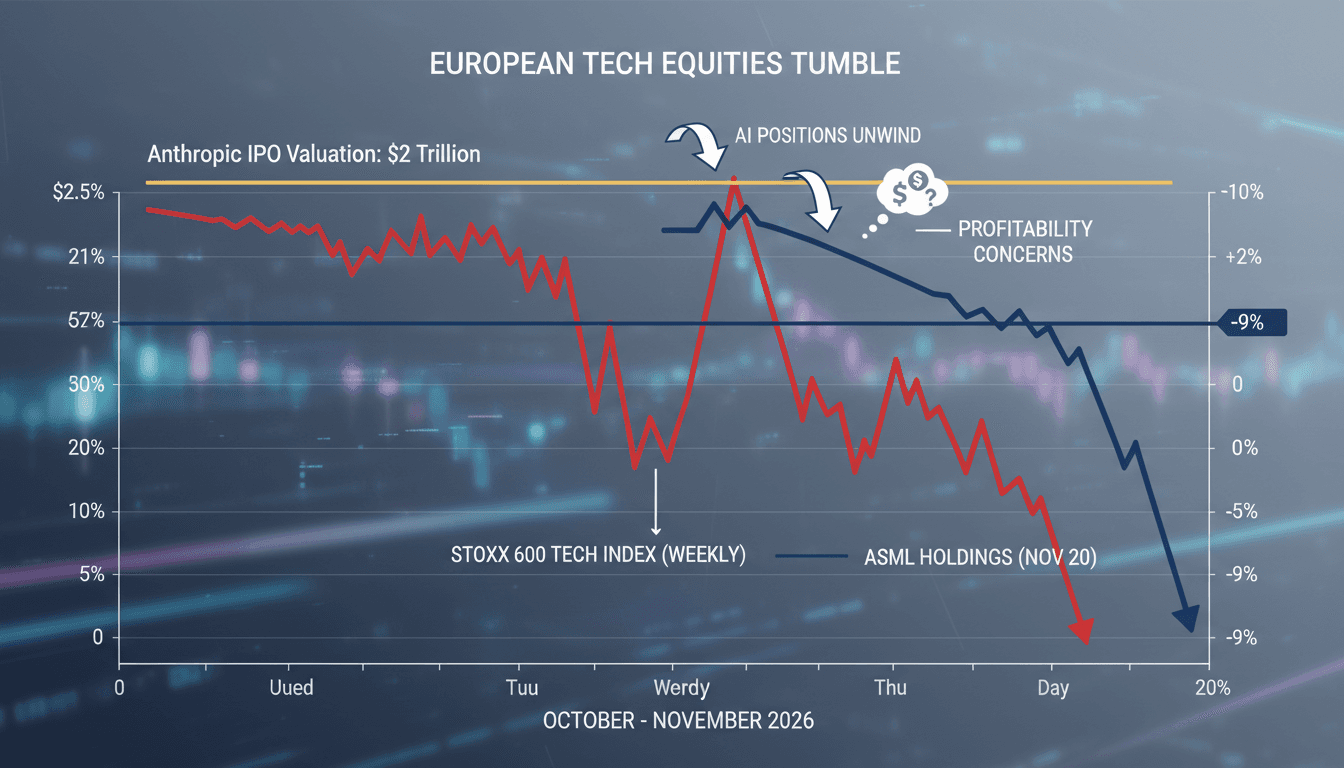
- Anthropic’s public listing triggered a broad sell-the-news unwinding, ending its debut with a valuation near $2 trillion on Nasdaq while sparking an immediate selloff across global technology equities.
- European indices logged multi-session drops, led by a 5.4 percent single-day plunge in the STOXX 600 Technology Index and a 5.7 percent weekly slide for the broader STOXX 600, which settled at 625.65 points.
- Critical hardware suppliers absorbed the steepest declines, with semiconductor giants ASML Holding, STMicroelectronics, and Infineon Technologies dropping between 4 and 9 percent or more.
The context you actually need
- Infrastructure capital expenditures entered a period of scrutiny, as institutional allocators questioned the balance between elevated corporate debt burdens and realized revenue yields from compute clusters.
- European equity markets posted historical pullbacks, recording their sharpest broad-market weekly retreat since late March 2025 and the worst weekly contraction for the technology sub-index in six years.
- Cross-market sentiment turned risk-off, spreading from specialized semiconductor manufacturing equipment providers into non-tech sectors sensitive to broader forward economic growth assumptions.
What's really happening
The selloff across European technology equities on November 20, 2026, illustrates the mechanical tension between private asset valuations and public liquidity requirements. When an anchor AI entity goes public at a landmark valuation—in this case, Anthropic listing at roughly $2 trillion—it ceases to be a speculative asset held on private ledgers and becomes a liquidity valve for early investors seeking distributions. Rather than sustaining buying interest, the execution of the listing removed speculative upside momentum, shifting market participants toward risk reduction.
The institutional rationale rests on a strict capital expenditure equation. For multiple quarters, public markets priced upstream semiconductor suppliers—such as lithography leader ASML and European chipmakers Infineon and STMicroelectronics—on expectations that downstream foundation-model developers would continue their compute procurement unchecked. Building frontier models requires vast outlays for processing units, networking hardware, and clean electrical infrastructure, obligations funded by substantial operational cash flows alongside corporate debt issuances.
When Anthropic's public shares declined post-debut, market participants initiated a re-evaluation of the return on investment (ROI) timeline for the entire hardware supply chain. If foundation-model monetization fails to match the amortization schedule of current high-performance computing hardware, hyperscalers and developers must recalibrate procurement cycles. Institutional allocators responded by reducing exposure to equipment manufacturers carrying premium multiples, forcing the STOXX 600 Technology Index down 3.7 percent early in the session before extending losses to 5.4 percent by the closing bell.
This shift reveals a structural transition from the infrastructure deployment phase to the return-verification phase. In this climate, balance sheet strength replaces compute benchmarks as the primary pricing mechanism. High debt burdens accrued during aggressive data-center hardware rollouts become liabilities when downstream software applications deliver incremental rather than exponential operational margins. Because upstream semiconductor manufacturers depend on forward orders from software model builders, European hardware specialists served as the liquid proxy for investors de-risking against longer capital turnover cycles.
Furthermore, broader institutional capital flows reacted to macro sensitivities beyond pure technology. The broad-market STOXX 600 closed its fifth consecutive negative session down approximately 2 percent on the day at 625.65, culminating in a 5.7 percent weekly drop. By punishing capital-intensive equities, markets are pricing a clear trade-off: tech leadership can no longer depend on narrative momentum to subsidize continuous, debt-financed capital accumulation.
Who feels it first (and how)
- Equity portfolio managers holding European technology allocations, who face immediate drawdowns after the STOXX 600 Technology Index closed down 5.4 percent in a single session.
- Semiconductor supply-chain executives, who must now navigate tighter pricing conditions and potential purchase order deferrals from downstream model developers.
- Corporate treasurers at high-debt tech enterprises, who confront increasing borrowing costs as investors penalize capital expenditure programs funded through debt rather than immediate operational cash flows.
- Global macro and multi-asset allocators, whose broader European equity benchmarks (STOXX 600) experienced a 5.7 percent weekly decline, dampening returns across growth-sensitive holdings.
What to watch next
- Downstream model revenue verification: Monitor quarterly earnings prints from large foundation-model operators for enterprise revenue gains relative to ongoing capital expenditures.
- Central bank commentary and economic indicators: Track upcoming interest rate signals and economic data releases, which will indicate how high rates will influence high-debt tech balance sheets.
- Semiconductor order backlog updates: Watch order intake disclosures from ASML and peer equipment manufacturers to see whether enterprise customers scale back capital allocation for manufacturing tools.
Anthropic completed its Nasdaq debut at an approximate valuation of $2 trillion, which was followed by an equity decline that pulled the pan-European STOXX 600 down 5.7 percent across the week to finish at 625.65 points.
Upstream suppliers like ASML, Infineon, and STMicroelectronics will trade under compressed forward valuation multiples until downstream AI operators prove tangible returns on their infrastructure investments.
Whether the institutional pullback marks a temporary "sell-the-news" repricing event or the start of a multi-quarter retrenchment in global data-center hardware capital expenditure.
Frequently Asked Questions
- Why it matters?
- The sudden retreat across semiconductor equipment suppliers shows how concentrated infrastructure bets face valuation limits when headline public listings fail to produce fresh buy-side momentum.
- What happened (in 30 seconds)?
- Anthropic’s public listing triggered a broad sell-the-news unwinding, ending its debut with a valuation near $2 trillion on Nasdaq while sparking an immediate selloff across global technology equities. European indices logged multi-session drops, led by a 5.4 percent single-day plunge in the STOXX 600 Technology Index and a 5.7 percent weekly slide for the broader STOXX 600, which settled at 625.65 points. Critical hardware suppliers absorbed the steepest declines, with semiconductor giants ASML
- What's really happening?
- The selloff across European technology equities on November 20, 2026, illustrates the mechanical tension between private asset valuations and public liquidity requirements. When an anchor AI entity goes public at a landmark valuation—in this case, Anthropic listing at roughly $2 trillion—it ceases to be a speculative asset held on private ledgers and becomes a liquidity valve for early investors seeking distributions. Rather than sustaining buying interest, the execution of the listing removed s
- Who feels it first (and how)?
- Equity portfolio managers holding European technology allocations, who face immediate drawdowns after the STOXX 600 Technology Index closed down 5.4 percent in a single session. Semiconductor supply-chain executives, who must now navigate tighter pricing conditions and potential purchase order deferrals from downstream model developers. Corporate treasurers at high-debt tech enterprises, who confront increasing borrowing costs as investors penalize capital expenditure programs funded through deb
- What to watch next?
- Downstream model revenue verification: Monitor quarterly earnings prints from large foundation-model operators for enterprise revenue gains relative to ongoing capital expenditures. Central bank commentary and economic indicators: Track upcoming interest rate signals and economic data releases, which will indicate how high rates will influence high-debt tech balance sheets. Semiconductor order backlog updates: Watch order intake disclosures from ASML and peer equipment manufacturers to see wheth
Global markets, investing, and macroeconomics from a premier financial newsroom.
"Bloomberg is respected for in-depth financial reporting and data-driven analysis."
— A47 Editor
European Tech Stocks Fall As AI Trade Buckles
European technology stocks fell sharply on Friday as the Stoxx 600 Technology Index slid 3.7% and was on track for its steepest weekly decline in six years, with the sell-off tied to a broader unwinding of the artificial intelligence trade. The drop ...
Curated tech headlines including AI stories.
"Influential aggregator surfacing the day’s top tech/AI links."
— A47 Editor
Asian tech stocks plunge as Anthropic's record IPO fails to stem an AI sell-off; SoftBank falls ~15%, TSMC falls 5%+, and Samsung and SK Hynix fall 6%+ (William Sandlund/Financial Times)
Asian technology stocks fell sharply on Friday, with SoftBank down about 15%, TSMC down more than 5%, and Samsung and SK Hynix each down more than 6%, as markets followed Wall Street lower despite the record listing of Anthropic, maker of the Claude ...
Technology business news, market impacts, and innovation trends.
"Bloomberg is a premier financial and tech news provider, respected for its in-depth reporting and analytical rigor."
— A47 Editor
European Stocks Rebound as Anthropic IPO Revives the AI Trade
European stocks rose, snapping a three-day decline, as Anthropic PBC's blockbuster initial public offering restored confidence in the artificial intelligence trade after a selloff in technology shares, according to Bloomberg Technology.