
US Air Force Cloud One Platform Breached by Unknown Hackers During 2026 Upgrade
Why it matters
When defense-grade cloud control planes are penetrated, enterprise operations face downstream operational freezing, delayed vulnerability patching, and systemic reconfiguration of multi-vendor architecture.
What happened (in 30 seconds)
- Control plane compromised: Hackers exploited a software vulnerability to gain access to the control plane of Cloud One, the US Air Force’s central computing ecosystem.
- Intervention by US Cyber Command: The intrusion was uncovered during upgrade operations between October and November 2026, prompting immediate operational containment by military cyber investigators.
- Widespread operational freeze: To contain the incident, administrators paused ongoing back-office migrations, restricted administrative rights, and halted platform-wide software updates.
The context you actually need
- A multi-cloud consolidation model: Launched in 2017, Cloud One was designed to unify the Air Force's computing environment by integrating underlying infrastructure from Amazon Web Services, Microsoft Azure, Oracle, and Alphabet.
- Mission-critical application scope: The shared platform hosts software environments responsible for air defense radar coordination, aircraft maintenance pipelines, supply-chain logistics, and personnel tracking.
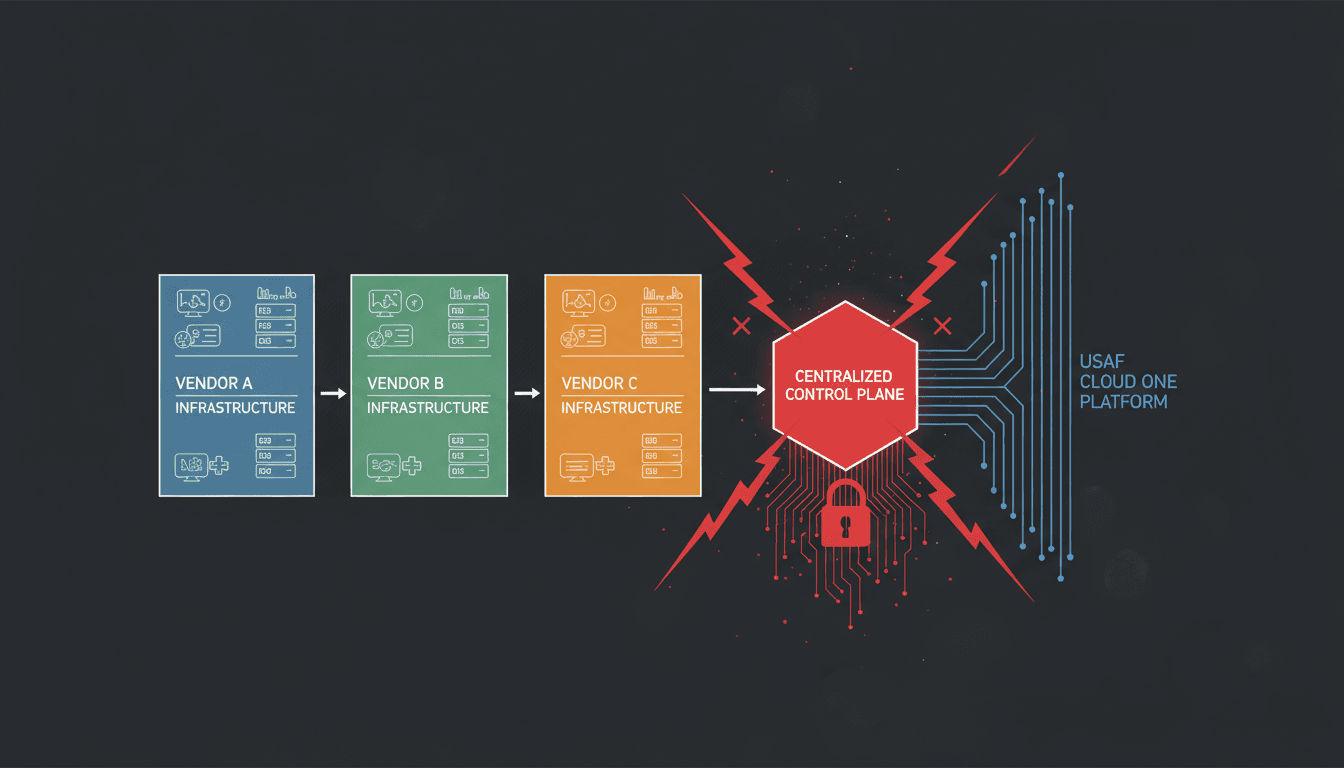
- Management-layer vulnerability: The intrusion struck the control plane—the administrative layer dictating resource allocation, configurations, and identity parameters—rather than targeting a single isolated database.
What's really happening
The operational challenge exposed by the Cloud One breach lies in the structural mechanics of multi-cloud management. When large organizations transition fragmented legacy workloads into a modern architecture, they aggregate underlying services from several distinct infrastructure providers—in this case, Amazon Web Services, Microsoft, Oracle, and Alphabet. To run these distinct ecosystems coherently, organizations implement a centralized control plane. That control plane handles identity access management, software pipeline updates, resource provisioning, and real-time operational monitoring across otherwise disconnected corporate clouds.
The operational incentive behind this architecture is clear: it reduces developer friction, standardizes procurement, and allows rapid deployment of applications ranging from air defense radar tracking to mundane maintenance scheduling. However, this same architectural model alters systemic vulnerability dynamics. Gaining unauthorized access to the control plane allows an adversary to target the administrative fabric governing multiple environments simultaneously, bypassing the compartmentalization inherent in using separate vendors.
The immediate operational response creates an operational trade-off. To contain an intrusion inside a control plane, incident teams typically revoke administrator privileges and suspend automated deployment pipelines. In the case of Cloud One, back-office migrations were halted, and application updates were blocked across the platform. While this containment step isolates the actor and prevents configuration tampering, it introduces a secondary vulnerability: security teams cannot deploy patches or standard software updates to other applications residing within the ecosystem. The defensive mechanism effectively locks down the entire software development lifecycle, accumulating technical debt and keeping latent vulnerabilities unpatched across hosted defense tools until the scope of the breach is mapped.
Furthermore, control-plane incidents obfuscate clear damage assessments. When an adversary penetrates the infrastructure that monitors operational metrics and provisions identities, determining what was observed versus what was exfiltrated becomes complex. Investigators from US Cyber Command must audit logs that may have been accessible to the adversary, reconstructing events without relying on standard automated reporting channels. For enterprise operators globally, the incentive structures guiding modern IT modernization now clash with the realities of concentrated administrative risk.
Who feels it first (and how)
- Enterprise IT architects: Must reassess multi-cloud control planes, acknowledging that abstraction layers can centralize identity risk across separate providers.
- Defense procurement and compliance officers: Face audit scrutiny regarding third-party cloud integration, leading to lengthened approval timelines for multi-vendor contracts.
- DevOps and platform engineers: Absorb direct operational friction when incident response teams block continuous integration pipelines and freeze administrative access rights.
What to watch next
- Resolution of the application update freeze: The duration of the platform block on software updates will indicate how deeply the administrative pipeline was compromised.
- Attribution and exfiltration findings: Investigations by US Cyber Command will reveal whether the adversary targeted data theft across logistics systems or sought persistent operational access.
- Architecture policy revisions: Watch whether defense procurement mandates isolated control planes instead of shared consolidation layers spanning multiple enterprise vendors.
The Cloud One platform control plane was accessed by unknown hackers via a software vulnerability; discoveries were made during upgrade work in late 2026; updates and migrations were halted.
The operational freeze will generate significant deployment backlogs across the dozens of applications relying on Cloud One infrastructure for maintenance and operations.
The identity of the hacking group, the full geographic origin, whether sensitive radar or personnel data was exfiltrated, and how long the update freeze will remain in place.
Frequently Asked Questions
- Why it matters?
- When defense-grade cloud control planes are penetrated, enterprise operations face downstream operational freezing, delayed vulnerability patching, and systemic reconfiguration of multi-vendor architecture.
- What happened (in 30 seconds)?
- Control plane compromised: Hackers exploited a software vulnerability to gain access to the control plane of Cloud One, the US Air Force’s central computing ecosystem. Intervention by US Cyber Command: The intrusion was uncovered during upgrade operations between October and November 2026, prompting immediate operational containment by military cyber investigators. Widespread operational freeze: To contain the incident, administrators paused ongoing back-office migrations, restricted administrat
- What's really happening?
- The operational challenge exposed by the Cloud One breach lies in the structural mechanics of multi-cloud management. When large organizations transition fragmented legacy workloads into a modern architecture, they aggregate underlying services from several distinct infrastructure providers—in this case, Amazon Web Services, Microsoft, Oracle, and Alphabet. To run these distinct ecosystems coherently, organizations implement a centralized control plane. That control plane handles identity access
- Who feels it first (and how)?
- Enterprise IT architects: Must reassess multi-cloud control planes, acknowledging that abstraction layers can centralize identity risk across separate providers. Defense procurement and compliance officers: Face audit scrutiny regarding third-party cloud integration, leading to lengthened approval timelines for multi-vendor contracts. DevOps and platform engineers: Absorb direct operational friction when incident response teams block continuous integration pipelines and freeze administrative acc
- What to watch next?
- Resolution of the application update freeze: The duration of the platform block on software updates will indicate how deeply the administrative pipeline was compromised. Attribution and exfiltration findings: Investigations by US Cyber Command will reveal whether the adversary targeted data theft across logistics systems or sought persistent operational access. Architecture policy revisions: Watch whether defense procurement mandates isolated control planes instead of shared consolidation layers
Curated tech headlines including AI stories.
"Influential aggregator surfacing the day’s top tech/AI links."
— A47 Editor
Sources: the US Air Force recently found that hackers breached Cloud One, the cloud computing platform powering its air defense radar and other data feeds (Reuters)
Reuters reported, citing three people familiar with the matter, that the US Air Force recently found hackers had breached Cloud One, its flagship cloud computing platform that powers air defense radar and other data feeds.
Market-moving headlines impacting equities, bonds, and related risk assets.
"Real-time catalysts and volatility drivers across indices and sectors."
— A47 Editor
Exclusive-Hackers breach US Air Force flagship Cloud One computing platform
Hackers have breached Cloud One, the flagship cloud computing platform of the US Air Force, according to an exclusive report published by Investing.com in its markets category with negative sentiment. The base report is brief and does not detail the ...
Technology business and AI-related headlines.
"Data-driven tech newsroom with global scope."
— A47 Editor
Hackers Breached US Air Force’s Cloud Platform, Says Reuters
Hackers breached the US Air Force’s flagship cloud infrastructure, Cloud One, potentially putting large amounts of sensitive tactical and personnel data at risk, Reuters reported on Friday, with the report characterizing the incident as a serious sec...
Technology business news, market impacts, and innovation trends.
"Bloomberg is a premier financial and tech news provider, respected for its in-depth reporting and analytical rigor."
— A47 Editor
Hackers Breached US Air Force’s Cloud Platform, Says Reuters
Hackers breached the US Air Force’s flagship cloud infrastructure, Cloud One, potentially putting large amounts of sensitive tactical and personnel data at risk, Reuters reported on Friday, with the report characterizing the incident as a serious sec...
English-language digital publication covering business, politics, technology, and current affairs.
"The Arabian Post mixes original and syndicated-style coverage with a broad regional and global business-news orientation."
— A47 Editor
US Air Force confronts Cloud One security breach
The US Air Force has reportedly suffered a cyberattack on Cloud One, a major military computing platform that supports operational systems and sensitive defence information, though the full extent of the intrusion remains unclear. The Air Force decli...