
Google Requires AI Agents to Use MCP Servers for Workspace Data Access from February 2027
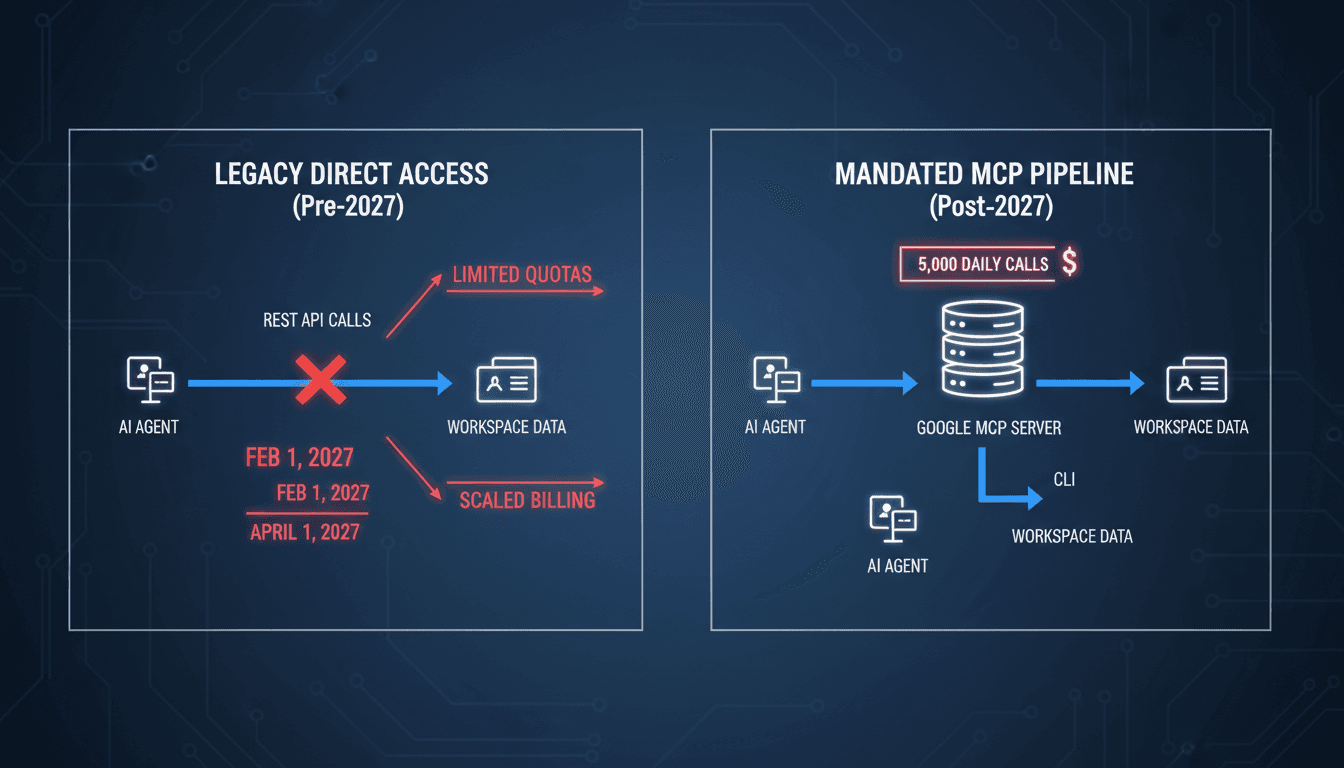
If your operational workflows rely on autonomous software interacting directly with Google Workspace, your engineering stack must be rebuilt around Google-hosted protocol servers before quotas lock your systems down.
Why it matters
By forcing autonomous agents off direct REST endpoints and onto metered protocol servers, Google is establishing a controlled gatekeeper layer over enterprise data retrieval, redefining the unit economics and data boundaries of artificial intelligence tooling.
What happened (in 30 seconds)
- The policy shift: On November 24, 2026, Google announced that autonomous software must access Workspace applications via Google-hosted Model Context Protocol (MCP) servers or command-line interfaces rather than direct REST API calls.
- The implementation clock: Technical enforcement begins on February 1, 2027, restricting non-compliant implementations to base tier limits, with billing for scaled infrastructure usage starting on April 1, 2027.
- The developer friction: As reported by The Information, builders of autonomous agents have pushed back against the mandate, citing higher operational expenditures, strict data retention limitations, and diminished interface flexibility.
The context you actually need
- The protocol standard: The Model Context Protocol (MCP) emerged across the software landscape as an open architecture designed to streamline how large language models query tools and ingest operational context.
- The carve-out boundary: Google’s Workspace AI Tools Addendum applies exclusively to automated agents and synthetic assistants; standard consumer software and traditional integrations continue through legacy REST pathways unaffected.
- The baseline allowance: Google established a ceiling of 5,000 requests daily per project per product on its free Standard tier, creating an immediate technical bottleneck for high-frequency algorithmic queries.
What's really happening
This policy transition shifts how enterprise productivity infrastructure interfaces with automated reasoning engines. For years, developers connected external software to Gmail, Drive, Docs, Sheets, Slides, Calendar, Chat, and Tasks using standard REST APIs. These interfaces were engineered around human-speed interaction models, where user permissions were granted in aggregate and calls occurred predictably.
The surge of autonomous agents running continuous loops altered those operational assumptions. Software programs that draft emails, parse calendar availability, retrieve tabular data, and update files operate at query volumes that strain shared endpoints. By creating dedicated, Google-hosted MCP servers and issuing the Workspace AI Tools Addendum, Google is asserting control over this interaction layer.
The architecture introduces per-agent OAuth identities, enforced query tracking, and precise guidelines on model training and data retention. Rather than permitting an external script to pull broad context through a single legacy API token, Google now requires agents to interact through explicit protocol definitions. This ensures Google can authenticate precisely which tool is acting, log the nature of the context retrieved, and govern downstream persistence.
The tension centers on platform incentives versus developer flexibility. Direct REST interfaces allowed software architects to design bespoke context-assembly pipelines, optimizing data payloads and caching protocols locally. Moving through Google’s standardized MCP architecture introduces friction for custom orchestrators, while binding operations to standardized usage bands. Once usage exceeds the 5,000 daily request threshold per project, operators face Scaled tier fee structures taking effect in April 2027.
Consequently, Google transforms an unmetered, generic API pipe into a governed, billable pipeline tailored for synthetic workloads. This move prevents third-party model providers from freely using Workspace as an unindexed training and grounding repository without formal compliance. It simultaneously positions Google to monitor agent behaviors across its productivity suite, ensuring enterprise compliance at the cost of developer autonomy.
Who feels it first (and how)
- Enterprise software engineering teams: Must audit all active internal integrations, rewriting direct REST logic to run through official MCP servers or CLI wrappers prior to the February 1, 2027 enforcement deadline.
- Autonomous workflow startups: Face direct margin compression as agent execution costs increase through required transitions to Google's Scaled tier once daily operations surpass the 5,000-call quota.
- Corporate IT and compliance leads: Gain centralized visibility via discrete per-agent OAuth identities and explicit controls over whether Workspace records can be ingested for continuous model training.
What to watch next
- The February 1 enforcement event: Monitor developer forums and service telemetry when non-compliant agents drop to Standard tier limits, which will reveal how strictly Google throttles direct REST calls.
- The April 1 billing rollout: Watch the pricing structure published for the Scaled tier, which will establish the baseline operational cost for running business automations on Google Workspace.
- Competing platform reactions: Observe whether rival enterprise productivity ecosystems mandate similar proprietary MCP hosting layers or use open REST parity to attract frustrated builders.
Technical enforcement of Google’s Workspace AI Tools Addendum begins February 1, 2027, capping non-compliant agents at 5,000 daily requests per project per product, with billable Scaled tiers launching April 1, 2027.
Third-party developer architectures will rapidly standardize around MCP tooling, treating direct REST wrappers as legacy debt for all Workspace automation tasks.
Whether enterprise customers will absorb the additional cost layer or bypass Workspace storage in favor of less restrictive, open-protocol cloud platforms.
Frequently Asked Questions
- Why it matters?
- By forcing autonomous agents off direct REST endpoints and onto metered protocol servers, Google is establishing a controlled gatekeeper layer over enterprise data retrieval, redefining the unit economics and data boundaries of artificial intelligence tooling.
- What happened (in 30 seconds)?
- The policy shift: On November 24, 2026, Google announced that autonomous software must access Workspace applications via Google-hosted Model Context Protocol (MCP) servers or command-line interfaces rather than direct REST API calls. The implementation clock: Technical enforcement begins on February 1, 2027, restricting non-compliant implementations to base tier limits, with billing for scaled infrastructure usage starting on April 1, 2027. The developer friction: As reported by The Information,
- What's really happening?
- This policy transition shifts how enterprise productivity infrastructure interfaces with automated reasoning engines. For years, developers connected external software to Gmail, Drive, Docs, Sheets, Slides, Calendar, Chat, and Tasks using standard REST APIs. These interfaces were engineered around human-speed interaction models, where user permissions were granted in aggregate and calls occurred predictably. The surge of autonomous agents running continuous loops altered those operational assum
- Who feels it first (and how)?
- Enterprise software engineering teams: Must audit all active internal integrations, rewriting direct REST logic to run through official MCP servers or CLI wrappers prior to the February 1, 2027 enforcement deadline. Autonomous workflow startups: Face direct margin compression as agent execution costs increase through required transitions to Google's Scaled tier once daily operations surpass the 5,000-call quota. Corporate IT and compliance leads: Gain centralized visibility via discrete per-agen
- What to watch next?
- The February 1 enforcement event: Monitor developer forums and service telemetry when non-compliant agents drop to Standard tier limits, which will reveal how strictly Google throttles direct REST calls. The April 1 billing rollout: Watch the pricing structure published for the Scaled tier, which will establish the baseline operational cost for running business automations on Google Workspace. Competing platform reactions: Observe whether rival enterprise productivity ecosystems mandate similar
Curated tech headlines including AI stories.
"Influential aggregator surfacing the day’s top tech/AI links."
— A47 Editor
Google will require that AI agents use MCP servers, not the REST API, to access Workspace apps starting in February, drawing developer backlash (The Information)
Google has announced that, starting February 1, 2027, AI agents that access Gmail, Google Drive and other Google Workspace apps must connect through Model Context Protocol (MCP) servers rather than the regular REST API, after new controls were unveil...
Community posts including AI/ML tutorials and news.
"Open platform where developers share AI learnings."
— A47 Editor
Google's Gmail MCP server can read everything and send nothing
Google's Workspace MCP servers, which can read Gmail and create drafts but cannot send, reply or forward emails, face a 1 February 2027 deadline after which AI agents touching Google Workspace must connect through Google's own MCP servers rather than...
Community posts including AI/ML tutorials and news.
"Open platform where developers share AI learnings."
— A47 Editor
Google บังคับ AI Agent ใช้ MCP ต่อ Workspace แต่ Gmail ส่งเมลไม่ได้
Google has made its Workspace MCP servers generally available across eight services and set a deadline of February 1, 2027, after which any AI tool or AI-driven system that touches Gmail, Drive, Calendar or other Workspace services must connect throu...
News and guidance for IT pros on AI adoption.
"Enterprise-focused tips, explainers, and news for professionals."
— A47 Editor
Google Expands AI Agent Access to Gmail, Drive, and Docs — but Tightens the Rules
Google has expanded AI agent access to Gmail, Google Drive, and Google Docs through its Workspace platform, while introducing tighter security controls and new integration requirements, according to TechRepublic. The changes place the company's Works...