
Iran's IRGC Attacks Oil Tankers Under US Escort in Strait of Hormuz
Here's what it means for you.
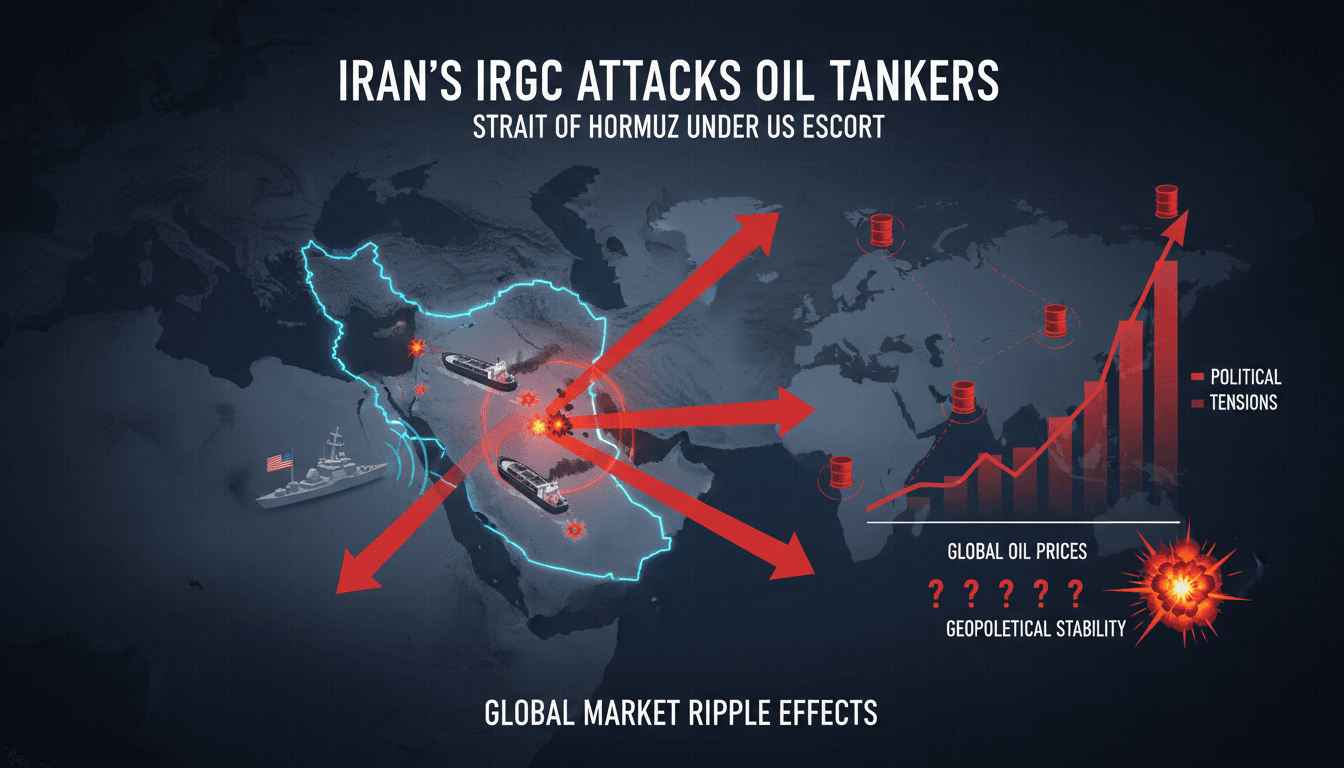
The recent attack by Iran's Islamic Revolutionary Guard Corps (IRGC) on oil tankers under U.S. military escort signals a significant escalation in regional tensions. This incident could lead to increased military confrontations, impacting global oil markets and geopolitical stability. As energy prices surge, the implications for U.S. policy and the upcoming midterm elections are becoming increasingly pronounced. The situation demands close monitoring, particularly regarding U.S. military responses and market reactions to fluctuating energy prices. Stakeholders in the energy sector should prepare for potential disruptions in supply and pricing volatility.
What happened
Iran's IRGC has claimed responsibility for striking two oil tankers in the strategically vital Strait of Hormuz while they were reportedly under U.S. military escort. This incident marks a notable escalation in ongoing tensions between the U.S. and Iran, coinciding with rising energy prices and discussions of military action among U.S. officials. The IRGC stated that the tankers were targeted for attempting to navigate through an undeclared route.
Following the attack, four other oil tankers reportedly altered their courses, highlighting the immediate impact of the incident on maritime operations in the region. U.S. officials, including President Trump, have convened to address the escalating conflict and its implications.
The Context
The attack occurs amid a backdrop of ongoing conflict between the U.S. and Iran, with energy prices surging due to renewed fighting in the Middle East. The geopolitical landscape is further complicated by the approaching U.S. midterm elections, which add political pressure to the situation. The Strait of Hormuz is a critical chokepoint for global oil supply, making any disruption particularly concerning for international markets.
The IRGC's actions reflect Iran's broader strategy to assert its influence in the region, challenging U.S. military presence and signaling its willingness to engage in aggressive tactics. As tensions rise, the potential for further military confrontations looms large, with significant implications for global energy security.
Takeaway
The situation in the Strait of Hormuz is likely to continue evolving, with the potential for further military actions that could disrupt international oil supply. Stakeholders should closely monitor U.S. military responses to the incident, as well as changes in energy prices and market reactions. The conflict's impact on global oil markets and geopolitical stability will be critical to watch in the coming weeks.
As the U.S. government navigates this complex scenario, the interplay between military strategy and political considerations will shape the future of U.S.-Iran relations and regional stability.
News from the United States including domestic politics, society, and culture.
"The Guardian is known for its progressive editorial stance and in-depth analysis, often advocating for social justice, environmental issues, and liberal values."
— A47 Editor
Iran strikes tankers under US escort in Hormuz strait as Trump gathers cabinet to discuss war
Iran's Islamic Revolutionary Guard Corps announced it struck two oil tankers in the Strait of Hormuz that were under U.S. military escort, claiming the vessels attempted to navigate through an undeclared route. This incident escalates tensions in the...
International coverage from The Guardian's global desks.
"The Guardian is known for its progressive editorial stance and in-depth analysis."
— A47 Editor
Iran strikes tankers under US escort in Hormuz strait as Trump gathers cabinet to discuss war
Iran's Islamic Revolutionary Guard Corps announced it struck two oil tankers in the Strait of Hormuz that were under U.S. military escort, claiming the vessels attempted to navigate through an undeclared route. This incident escalates tensions in the...
Pan-Arab news coverage spanning politics, business, sports, and regional affairs.
"Asharq Al-Awsat reflects a broad Arab editorial perspective with strong attention to regional geopolitics."
— A47 Editor
«الحرس الثوري»: استهداف ناقلتين حاولتا عبور مضيق هرمز «بمؤازرة جوية» أميركية
The Iranian Revolutionary Guard Corps announced that it targeted two tankers attempting to pass through the strategic Strait of Hormuz, claiming U.S. military air support during the operation. This incident highlights ongoing tensions in the region, ...
Conservative-leaning political and national coverage.
"The Washington Times is a conservative-leaning newspaper known for its political coverage and advocacy of right-of-center viewpoints."
— A47 Editor
IRGC says it struck two tankers in the Strait of Hormuz that were escorted by U.S. military
The Islamic Revolutionary Guard Corps (IRGC) announced that it struck two oil tankers in the Strait of Hormuz, which were reportedly under U.S. military escort, leading to the rerouting of several other vessels. This incident underscores the ongoing ...