
Total solar eclipse captivates viewers across Europe and Africa
What happened
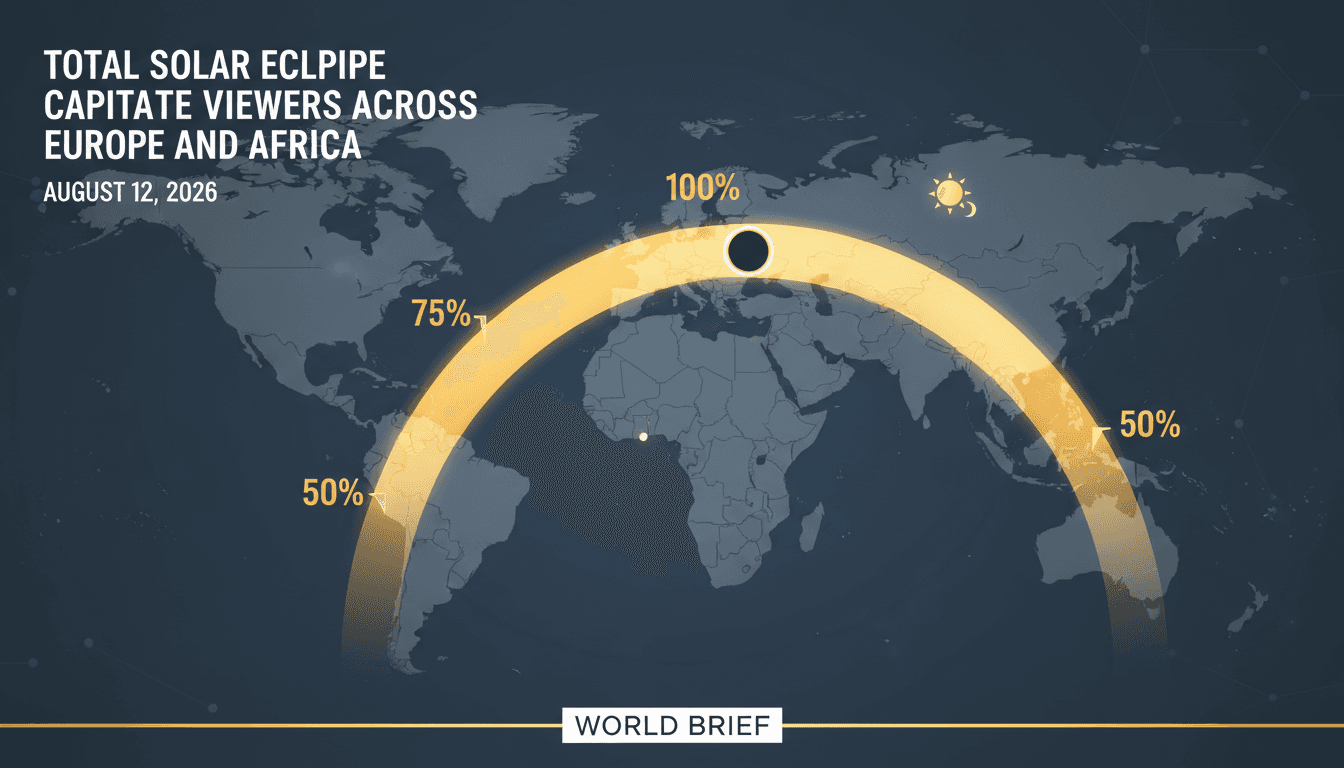
On August 12, 2026, a total solar eclipse captivated viewers across parts of Europe and the North Atlantic, while a partial eclipse was observed in regions of Africa. The path of totality included locations such as Greenland, Iceland, Spain, and northeastern Portugal. In Tunisia, 59.06% of the Sun was obscured, while Senegal experienced a maximum of 37% obscuration.
The event showcased stunning visuals of the sun's atmosphere as it was obscured by the moon, drawing attention from astronomy enthusiasts worldwide. Media outlets widely documented the eclipse, capturing the awe and excitement it generated among viewers.
The Context
The total solar eclipse of 2026 was a significant astronomical event that underscored the global fascination with solar eclipses. The varying degrees of obscuration across different regions, particularly in Tunisia and Senegal, highlighted the diverse experiences of viewers. This event not only provided a visual spectacle but also served as an opportunity for scientific engagement and public education.
As the path of totality traversed several countries, it brought together communities and sparked interest in astronomy. The widespread media coverage further amplified the event's impact, showcasing the potential for future eclipses to engage and educate the public.
Takeaway
Looking ahead, future solar eclipses in 2027 and 2028 are expected to draw even larger audiences and foster advancements in astronomical research. The continued interest in these celestial events will likely lead to improved observation technologies and public engagement strategies. As the scientific community prepares for these upcoming events, the excitement surrounding solar eclipses will remain a powerful tool for education and outreach.
The eclipse of 2026 serves as a reminder of the importance of celestial events in connecting people with science. As we anticipate the next occurrences, the potential for increased public interest and scientific discovery remains significant.
24/7 international news from a French perspective in multiple languages.
"France 24 is viewed as a globally focused outlet with balanced coverage and a European perspective."
— A47 Editor
Solar eclipse 2026: Africa witnesses partial eclipse
On August 12, 2026, a partial solar eclipse was visible across parts of Africa, with Tabarka, Tunisia experiencing the most significant obscuration at 59.06% of the Sun. The phenomenon was also observed in Dakar and other regions of Senegal, where ap...
Reports on science policy, discoveries, and public debate in the scientific realm.
"The Guardian’s science section is known for thoughtful and critical reporting on global research, ethics, and public understanding of science."
— A47 Editor
Solar eclipse 2026 across Europe: in pictures
A total solar eclipse occurred on August 12, 2026, sweeping across parts of Europe and the North Atlantic, with the path of totality moving through Greenland, Iceland, Spain, and a small section of north-eastern Portugal. Surrounding areas experience...
News and current affairs from across Europe.
"The Guardian is known for its progressive editorial stance and in-depth analysis."
— A47 Editor
Solar eclipse 2026 across Europe: in pictures
A total solar eclipse occurred on August 12, 2026, sweeping across parts of Europe, including Greenland, Iceland, Spain, and a small section of northeastern Portugal, with the European Space Agency confirming the path of totality. Surrounding areas e...
Scientific research, technology, environment, and society.
"Scientific American is one of the oldest and most authoritative science magazines, known for deep dives into science, technology, and society."
— A47 Editor
See the 2026 total solar eclipse from around the world
On August 12, 2026, a total solar eclipse will occur, providing a spectacular view across various regions including Spain, Greenland, and Iceland. This astronomical event is expected to draw millions of spectators eager to witness the rare phenomenon...
Space science news, astronomy updates, and spaceflight developments.
"Space.com delivers space science news, astronomy updates, and spaceflight developments with engaging coverage."
— A47 Editor
Total solar eclipse 2026 has begun. Here are the first views of totality
The total solar eclipse of August 12, 2026, has commenced, with stunning images of totality emerging, showcasing the sun's atmosphere as it radiates from behind the moon's silhouette. This rare celestial event is being witnessed by millions across re...