
UK Met Office Predicts Unprecedented 2026 El Niño with Sea Surface Temperatures Surpassing 3°C
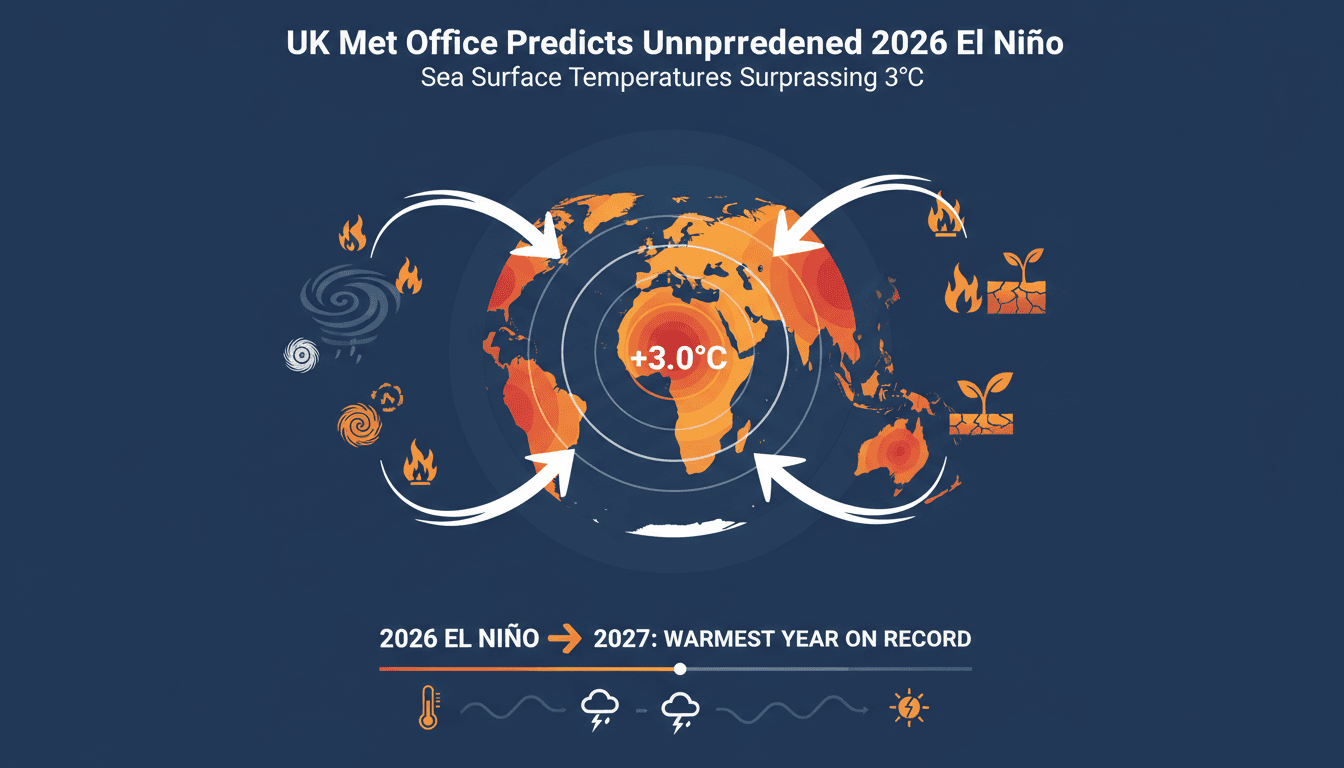
Why it matters
The forecasted intensity of the 2026 El Niño could disrupt global weather systems, affecting agriculture, infrastructure, and economies worldwide.
What happened (in 30 seconds)
- Forecast announcement: On August 21, 2026, the UK Met Office projected a record-intensity El Niño with sea surface temperatures exceeding 3°C.
- Extreme weather risks: This phenomenon is expected to lead to severe droughts in the tropics and increased storminess in northwestern Europe.
- Global temperature peak: The event is likely to contribute to 2027 being the warmest year on record.
The context you actually need
- El Niño explained: This climate pattern is characterized by unusually warm sea surface temperatures in the tropical Pacific, disrupting global weather.
- Historical precedents: Previous strong El Niño events, such as those in 1997-1998, resulted in widespread extreme weather and climate anomalies.
- Climate change amplification: The current El Niño is occurring amid accelerating human-induced climate change, raising baseline temperatures and intensifying its effects.
What's really happening
The 2026 El Niño is projected to be the most intense in over a century, with sea surface temperature anomalies in the Nino 3.4 region expected to exceed 3°C (5.4°F). This forecast, issued by the UK Met Office, is based on advanced climate modeling systems, particularly the GloSea system, which has indicated unprecedented signals in its outputs. The implications of such an extreme event are profound, as it is likely to amplify existing climate stressors already observed in 2026, including severe wildfires in Indonesia and heatwaves across Europe.
The phenomenon of El Niño disrupts global atmospheric circulation, leading to a cascade of weather-related impacts. For instance, regions like South America and parts of Africa may experience suppressed rainfall, while northwestern Europe could see increased storminess and rainfall during the autumn and winter months. The Met Office has highlighted that the combination of this El Niño event and ongoing climate change makes it highly probable that 2027 will set records for global temperatures.
The forecast aligns with prior warnings from the World Meteorological Organization, which indicated an 80-90% probability of El Niño conditions emerging in 2026. As the event develops, governments and sectors worldwide are bracing for potential disruptions. The agricultural sector, in particular, is on high alert for droughts that could impact crop yields, while energy markets may face volatility due to altered weather patterns affecting supply and demand.
In summary, the 2026 El Niño is not just a weather phenomenon; it represents a significant climate event that could reshape global weather patterns and economic conditions. The interconnectedness of climate systems means that the effects will be felt far beyond the Pacific region, influencing weather and climate across continents.
Who feels it first (and how)
- Farmers: Increased drought risks may lead to crop failures, impacting food supply and prices.
- Energy sectors: Fluctuations in weather patterns could disrupt energy production and consumption.
- Insurance companies: Heightened extreme weather risks may lead to increased claims and financial instability.
- Governments: National and local governments will need to allocate resources for disaster preparedness and response.
What to watch next
- Temperature anomalies: Monitor sea surface temperature readings in the Nino 3.4 region for signs of further increases, which could indicate worsening conditions.
- Weather patterns: Keep an eye on rainfall and storm forecasts in affected regions, particularly in Europe and the tropics, to assess immediate impacts.
- Economic indicators: Watch for shifts in agricultural yields and energy prices as the event unfolds, which could signal broader economic implications.
- The 2026 El Niño is forecasted to exceed 3°C in sea surface temperature anomalies.
- The event will lead to increased extreme weather risks globally, including droughts and storms.
- The specific economic impacts and regional responses to the event remain to be fully assessed.
Frequently Asked Questions
- Why it matters?
- The forecasted intensity of the 2026 El Niño could disrupt global weather systems, affecting agriculture, infrastructure, and economies worldwide.
- What happened (in 30 seconds)?
- Forecast announcement: On August 21, 2026, the UK Met Office projected a record-intensity El Niño with sea surface temperatures exceeding 3°C. Extreme weather risks: This phenomenon is expected to lead to severe droughts in the tropics and increased storminess in northwestern Europe. Global temperature peak: The event is likely to contribute to 2027 being the warmest year on record.
- What's really happening?
- The 2026 El Niño is projected to be the most intense in over a century, with sea surface temperature anomalies in the Nino 3.4 region expected to exceed 3°C (5.4°F). This forecast, issued by the UK Met Office, is based on advanced climate modeling systems, particularly the GloSea system, which has indicated unprecedented signals in its outputs. The implications of such an extreme event are profound, as it is likely to amplify existing climate stressors already observed in 2026, including severe
- Who feels it first (and how)?
- Farmers: Increased drought risks may lead to crop failures, impacting food supply and prices. Energy sectors: Fluctuations in weather patterns could disrupt energy production and consumption. Insurance companies: Heightened extreme weather risks may lead to increased claims and financial instability. Governments: National and local governments will need to allocate resources for disaster preparedness and response.
- What to watch next?
- Temperature anomalies: Monitor sea surface temperature readings in the Nino 3.4 region for signs of further increases, which could indicate worsening conditions. Weather patterns: Keep an eye on rainfall and storm forecasts in affected regions, particularly in Europe and the tropics, to assess immediate impacts. Economic indicators: Watch for shifts in agricultural yields and energy prices as the event unfolds, which could signal broader economic implications.
Global news coverage with extensive reporting on Middle Eastern conflicts and geopolitics.
"Al Jazeera is a Qatar-based broadcaster known for wide regional coverage and alternative perspectives."
— A47 Editor
El Nino set to be most intense ‘for over a century’: UK forecasters
The UK Met Office has predicted that the upcoming El Niño phenomenon will be the most intense in over a century, forecasting a rise in sea surface temperatures by 3°C (5.4°F) which is expected to exacerbate extreme weather conditions globally.
Comprehensive coverage of Middle Eastern and global issues.
"Al Jazeera is a prominent voice from the Global South, especially the Middle East, with an emphasis on underreported stories."
— A47 Editor
El Nino set to be most intense ‘for over a century’: UK forecasters
The UK Met Office has predicted that the upcoming El Niño phenomenon will be the most intense in over a century, forecasting a rise in sea surface temperatures by 3°C (5.4°F) which is expected to exacerbate extreme weather conditions globally.
Pan-Arab news coverage spanning politics, business, sports, and regional affairs.
"Asharq Al-Awsat reflects a broad Arab editorial perspective with strong attention to regional geopolitics."
— A47 Editor
«الأرصاد البريطانية» تتوقع أقوى ظواهر «إلنينيو» في التاريخ الحديث
The British Meteorological Office announced that the current El Niño weather phenomenon is expected to be the strongest in modern history. This prediction highlights the significant climatic changes anticipated due to this weather pattern.
Arabic-language political and world news coverage for UAE readers.
"Emarat Al Youm world coverage usually presents international developments through a UAE and Arab audience lens."
— A47 Editor
هيئة الأرصاد البريطانية تتوقع أقوى ظواهر النينيو في التاريخ الحديث هيئة الأرصاد البريطانية تتوقع أقوى ظواهر النينيو في التاريخ الحديث
The British Meteorological Office announced on Friday that the currently forming El Niño weather phenomenon is expected to be the strongest in modern history. This prediction highlights the significant climatic changes that may occur as a result of t...
Regional and international reporting focused on Middle Eastern politics, diplomacy, and economics.
"Asharq Al-Awsat is a Saudi-owned international newspaper reflecting mainstream Gulf political perspectives."
— A47 Editor
UK Met Office: El Nino to be 'Biggest for Over a Century’
The UK Met Office has announced that the ongoing El Niño phenomenon is expected to be the most significant in over a century, indicating a substantial intensification of this climate pattern. This forecast aligns with predictions from various meteoro...