
UN Issues Urgent Warning on Rapidly Expanding Ebola Outbreak in DRC
Here's what it means for you.
As the Ebola outbreak in the Democratic Republic of the Congo escalates, global health systems may face increased pressure, impacting international travel and health advisories.
Why it matters
The rapid spread of Ebola in the DRC poses a significant risk to global health security, potentially affecting international travel and trade.
What happened (in 30 seconds)
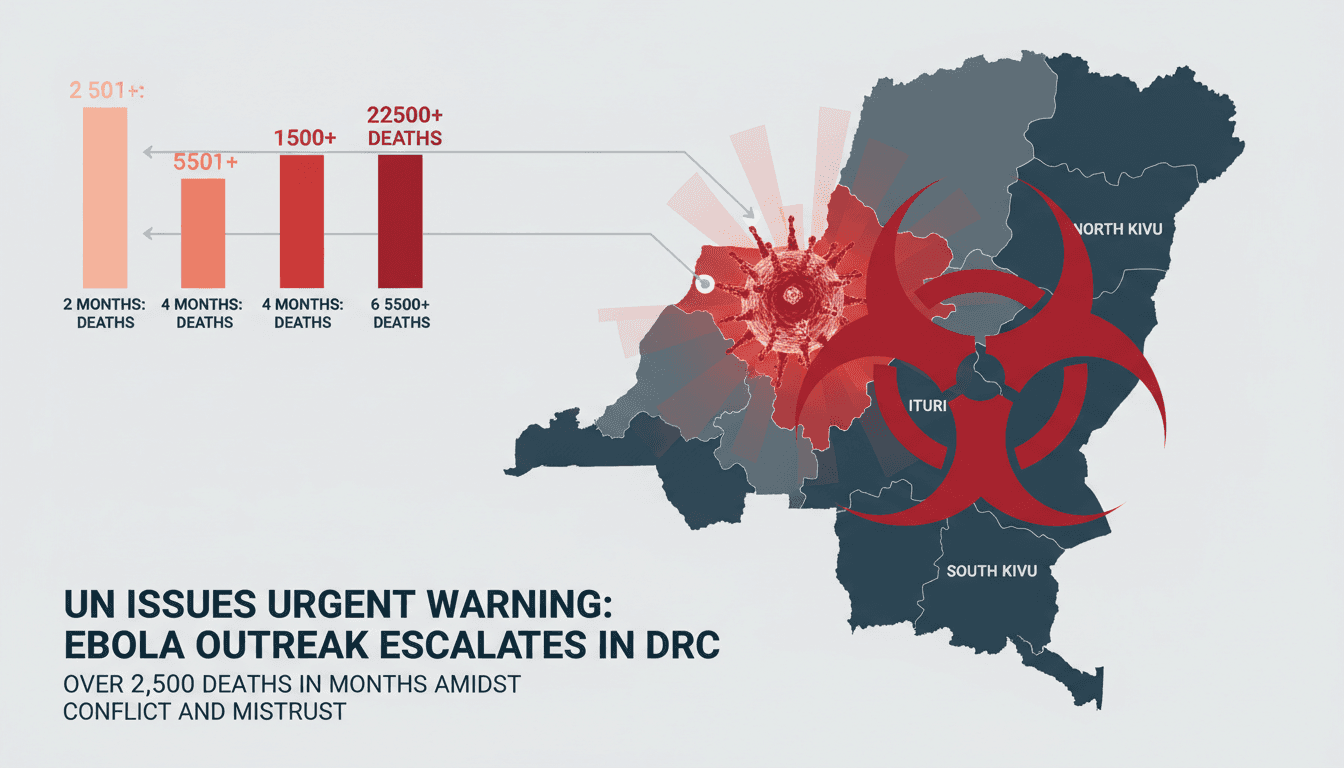
- UN issued a warning on August 21, 2026, about an accelerating Ebola outbreak in the DRC, with over 2,500 deaths reported.
- The outbreak is expanding across six provinces and has briefly spread to Uganda, outpacing response efforts amid ongoing conflict and weak health infrastructure.
- Healthcare workers are heavily impacted, with 160 infections and 43 fatalities, complicating containment efforts.
The context you actually need
- Repeated outbreaks: The DRC has a history of Ebola outbreaks due to its vast territory, porous borders, and ongoing armed conflicts that disrupt health systems.
- Bundibugyo strain: The current outbreak is caused by the Bundibugyo strain, which has shown a rapid increase in cases since its declaration in May 2026.
- Funding shortfalls: The response to the outbreak is critically underfunded, with appeals for immediate financial support from international organizations.
What's really happening
The Democratic Republic of the Congo (DRC) is currently grappling with its 17th recorded Ebola outbreak, which has escalated alarmingly since its official declaration on May 15, 2026. The outbreak, caused by the Bundibugyo strain, has already resulted in over 2,500 deaths, with nearly half occurring in just the last 20 days. This rapid increase is attributed to several interrelated factors, including delayed detection, ongoing armed conflicts, and a weak health infrastructure that struggles to cope with the surge in cases.
The DRC's vast territory and porous borders have historically facilitated the spread of infectious diseases, and the current outbreak is no exception. The virus has spread across six provinces, primarily in the eastern regions, and has even crossed into neighboring Uganda, albeit briefly. The situation is exacerbated by geopolitical instability, with armed groups disrupting healthcare delivery and creating an environment of mistrust among local communities. This mistrust has hindered effective communication and cooperation between health authorities and the affected populations, further complicating containment efforts.
Healthcare workers are on the front lines of this crisis, facing significant risks as they attempt to manage the outbreak. With 160 healthcare workers infected and 43 fatalities reported, the strain on medical personnel is immense. Attacks on healthcare facilities and responders have further hampered efforts to control the virus's spread, leading to a critical shortage of personnel and resources.
International organizations, including the World Health Organization (WHO) and Doctors Without Borders (MSF), are actively involved in the response, but they face significant challenges. The WHO has initiated trials for the Ervebo vaccine, which may offer cross-protection against the Bundibugyo strain, but the rollout of vaccines and treatments is lagging behind the rapid transmission rates. Funding for the response is critically low, with appeals for immediate financial support to prevent further spread to neighboring countries.
As the outbreak continues to expand, the implications for global health security are profound. The potential for the virus to spread beyond the DRC raises concerns about international travel and trade, as countries may implement stricter health advisories and border controls. The situation underscores the need for robust global health systems capable of responding to infectious disease outbreaks swiftly and effectively.
Who feels it first (and how)
- Healthcare workers: Facing high infection rates and fatalities, impacting their ability to respond effectively.
- Local communities: Experiencing mistrust and fear, leading to resistance against health interventions.
- International travelers: Potentially facing increased health advisories and travel restrictions due to the outbreak.
- Global health organizations: Struggling with funding and resource allocation to manage the outbreak effectively.
What to watch next
- Funding appeals: Watch for responses to funding appeals from the UN and WHO, as additional resources are critical for containment efforts.
- Vaccine distribution: Monitor the rollout of the Ervebo vaccine and its effectiveness against the Bundibugyo strain, which could influence containment strategies.
- Regional spread: Keep an eye on case numbers in neighboring countries, as any increase could lead to broader international health implications.
The outbreak has resulted in over 2,500 deaths, with a rapid increase in cases.
The situation will continue to escalate without significant funding and resources for response efforts.
The long-term impact on global health security and international travel remains uncertain.
Frequently Asked Questions
- Why it matters?
- The rapid spread of Ebola in the DRC poses a significant risk to global health security, potentially affecting international travel and trade.
- What happened (in 30 seconds)?
- UN issued a warning on August 21, 2026, about an accelerating Ebola outbreak in the DRC, with over 2,500 deaths reported. The outbreak is expanding across six provinces and has briefly spread to Uganda, outpacing response efforts amid ongoing conflict and weak health infrastructure. Healthcare workers are heavily impacted, with 160 infections and 43 fatalities, complicating containment efforts.
- What's really happening?
- The Democratic Republic of the Congo (DRC) is currently grappling with its 17th recorded Ebola outbreak, which has escalated alarmingly since its official declaration on May 15, 2026. The outbreak, caused by the Bundibugyo strain, has already resulted in over 2,500 deaths, with nearly half occurring in just the last 20 days. This rapid increase is attributed to several interrelated factors, including delayed detection, ongoing armed conflicts, and a weak health infrastructure that struggles to c
- Who feels it first (and how)?
- Healthcare workers: Facing high infection rates and fatalities, impacting their ability to respond effectively. Local communities: Experiencing mistrust and fear, leading to resistance against health interventions. International travelers: Potentially facing increased health advisories and travel restrictions due to the outbreak. Global health organizations: Struggling with funding and resource allocation to manage the outbreak effectively.
- What to watch next?
- Funding appeals: Watch for responses to funding appeals from the UN and WHO, as additional resources are critical for containment efforts. Vaccine distribution: Monitor the rollout of the Ervebo vaccine and its effectiveness against the Bundibugyo strain, which could influence containment strategies. Regional spread: Keep an eye on case numbers in neighboring countries, as any increase could lead to broader international health implications.
Pan-Arab news coverage spanning politics, business, sports, and regional affairs.
"Asharq Al-Awsat reflects a broad Arab editorial perspective with strong attention to regional geopolitics."
— A47 Editor
الأمم المتّحدة تدق ناقوس الخطر مع اتّساع تفشّي إيبولا في الكونغو الديمقراطية
The United Nations has raised alarms regarding the Ebola outbreak in the Democratic Republic of the Congo, indicating that the epidemic now spans an area larger than France. This escalation highlights the severity of the public health crisis and the ...
Global news coverage with extensive reporting on Middle Eastern conflicts and geopolitics.
"Al Jazeera is a Qatar-based broadcaster known for wide regional coverage and alternative perspectives."
— A47 Editor
Ebola outbreak ‘growing faster, wider’ as DRC death toll passes 2,500: UN
The Ebola outbreak in the Democratic Republic of Congo (DRC) is escalating rapidly, with the death toll surpassing 2,500, as reported by the UN. This epidemic is characterized by its unprecedented spread and is exacerbated by ongoing conflict, fundin...
Comprehensive coverage of Middle Eastern and global issues.
"Al Jazeera is a prominent voice from the Global South, especially the Middle East, with an emphasis on underreported stories."
— A47 Editor
Ebola outbreak ‘growing faster, wider’ as DRC death toll passes 2,500: UN
The Ebola outbreak in the Democratic Republic of Congo (DRC) is escalating rapidly, with the death toll surpassing 2,500, as reported by the UN. This epidemic is characterized by its unprecedented spread and is exacerbated by ongoing conflict, fundin...
International news, politics, and culture.
"Sky News is a UK-based 24-hour channel known for fast-breaking news and political coverage."
— A47 Editor
More than 2,500 dead in DR Congo Ebola outbreak, UN says
The Ebola outbreak in the Democratic Republic of Congo (DRC) has resulted in over 2,500 deaths, with the virus spreading to an area larger than France, according to a UN coordinator. Healthcare workers are struggling to manage the crisis as fatalitie...
Regional and international reporting focused on Middle Eastern politics, diplomacy, and economics.
"Asharq Al-Awsat is a Saudi-owned international newspaper reflecting mainstream Gulf political perspectives."
— A47 Editor
UN: DR Congo Ebola Outbreak 'Growing Exponentially'
The Ebola outbreak in the Democratic Republic of the Congo (DRC) is escalating rapidly, with the United Nations reporting that the situation is 'growing exponentially.' The outbreak has become the deadliest in the country's history, with over 2,100 d...