
Research Shows Global Warming Intensifies Super El Niño Events
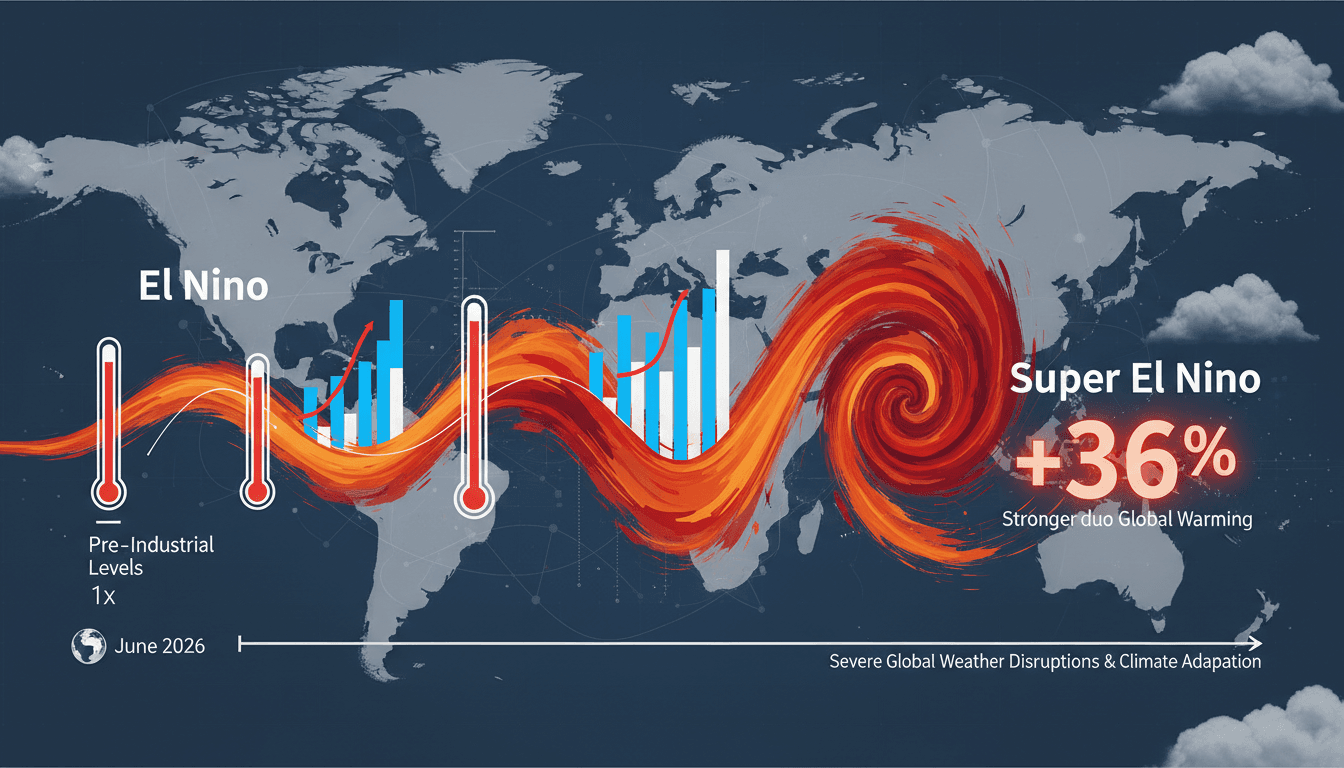
Here's what it means for you.
As global warming amplifies the intensity of El Niño events, you may face increased risks of extreme weather impacting your daily life and economic stability.
Why it matters
The amplified intensity of El Niño phenomena poses significant risks to global weather patterns, affecting agriculture, infrastructure, and public health.
What happened (in 30 seconds)
- A study published on September 4, 2026, reveals that modern El Niños are approximately 36% stronger than pre-industrial levels due to human-caused global warming.
- The current super El Niño event, forming since June 2026, is forecasted to become the strongest on record, exacerbating extreme weather globally.
- California officials and the UN are warning of prolonged extreme weather risks into 2027, with potential record global temperatures.
The context you actually need
- El Niño events occur every two to seven years, disrupting global weather patterns through warming sea surface temperatures in the tropical Pacific.
- The current super El Niño is developing against a backdrop of record ocean temperatures and marine heat waves, raising concerns about unprecedented strength.
- Previous strong El Niños, such as those in 1997-98 and 2015-16, have already demonstrated significant impacts on global weather, agriculture, and economies.
What's really happening
The recent study led by paleoclimatologist Julia Cole at the University of Michigan highlights a critical shift in the behavior of El Niño events, linking their increased intensity directly to anthropogenic climate change. By analyzing nearly 1,000 years of coral records from the Galápagos Islands, researchers found that modern El Niños are approximately 36% stronger than those observed before the industrial era. This amplification has accelerated over the last 40 years, with a notable 16% increase in intensity.
As the current super El Niño develops, forecasts indicate it could surpass previous records, raising alarms among scientists and policymakers alike. The World Meteorological Organization has issued warnings about the potential for extreme weather events, including heat waves, floods, and droughts, which could persist into 2027. UN Secretary-General António Guterres has characterized the situation as "supersizing before our eyes," emphasizing the urgency of addressing climate change.
The implications of this intensified El Niño are profound. Economies reliant on agriculture may face significant disruptions due to altered precipitation patterns, leading to crop failures and food shortages. Coastal regions could experience increased flooding and erosion, threatening infrastructure and livelihoods. Additionally, public health systems may be strained as extreme weather events lead to increased heat-related illnesses and vector-borne diseases.
Skeptics of the study point to uncertainties in proxy data and the influence of natural variability. However, the findings align with observed trends in recent strong El Niño events, suggesting a clear connection between climate change and the intensification of the El Niño-Southern Oscillation (ENSO) system. As the scientific community continues to debate these findings, the reality of a warming planet and its impact on weather patterns is becoming increasingly evident.
Who feels it first (and how)
- Farmers and agricultural sectors: Facing crop failures and economic instability due to altered weather patterns.
- Coastal communities: Experiencing increased flooding and erosion, threatening homes and infrastructure.
- Public health officials: Managing rising health risks associated with extreme weather, including heat-related illnesses.
- Insurance companies: Anticipating higher claims due to weather-related damages, impacting premiums and coverage availability.
What to watch next
- Weather forecasts: Monitor predictions for extreme weather events linked to the developing super El Niño, as they will impact various sectors.
- Agricultural reports: Keep an eye on crop yield forecasts and food prices, as disruptions may lead to shortages and inflation.
- Climate adaptation investments: Watch for shifts in market focus towards climate resilience strategies, as businesses and governments respond to increased risks.
Modern El Niños are 36% stronger than pre-industrial levels.
The current super El Niño will exacerbate extreme weather events globally.
The full extent of localized impacts in specific regions, including the Middle East.
Frequently Asked Questions
- Why it matters?
- The amplified intensity of El Niño phenomena poses significant risks to global weather patterns, affecting agriculture, infrastructure, and public health.
- What happened (in 30 seconds)?
- A study published on September 4, 2026, reveals that modern El Niños are approximately 36% stronger than pre-industrial levels due to human-caused global warming. The current super El Niño event, forming since June 2026, is forecasted to become the strongest on record, exacerbating extreme weather globally. California officials and the UN are warning of prolonged extreme weather risks into 2027, with potential record global temperatures.
- What's really happening?
- The recent study led by paleoclimatologist Julia Cole at the University of Michigan highlights a critical shift in the behavior of El Niño events, linking their increased intensity directly to anthropogenic climate change. By analyzing nearly 1,000 years of coral records from the Galápagos Islands, researchers found that modern El Niños are approximately 36% stronger than those observed before the industrial era. This amplification has accelerated over the last 40 years, with a notable 16% incre
- Who feels it first (and how)?
- Farmers and agricultural sectors: Facing crop failures and economic instability due to altered weather patterns. Coastal communities: Experiencing increased flooding and erosion, threatening homes and infrastructure. Public health officials: Managing rising health risks associated with extreme weather, including heat-related illnesses. Insurance companies: Anticipating higher claims due to weather-related damages, impacting premiums and coverage availability.
- What to watch next?
- Weather forecasts: Monitor predictions for extreme weather events linked to the developing super El Niño, as they will impact various sectors. Agricultural reports: Keep an eye on crop yield forecasts and food prices, as disruptions may lead to shortages and inflation. Climate adaptation investments: Watch for shifts in market focus towards climate resilience strategies, as businesses and governments respond to increased risks.
California news and regional developments.
"The Los Angeles Times is a major West Coast newspaper offering in-depth reporting with a liberal editorial tone and strong regional focus."
— A47 Editor
As world braces for 'super' El Niño, research suggests global warming has increased its punch
New research indicates that human-induced climate change is intensifying the effects of El Niño, leading to more extreme weather patterns globally. This year's forecast suggests a 'super' El Niño is likely, with a 95% chance of development, raising c...
International news with cultural insight.
"The Los Angeles Times is a major West Coast newspaper offering in-depth reporting with a liberal editorial tone and strong regional focus."
— A47 Editor
As world braces for 'super' El Niño, research suggests global warming has increased its punch
New research indicates that human-induced climate change is intensifying the effects of El Niño, leading to more extreme weather patterns globally. This year's forecast suggests a 'super' El Niño is likely, with a 95% chance of development, raising c...
Global business headlines with AI angles.
"General business outlet that frequently covers AI."
— A47 Editor
A 'Supersized' El Niño Is Getting Stronger. The Economic Pain Could Spread Far Beyond The Countries Hit First.
A 'supersized' El Niño is intensifying, leading to significant crop losses reported from Central America to South Asia, with changing rainfall patterns and extreme heat threatening food production, water supplies, and energy systems.
Global political, business, and cultural coverage from WSJ international desks.
"The Wall Street Journal offers extensive international reporting with a reputation for financial insight and a center-right editorial stance."
— A47 Editor
El Nino Is Yet to Peak, Bringing Heat and Agricultural Damage in Tow, UN Says
The United Nations has reported that the current El Niño phenomenon is on track to be the strongest in at least 70 years, with significant implications for global agricultural markets as it intensifies.
English-language reporting on Saudi politics, policy, and society.
"Saudi Gazette reflects mainstream Saudi institutional perspectives."
— A47 Editor
UN warns of 'supersized' El Niño as world prepares for impact
The United Nations has issued a warning that the El Niño phenomenon is firmly established and is expected to intensify into a very strong event, potentially the strongest in over 70 years, leading to significant impacts on global weather patterns, in...
Top international stories selected by The Guardian editors.
"The Guardian is known for its progressive editorial stance and in-depth analysis."
— A47 Editor
‘Supersizing before our eyes’: UN warns of record El Niño approaching
The United Nations has issued a stark warning regarding an approaching El Niño phenomenon, which is projected to be the largest in over a millennium, potentially leading to unprecedented global temperature records. This event is expected to exacerbat...