
Houthi Forces Capture Strategic Red Sea Positions Displacing Thousands in Yemen
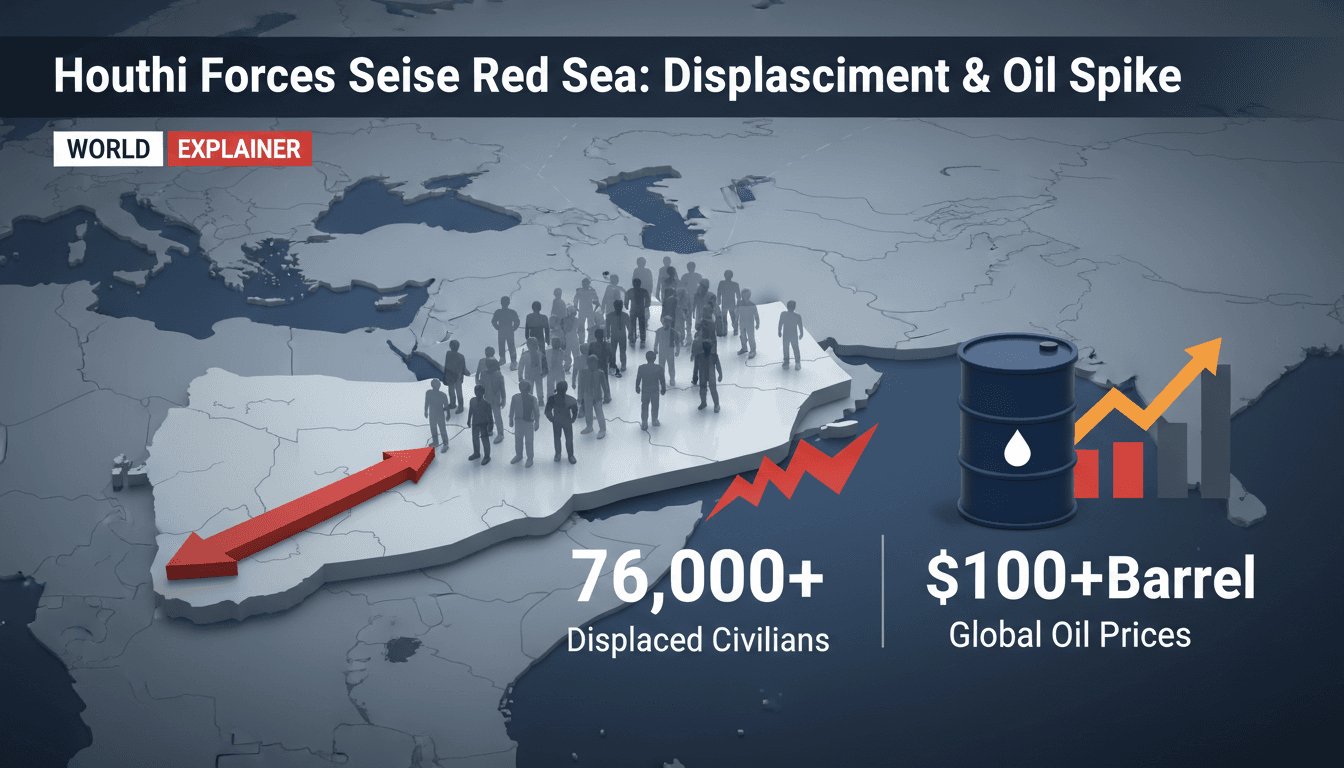
Here's what it means for you.
Rising oil prices due to conflict in Yemen could increase fuel costs for businesses and consumers worldwide.
Why it matters
The ongoing conflict threatens critical shipping routes, impacting global trade and energy prices.
What happened (in 30 seconds)
- Houthi forces launched an offensive along Yemen's Red Sea coast, seizing key locations including the port of Mocha.
- Over 76,000 civilians have been displaced since July 2026, with nearly 50,000 fleeing in just a few days amid escalating violence.
- Oil prices have surged above $100 per barrel as the conflict raises concerns over shipping security in the Bab al-Mandab strait.
The context you actually need
- Yemen's civil war has been ongoing since 2014, with proxy forces involved, complicating the humanitarian crisis.
- The Bab al-Mandab strait is a vital global shipping chokepoint, making stability in the region crucial for international trade.
- The recent escalation is linked to broader US-Iran tensions, which have empowered Houthi forces and intensified regional conflicts.
What's really happening
In early September 2026, Houthi forces executed a rapid offensive along Yemen's Red Sea coast, capturing the strategic port of Mocha and surrounding areas. This military maneuver has resulted in significant civilian displacement, with the International Organization for Migration (IOM) reporting that nearly 50,000 people fled their homes in just a few days. The total number of displaced individuals has now exceeded 76,000 since July 2026, highlighting the urgency of the humanitarian crisis.
The conflict is not merely a local issue; it has global implications. The Bab al-Mandab strait is a critical maritime route for oil shipments, and any instability in this region can lead to increased shipping costs and disruptions. As Houthi forces gain ground, the risk of attacks on commercial vessels rises, prompting oil prices to soar above $100 per barrel. This spike in oil prices is not just a statistic; it translates into higher fuel costs for consumers and businesses worldwide, affecting everything from transportation to manufacturing.
The humanitarian situation is dire, with civilians fleeing with minimal belongings amid ongoing shelling and looting. Aid organizations face significant challenges in providing necessary support, as access to affected areas becomes increasingly restricted. The UN has described this as a "new and more dangerous phase" in Yemen's civil war, emphasizing the urgent need for international intervention and support.
Moreover, the conflict's escalation is intertwined with broader geopolitical tensions, particularly the US-Iran rivalry. As the US and its allies, including Saudi Arabia, continue to confront Iranian influence in the region, the Houthis have seized the opportunity to expand their territorial control. This dynamic not only complicates the conflict but also raises the stakes for global energy markets, as any disruption in oil supply can have cascading effects on economies worldwide.
Who feels it first (and how)
- Consumers: Higher fuel prices will increase transportation costs, affecting everyday expenses.
- Businesses: Companies reliant on oil and shipping will face rising operational costs, impacting profit margins.
- Aid organizations: Humanitarian efforts will be hampered by access restrictions and funding shortfalls.
- Regional governments: Countries in the Middle East may experience increased instability and economic strain due to the conflict.
What to watch next
- Oil price fluctuations: Monitor how ongoing conflict impacts global oil prices and supply chains.
- Humanitarian aid responses: Watch for international efforts to address the growing humanitarian crisis in Yemen.
- Geopolitical developments: Keep an eye on US-Iran relations and their influence on the conflict's trajectory.
The Houthi offensive has displaced over 76,000 civilians since July 2026.
Oil prices will remain volatile as the conflict continues to threaten shipping routes.
The potential for a diplomatic resolution or ceasefire in Yemen remains uncertain.
Frequently Asked Questions
- Why it matters?
- The ongoing conflict threatens critical shipping routes, impacting global trade and energy prices.
- What happened (in 30 seconds)?
- Houthi forces launched an offensive along Yemen's Red Sea coast, seizing key locations including the port of Mocha. Over 76,000 civilians have been displaced since July 2026, with nearly 50,000 fleeing in just a few days amid escalating violence. Oil prices have surged above $100 per barrel as the conflict raises concerns over shipping security in the Bab al-Mandab strait.
- What's really happening?
- In early September 2026, Houthi forces executed a rapid offensive along Yemen's Red Sea coast, capturing the strategic port of Mocha and surrounding areas. This military maneuver has resulted in significant civilian displacement, with the International Organization for Migration (IOM) reporting that nearly 50,000 people fled their homes in just a few days. The total number of displaced individuals has now exceeded 76,000 since July 2026, highlighting the urgency of the humanitarian crisis. The
- Who feels it first (and how)?
- Consumers: Higher fuel prices will increase transportation costs, affecting everyday expenses. Businesses: Companies reliant on oil and shipping will face rising operational costs, impacting profit margins. Aid organizations: Humanitarian efforts will be hampered by access restrictions and funding shortfalls. Regional governments: Countries in the Middle East may experience increased instability and economic strain due to the conflict.
- What to watch next?
- Oil price fluctuations: Monitor how ongoing conflict impacts global oil prices and supply chains. Humanitarian aid responses: Watch for international efforts to address the growing humanitarian crisis in Yemen. Geopolitical developments: Keep an eye on US-Iran relations and their influence on the conflict's trajectory.
International coverage from The Guardian's global desks.
"The Guardian is known for its progressive editorial stance and in-depth analysis."
— A47 Editor
Nearly 50,000 Yemeni civilians flee as Houthis advance along Red Sea coast
Nearly 50,000 Yemeni civilians have fled their homes as Houthi forces advance along the Red Sea coast, capturing key locations such as the port city of Mocha and the strategic island of Perim. This sudden escalation has left entire villages emptied a...
International coverage of politics, culture, and current affairs.
"BBC News is widely regarded as a reputable international news organization, known for its impartial tone and public service mandate."
— A47 Editor
How global trade and oil prices could be hit by Houthi advance
Yemen's Houthi rebels have advanced towards the Bab al-Mandab Strait, a critical maritime route for global trade and oil shipping, raising concerns over potential disruptions. This escalation follows their recent military offensives and the seizure o...
English-language digital publication covering business, politics, technology, and current affairs.
"The Arabian Post mixes original and syndicated-style coverage with a broad regional and global business-news orientation."
— A47 Editor
Houthis seize key positions around Bab al-Mandab strait
The Houthi rebels have intensified their military operations, seizing key positions around the Bab al-Mandab Strait, a critical maritime route. This escalation follows their recent capture of the strategic port city of Mocha and Perim Island, further...
Comprehensive coverage of Middle Eastern and global issues.
"Al Jazeera is a prominent voice from the Global South, especially the Middle East, with an emphasis on underreported stories."
— A47 Editor
What’s happening in Yemen and how did we get here?
Fighting has reignited in Yemen as Houthi forces push south towards the strategic Bab al-Mandab Strait, intensifying the ongoing conflict. This escalation follows recent military offensives by the Houthis, who have seized control of key locations, in...