
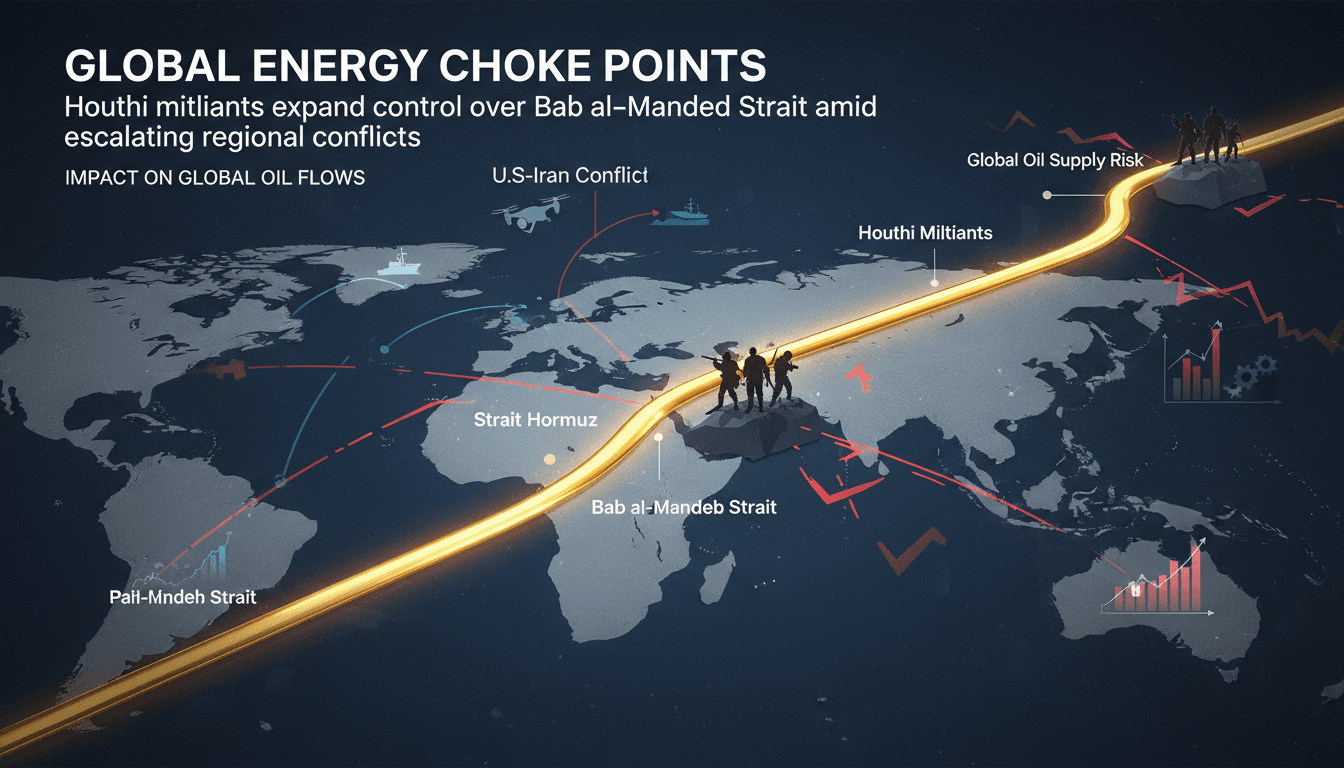
Houthi militants expand control over Bab al-Mandeb Strait amid escalating regional conflicts
Here's what it means for you.
Rising oil prices and supply disruptions could impact your transportation and living costs.
Why it matters
This escalation in Yemen threatens global oil supplies, affecting energy prices and economic stability worldwide.
What happened (in 30 seconds)
- Houthi militants seized key territory around the Bab al-Mandeb Strait in early September 2026.
- Iran's influence over critical energy corridors has expanded, compounding existing disruptions from the U.S.-Iran conflict.
- Saudi oil production fell to a three-decade low, with prices surging above $100 per barrel.
The context you actually need
- The U.S.-Iran conflict began in February 2026, severely restricting oil flows through the Strait of Hormuz, a vital global shipping route.
- Houthi forces capitalized on the chaos to launch a rapid offensive, gaining control over strategic areas in Yemen.
- Saudi Arabia's oil production has plummeted, with the country now producing only 6 million barrels per day, the lowest in over 30 years.
What's really happening
The recent Houthi offensive in Yemen is a significant development in a broader geopolitical landscape marked by escalating tensions between Iran and the United States. Following the initiation of the U.S.-Iran war in February 2026, which involved joint U.S.-Israel strikes on Iran, the Strait of Hormuz—responsible for approximately 20% of global oil flow—was effectively closed or severely restricted. This disruption triggered the largest oil supply crisis in modern history, with Gulf producers forced to dramatically curtail output as storage facilities reached capacity and exports halted. Initial losses were estimated at over 8-10 million barrels per day.
In this context, the Houthi militants, backed by Iran, launched a rapid offensive in early September 2026, seizing control of key southern Red Sea territories, including the Bab al-Mandeb Strait and the port of Mokha. This strategic move places another critical energy corridor under Iranian influence, further complicating the already precarious global oil supply situation. The Bab al-Mandeb Strait serves as a vital alternative shipping route, and its control by Iran-aligned forces raises immediate concerns about tanker routing and supply chain stability.
In response to these developments, Saudi Arabia has taken drastic measures, including shutting down segments of its East-West pipeline following drone attacks. This has further reduced the country's export capacity, contributing to a significant decline in oil production, which fell to 6 million barrels per day in August 2026—the lowest level in over three decades. As a result, oil prices have surged, with Brent crude exceeding $100 per barrel amid fears of prolonged disruptions.
The interconnected nature of these conflicts means that the implications extend beyond the immediate region. The ongoing instability in Yemen and the Red Sea, combined with the existing crisis in the Strait of Hormuz, creates a precarious situation for global energy markets. The International Energy Agency has projected sustained supply shortfalls, prompting stock releases and adjustments in demand. As regional governments signal no immediate off-ramp from the conflict, prices are expected to remain elevated into 2027, impacting consumers and businesses worldwide.
Who feels it first (and how)
- Consumers: Higher fuel and energy costs will directly affect transportation and living expenses.
- Businesses: Companies reliant on oil and gas will face increased operational costs, impacting profitability.
- Expatriates in the UAE: Rising costs of living due to elevated energy prices will affect disposable income and lifestyle choices.
- Global markets: Investors in energy stocks and commodities will experience volatility and potential losses.
What to watch next
- Oil price trends: Monitor Brent and WTI prices for indications of sustained supply disruptions and market reactions.
- Saudi production levels: Watch for any changes in Saudi Arabia's output and export strategies as they adapt to the ongoing crisis.
- Diplomatic developments: Keep an eye on potential negotiations or escalations in the U.S.-Iran conflict that could further impact oil supply.
Oil prices have surged above $100 per barrel due to supply disruptions.
Continued instability in the region will keep prices elevated and may lead to further production cuts.
The timeline for resolution in the U.S.-Iran conflict and its impact on global oil supply remains uncertain.
Frequently Asked Questions
- Why it matters?
- This escalation in Yemen threatens global oil supplies, affecting energy prices and economic stability worldwide.
- What happened (in 30 seconds)?
- Houthi militants seized key territory around the Bab al-Mandeb Strait in early September 2026. Iran's influence over critical energy corridors has expanded, compounding existing disruptions from the U.S.-Iran conflict. Saudi oil production fell to a three-decade low, with prices surging above $100 per barrel.
- What's really happening?
- The recent Houthi offensive in Yemen is a significant development in a broader geopolitical landscape marked by escalating tensions between Iran and the United States. Following the initiation of the U.S.-Iran war in February 2026, which involved joint U.S.-Israel strikes on Iran, the Strait of Hormuz—responsible for approximately 20% of global oil flow—was effectively closed or severely restricted. This disruption triggered the largest oil supply crisis in modern history, with Gulf producers fo
- Who feels it first (and how)?
- Consumers: Higher fuel and energy costs will directly affect transportation and living expenses. Businesses: Companies reliant on oil and gas will face increased operational costs, impacting profitability. Expatriates in the UAE: Rising costs of living due to elevated energy prices will affect disposable income and lifestyle choices. Global markets: Investors in energy stocks and commodities will experience volatility and potential losses.
- What to watch next?
- Oil price trends: Monitor Brent and WTI prices for indications of sustained supply disruptions and market reactions. Saudi production levels: Watch for any changes in Saudi Arabia's output and export strategies as they adapt to the ongoing crisis. Diplomatic developments: Keep an eye on potential negotiations or escalations in the U.S.-Iran conflict that could further impact oil supply.
Global political, business, and cultural coverage from WSJ international desks.
"The Wall Street Journal offers extensive international reporting with a reputation for financial insight and a center-right editorial stance."
— A47 Editor
Widening Mideast Instability Squeezes Global Oil Supplies
The Houthi rebels in Yemen have intensified their military operations, capturing key locations including the strategic port city of Mocha and the island of Perim, thereby tightening their control over the Bab al-Mandab Strait, a vital maritime route ...
Regional coverage and analysis focused on politics, diplomacy, and business across the Middle East.
"Al-Monitor is known for analytical reporting on Middle East politics and policy developments."
— A47 Editor
Houthis' Yemen advance leaves Gulf states with uncomfortable choice
The Houthi rebels have advanced significantly in Yemen, capturing the strategic port city of Mocha and tightening their control over the Bab el-Mandeb Strait, a critical maritime route. This military escalation is reshaping the balance of power in th...
European coverage of Middle East politics and security issues.
"France 24 offers international reporting with a European editorial perspective."
— A47 Editor
Yemen: The Houthis test Iran's regional influence
Houthi forces have intensified their military operations in Yemen, capturing key sites around the Bab el-Mandeb Strait, including the strategic island of Perim and the port city of Mocha. This escalation follows a series of drone attacks that have di...
24/7 international news from a French perspective in multiple languages.
"France 24 is viewed as a globally focused outlet with balanced coverage and a European perspective."
— A47 Editor
Yemen: The Houthis test Iran's regional influence
Houthi forces have intensified their military operations in Yemen, capturing key sites around the Bab el-Mandeb Strait, including the strategic island of Perim and the port city of Mocha. This escalation follows a series of drone attacks that have di...
Comprehensive coverage of Middle Eastern and global issues.
"Al Jazeera is a prominent voice from the Global South, especially the Middle East, with an emphasis on underreported stories."
— A47 Editor
Will Houthi advances in Yemen give Iran leverage in its war with the US?
The Houthi rebels in Yemen have made significant military advances, capturing the strategic port city of Mocha and the island of Perim, thereby tightening their control over the Bab al-Mandeb Strait, a crucial maritime route for global shipping and o...
Global news coverage with extensive reporting on Middle Eastern conflicts and geopolitics.
"Al Jazeera is a Qatar-based broadcaster known for wide regional coverage and alternative perspectives."
— A47 Editor
Will Houthi advances in Yemen give Iran leverage in its war with the US?
The Houthi rebels in Yemen have made significant military advances, capturing the strategic port city of Mocha and the island of Perim, thereby tightening their control over the Bab al-Mandeb Strait, a crucial maritime route for global shipping and o...
Regional coverage and analysis focused on politics, diplomacy, and business across the Middle East.
"Al-Monitor is known for analytical reporting on Middle East politics and policy developments."
— A47 Editor
Analysis-Houthi advance in Yemen puts U.S. in a new bind
The Iran-aligned Houthi rebels have launched a rapid offensive in Yemen, capturing the strategic port city of Mocha and tightening their control over the Bab al-Mandeb Strait, a vital maritime route. This escalation poses a significant challenge for ...
Capitol Hill news, legislation, and policy insight.
"The Hill specializes in U.S. politics and policy, with a focus on Capitol Hill developments and a reputation for insider reporting."
— A47 Editor
Proxy fight in Yemen heats up, risking new front in US-Iran war
The Iranian-backed Houthi rebel group's reported takeover of a port city in Yemen has escalated tensions in the region, prompting Saudi Arabia to urge the U.S. to take military action against the rebels. The U.S. has responded by deploying over 100 a...
Regional coverage and analysis focused on politics, diplomacy, and business across the Middle East.
"Al-Monitor is known for analytical reporting on Middle East politics and policy developments."
— A47 Editor
Houthis advance along Yemeni coast, threaten Saudi oil exports in the Red Sea
The Iran-aligned Houthi rebels have seized control of Yemen's strategic port city of Mocha, marking a significant escalation in their military operations along the Red Sea coast. This advance threatens Saudi oil exports and follows a series of violen...
Top international stories selected by The Guardian editors.
"The Guardian is known for its progressive editorial stance and in-depth analysis."
— A47 Editor
The rapid Houthi advance in Yemen: why it matters and what’s at stake
The Houthi forces have rapidly advanced along Yemen's Red Sea coast, seizing control of the strategic port city of Mocha and intensifying their military offensive against the Saudi-backed government. This escalation has resulted in over 1,000 casualt...