
BRICS Summit in New Delhi Promotes Multipolar Economic Frameworks
Here's what it means for you.
As global economic dynamics shift, your business strategies may need to adapt to emerging markets and alternative payment systems.
Why it matters
The BRICS Summit signals a significant move towards a multipolar world, potentially reshaping global trade and finance.
What happened (in 30 seconds)
- Leaders convened: The 18th BRICS Summit took place in New Delhi on September 12-13, 2026, with key participants including China, Russia, and Iran.
- De-dollarization discussions: Iranian President Masoud Pezeshkian called for alternatives to the dollar-based payment system amid ongoing Middle East tensions.
- New Delhi Declaration: The summit concluded with proposals for enhanced trade and finance cooperation among BRICS nations.
The context you actually need
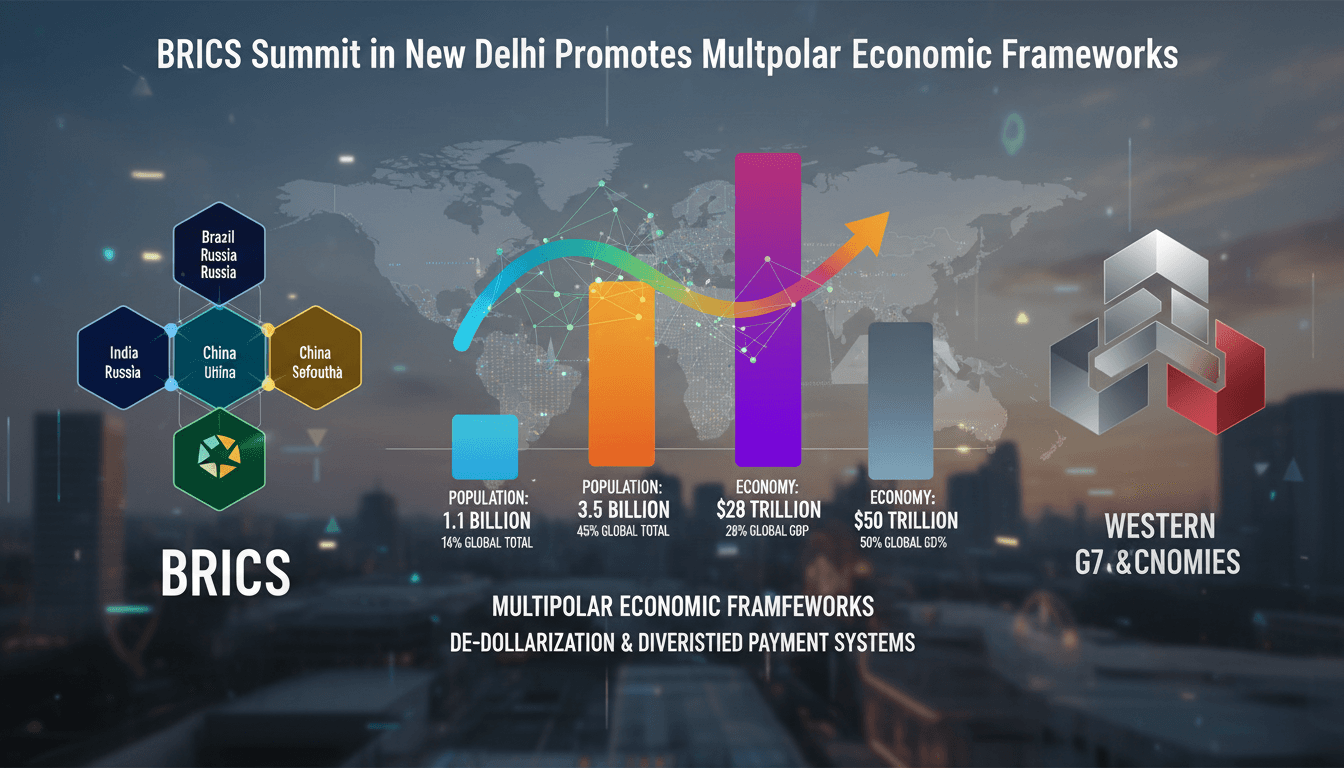
- BRICS expansion: Originally formed by Brazil, Russia, India, China, and South Africa, BRICS now includes Iran, UAE, Saudi Arabia, Egypt, Ethiopia, and Indonesia, representing about half the global population.
- Economic influence: The bloc advocates for reforms in international financial institutions and aims to reduce reliance on the U.S. dollar for trade settlements.
- Middle East tensions: Ongoing conflicts in the region, particularly involving Iran, have heightened the urgency for BRICS nations to explore alternative economic frameworks.
What's really happening
The 18th BRICS Summit in New Delhi marked a pivotal moment for emerging economies, as leaders from major nations convened to discuss economic cooperation and alternatives to Western-dominated institutions. The backdrop of ongoing Middle East conflicts, particularly involving Iran, added urgency to the discussions. Iranian President Masoud Pezeshkian's presence alongside Gulf leaders highlighted the complex dynamics at play, as he announced an agreement with Oman on a joint route through the Strait of Hormuz. This agreement is significant, as it underscores the importance of maritime security amid disruptions caused by the Yemen conflict.
A central theme of the summit was the call for de-dollarization, with Pezeshkian urging BRICS nations to develop alternatives to the dollar-based payment system. This move is aimed at mitigating the impacts of sanctions that have historically targeted countries like Iran. The discussions also touched on broader calls for multipolar economic frameworks, positioning BRICS as a platform for emerging market cooperation. China's role was particularly pronounced, as it emphasized the bloc's potential influence in reshaping global economic governance.
The summit concluded with the New Delhi Declaration, which proposed follow-up actions on trade and finance. However, experts noted that internal divisions within BRICS, such as trade halts between the UAE and Iran, may limit the immediate impact of these discussions. While markets showed limited immediate shifts, the focus remains on long-term institutional alternatives to the current global financial system. The anticipated U.S. responses regarding sanctions and tariffs will also play a crucial role in shaping the outcomes of this summit.
As the next BRICS summit is slated for China, the momentum generated in New Delhi could lead to further developments in the bloc's agenda, particularly in terms of economic cooperation and the push for a multipolar world.
Who feels it first (and how)
- Emerging market businesses: Companies in BRICS nations may benefit from new trade agreements and reduced reliance on the U.S. dollar.
- Financial institutions: Banks and financial services in Dubai and other BRICS member countries may need to adapt to new payment systems and trade routes.
- Global investors: Investors may need to reassess their strategies as BRICS nations push for alternatives to Western financial systems.
What to watch next
- Follow-up actions from the New Delhi Declaration: Monitoring how BRICS nations implement proposed trade and finance initiatives will be crucial for understanding the bloc's influence.
- U.S. responses to BRICS initiatives: Watch for potential sanctions or tariffs from the U.S. as it reacts to the growing influence of BRICS and its push for de-dollarization.
- Next year's summit in China: The outcomes of the upcoming summit could further solidify BRICS' role in global economic governance and reveal shifts in alliances.
BRICS represents approximately half the world's population and a significant share of global trade.
The bloc will continue to advocate for alternatives to the dollar-based payment system.
The immediate impact of internal divisions within BRICS on its collective agenda remains uncertain.
Frequently Asked Questions
- Why it matters?
- The BRICS Summit signals a significant move towards a multipolar world, potentially reshaping global trade and finance.
- What happened (in 30 seconds)?
- Leaders convened: The 18th BRICS Summit took place in New Delhi on September 12-13, 2026, with key participants including China, Russia, and Iran. De-dollarization discussions: Iranian President Masoud Pezeshkian called for alternatives to the dollar-based payment system amid ongoing Middle East tensions. New Delhi Declaration: The summit concluded with proposals for enhanced trade and finance cooperation among BRICS nations.
- What's really happening?
- The 18th BRICS Summit in New Delhi marked a pivotal moment for emerging economies, as leaders from major nations convened to discuss economic cooperation and alternatives to Western-dominated institutions. The backdrop of ongoing Middle East conflicts, particularly involving Iran, added urgency to the discussions. Iranian President Masoud Pezeshkian's presence alongside Gulf leaders highlighted the complex dynamics at play, as he announced an agreement with Oman on a joint route through the Stra
- Who feels it first (and how)?
- Emerging market businesses: Companies in BRICS nations may benefit from new trade agreements and reduced reliance on the U.S. dollar. Financial institutions: Banks and financial services in Dubai and other BRICS member countries may need to adapt to new payment systems and trade routes. Global investors: Investors may need to reassess their strategies as BRICS nations push for alternatives to Western financial systems.
- What to watch next?
- Follow-up actions from the New Delhi Declaration: Monitoring how BRICS nations implement proposed trade and finance initiatives will be crucial for understanding the bloc's influence. U.S. responses to BRICS initiatives: Watch for potential sanctions or tariffs from the U.S. as it reacts to the growing influence of BRICS and its push for de-dollarization. Next year's summit in China: The outcomes of the upcoming summit could further solidify BRICS' role in global economic governance and reve
International stories from NPR’s global desk.
"NPR is an American public media organization known for thoughtful reporting and a slightly left-leaning editorial tone."
— A47 Editor
'BRICS' forum brings together emerging economies, aimed at countering western dominance
The 18th BRICS summit is currently taking place in New Delhi, India, where leaders from major emerging economies are convening to discuss strategies aimed at enhancing economic cooperation and countering Western dominance. This summit focuses on link...
Sports reporting with a focus on Saudi and regional competitions.
"Okaz sports coverage is broad and audience-friendly, with strong attention to Saudi teams and leagues."
— A47 Editor
الهند تستضيف قادة «بريكس».. التجارة والصراعات على طاولة القمة
Leaders of the BRICS nations are convening in New Delhi, India, for a two-day summit, with notable attendees including Russian President Vladimir Putin and Chinese President Xi Jinping. The agenda is expected to focus on global and regional issues, p...
Regional coverage and analysis focused on politics, diplomacy, and business across the Middle East.
"Al-Monitor is known for analytical reporting on Middle East politics and policy developments."
— A47 Editor
BRICS bloc agrees on joint declaration, sources say
The BRICS group of countries, comprising Brazil, Russia, India, China, South Africa, Egypt, Ethiopia, Indonesia, Iran, and the United Arab Emirates, has reached an agreement on a joint declaration during its annual summit in New Delhi. The declaratio...
Regional coverage and analysis focused on politics, diplomacy, and business across the Middle East.
"Al-Monitor is known for analytical reporting on Middle East politics and policy developments."
— A47 Editor
Factbox-The evolution of BRICS and its challenges today
Leaders of the BRICS group of nations convened in New Delhi for their annual summit, addressing significant geopolitical tensions and disruptions in global trade and energy markets. This summit marks the 20th anniversary of BRICS, originally formed i...
RT is a Russian state-funded network covering global events from a Russian perspective.
"RT is widely criticized for promoting pro-Kremlin narratives and is considered by many to be a state propaganda outlet."
— A47 Editor
BRICS: The gears of change keep grinding
The 18th annual BRICS summit is currently taking place in India, where leaders are focusing on linking payment systems among member nations. This summit is significant as it aims to enhance economic cooperation and trade among BRICS countries amidst ...
UAE-based English-language newspaper covering regional politics, economics, and global affairs.
"The National reflects Emirati policy perspectives while maintaining international editorial standards."
— A47 Editor
Brics leaders arrive for summit in India focused on energy, trade and co-operation
Leaders from BRICS nations have gathered in New Delhi for a summit focused on enhancing energy cooperation, trade, and collaboration among emerging economies, marking the group's 20th anniversary. This event highlights the importance of collective ac...