
Putin Highlights Rising Global Interest in BRICS at New Delhi Summit
Here's what it means for you.
As BRICS expands its influence, businesses and investors must navigate new economic landscapes and opportunities.
Why it matters
The increasing interest in BRICS signals a shift in global economic power dynamics, impacting trade and investment strategies.
What happened (in 30 seconds)
- Putin highlighted the rising global interest in BRICS during the 18th Summit in New Delhi, emphasizing its independent approach.
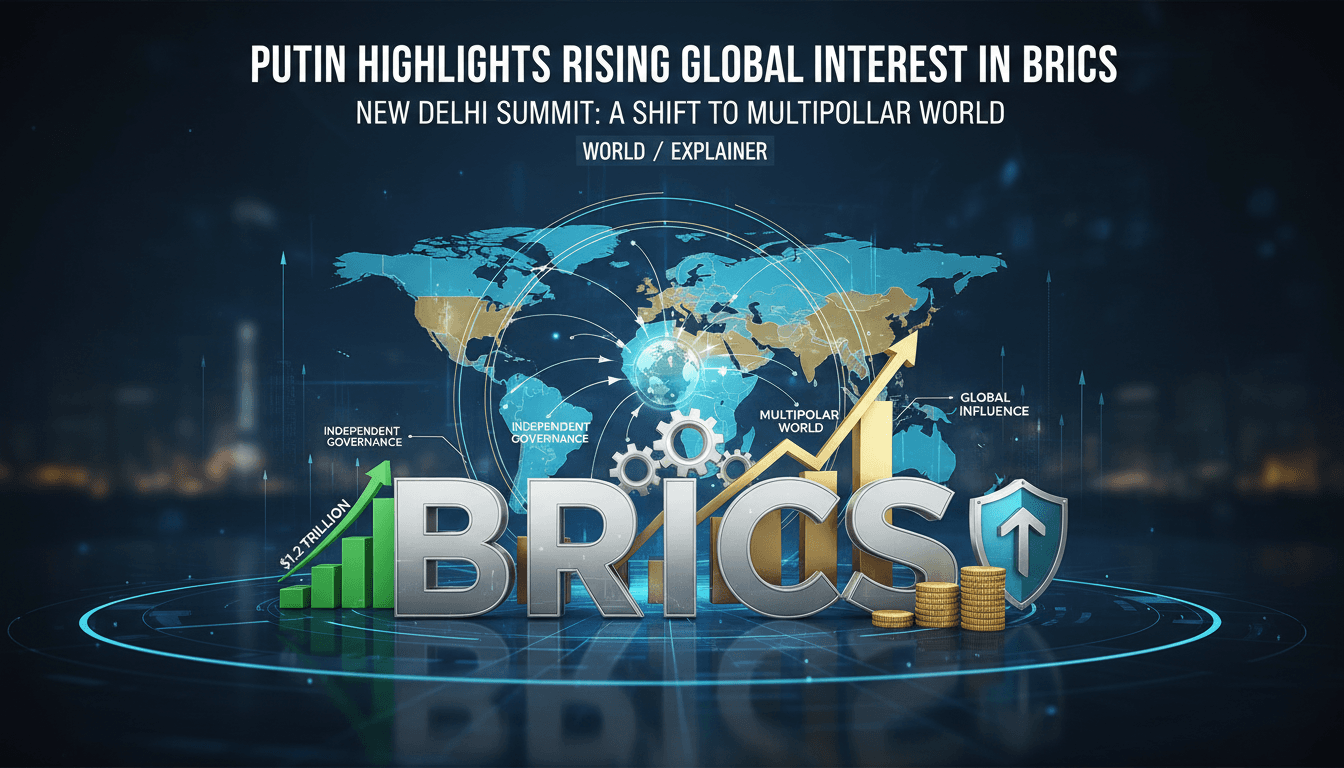
- Intra-BRICS trade reached $1.2 trillion, showcasing the bloc's economic significance and collective growth.
- The New Delhi Declaration called for reforms in global governance and proposed new financial mechanisms to enhance multilateralism.
The context you actually need
- BRICS has evolved from five original members to a broader coalition advocating for the Global South, aiming to reduce reliance on Western financial systems.
- The bloc accounts for 49% of global GDP growth, indicating its increasing economic weight and potential influence on global markets.
- The summit's proposals for payment infrastructure and trade mechanisms reflect a strategic pivot towards a multipolar world order, reshaping international economic relations.
What's really happening
The 18th BRICS Summit in New Delhi marked a pivotal moment for the bloc, as leaders from Brazil, Russia, India, China, and South Africa, along with partner nations, gathered to discuss the future of global governance. President Putin's remarks underscored the group's growing appeal, attributing it to a commitment to an independent course and collective problem-solving based on international law. This sentiment resonates with many nations seeking alternatives to Western-dominated systems.
The summit revealed significant economic metrics, including intra-BRICS trade reaching $1.2 trillion, which highlights the bloc's potential as a formidable economic entity. The fact that BRICS countries contribute to 49% of global GDP growth is a clear indicator of their rising influence. This growth is not merely a statistic; it reflects a broader trend of countries seeking to diversify their economic partnerships and reduce dependency on traditional Western markets.
Putin's proposals for new financial mechanisms, such as a BRICS payment infrastructure and a reinsurance mechanism, aim to facilitate trade and investment among member states while minimizing external pressures. These initiatives are designed to enhance economic resilience and foster deeper integration within the bloc. The emphasis on multilateralism in the New Delhi Declaration signals a collective commitment to reforming global governance structures, which many perceive as outdated and unrepresentative of current geopolitical realities.
As BRICS continues to expand its membership and influence, it is positioning itself as a counterbalance to Western hegemony. This shift is particularly relevant for countries in the Global South, which are increasingly looking for platforms that advocate for their interests and provide alternatives to existing financial systems. The summit's discussions on regional conflicts and the facilitation of talks regarding Ukraine further illustrate BRICS' ambition to play a more active role in global diplomacy.
In summary, the BRICS Summit in New Delhi not only showcased the bloc's economic achievements but also highlighted its strategic vision for a multipolar world. The implications of this shift are profound, as countries and businesses must adapt to a new landscape where BRICS plays a central role in shaping economic and political dynamics.
Who feels it first (and how)
- Emerging markets: Countries in the Global South may find new trade opportunities and partnerships.
- Investors: Those focusing on BRICS nations could see shifts in investment flows and market dynamics.
- Financial institutions: Banks and financial services may need to adapt to new payment systems and trade mechanisms.
- Exporters and importers: Businesses engaged in trade with BRICS countries could benefit from reduced transaction costs and enhanced market access.
What to watch next
- BRICS expansion: Monitor which countries may join BRICS next, as this could reshape global trade networks.
- Implementation of proposals: Watch for developments regarding the proposed payment infrastructure and trade mechanisms, which could impact cross-border transactions.
- Geopolitical shifts: Keep an eye on how BRICS nations engage in global conflicts and negotiations, particularly regarding Ukraine, as this may influence international relations.
BRICS countries account for 49% of global GDP growth.
The bloc will continue to expand its membership and influence in global governance.
The immediate impact of proposed financial mechanisms on global markets remains to be seen.
Frequently Asked Questions
- Why it matters?
- The increasing interest in BRICS signals a shift in global economic power dynamics, impacting trade and investment strategies.
- What happened (in 30 seconds)?
- Putin highlighted the rising global interest in BRICS during the 18th Summit in New Delhi, emphasizing its independent approach. Intra-BRICS trade reached $1.2 trillion, showcasing the bloc's economic significance and collective growth. The New Delhi Declaration called for reforms in global governance and proposed new financial mechanisms to enhance multilateralism.
- What's really happening?
- The 18th BRICS Summit in New Delhi marked a pivotal moment for the bloc, as leaders from Brazil, Russia, India, China, and South Africa, along with partner nations, gathered to discuss the future of global governance. President Putin's remarks underscored the group's growing appeal, attributing it to a commitment to an independent course and collective problem-solving based on international law. This sentiment resonates with many nations seeking alternatives to Western-dominated systems. The su
- Who feels it first (and how)?
- Emerging markets: Countries in the Global South may find new trade opportunities and partnerships. Investors: Those focusing on BRICS nations could see shifts in investment flows and market dynamics. Financial institutions: Banks and financial services may need to adapt to new payment systems and trade mechanisms. Exporters and importers: Businesses engaged in trade with BRICS countries could benefit from reduced transaction costs and enhanced market access.
- What to watch next?
- BRICS expansion: Monitor which countries may join BRICS next, as this could reshape global trade networks. Implementation of proposals: Watch for developments regarding the proposed payment infrastructure and trade mechanisms, which could impact cross-border transactions. Geopolitical shifts: Keep an eye on how BRICS nations engage in global conflicts and negotiations, particularly regarding Ukraine, as this may influence international relations.
RT is a Russian state-funded network covering global events from a Russian perspective.
"RT is widely criticized for promoting pro-Kremlin narratives and is considered by many to be a state propaganda outlet."
— A47 Editor
Global interest in BRICS keeps growing – Putin
Russian President Vladimir Putin has highlighted the growing global interest in BRICS, emphasizing its independent approach and collective strategies to address international challenges. This statement comes as Putin participates in the BRICS summit ...
English-language reporting on Saudi politics, policy, and society.
"Saudi Gazette reflects mainstream Saudi institutional perspectives."
— A47 Editor
Putin calls for expanding UN Security Council representation for Asia, Africa, Latin America
Russian President Vladimir Putin called for an expansion of the UN Security Council to enhance representation for countries in Asia, Africa, and Latin America during the 18th BRICS Summit in New Delhi. He emphasized the importance of strengthening th...
English-language digital publication covering business, politics, technology, and current affairs.
"The Arabian Post mixes original and syndicated-style coverage with a broad regional and global business-news orientation."
— A47 Editor
Russia-China alignment reshapes Modi’s BRICS diplomacy
Prime Minister Narendra Modi is hosting the BRICS summit in New Delhi, where the strategic alignment between Russia and China is becoming increasingly evident. This development adds pressure on India to balance its longstanding ties with Moscow while...