
Middle Powers Strengthen Economic Alliances in Response to US-China Trade Tensions
Why it matters
The rise of middle powers in economic alliances could reshape global trade frameworks, impacting supply chains and market access.
What happened (in 30 seconds)
- On September 17, 2026, Canadian Prime Minister Mark Carney proposed closer Canada-EU ties amid US tariffs.
- Middle powers, including Australia and Japan, are exploring economic coordination to counteract larger states' coercive actions.
- Ongoing negotiations aim to enhance trade facilitation and supply chain resilience without forming a formal bloc.
The context you actually need
- US-China rivalry has intensified, prompting middle powers to seek diversification in their economic partnerships.
- Mark Carney's Davos remarks in January 2026 emphasized the need for middle powers to collaborate to avoid being sidelined.
- Previous initiatives, like the Multi-Party Interim Appeal Arbitration Arrangement, have laid groundwork for cooperative frameworks among middle powers.
What's really happening
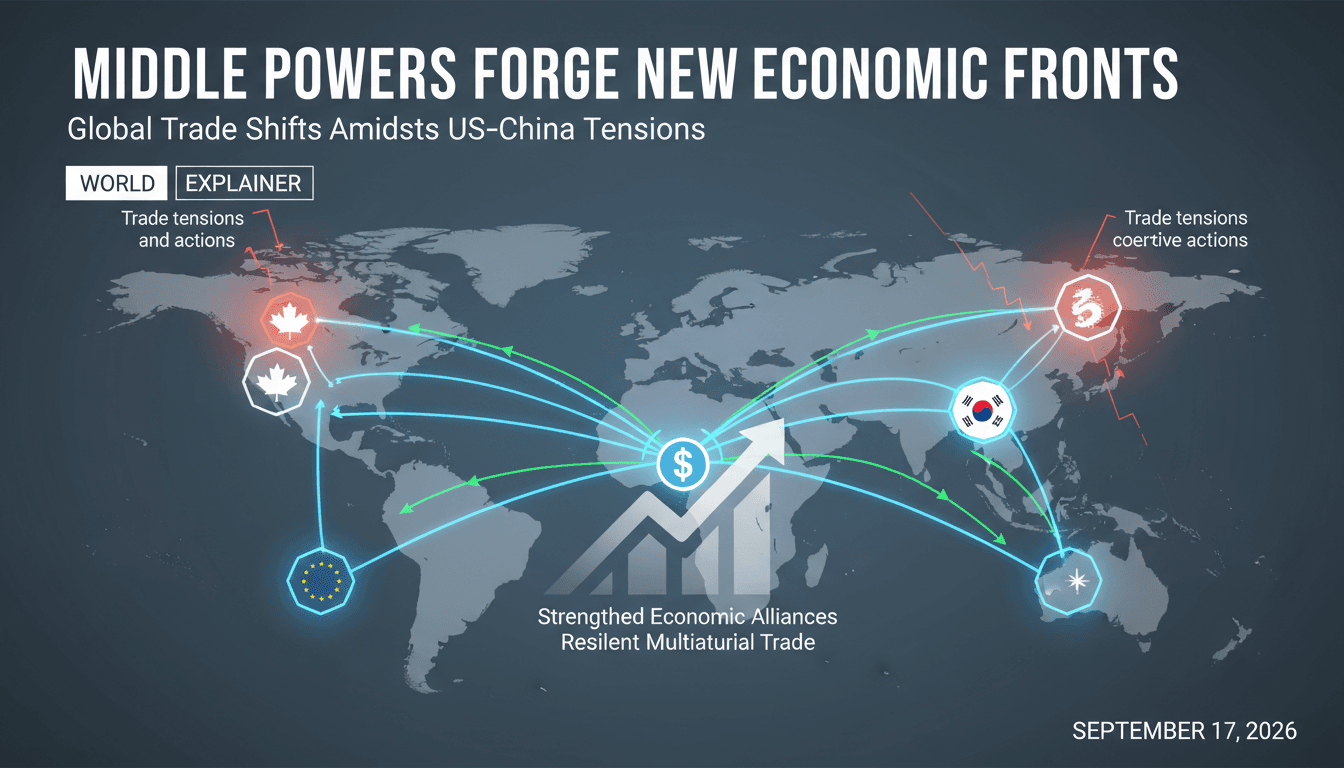
In the wake of renewed tariffs and trade threats from the United States under President Donald Trump, middle powers are increasingly motivated to diversify their economic partnerships. The September 2026 discussions in the European Parliament, led by Canadian Prime Minister Mark Carney, reflect a strategic pivot towards enhanced collaboration among nations like Canada, the EU, Australia, Japan, and South Korea. This coalition aims to safeguard their economic sovereignty and market access against unilateral actions from larger states.
Carney's earlier remarks at the World Economic Forum in Davos highlighted the urgency of this collaboration, warning that if middle powers are not at the negotiating table, they risk being marginalized. His call for coordinated action resonates with the broader context of rising protectionism and trade tensions, particularly between the US and China. The proposed associate member status for Canada within the EU is a significant step towards deeper economic integration, allowing for regulatory alignment and trade facilitation.
The ongoing negotiations are characterized by a focus on variable geometry coalitions, which allow for flexible partnerships without the need for a formalized bloc. This approach enables middle powers to engage in plurilateral agreements, such as the Digital Economic Partnership Agreement, which seeks to enhance digital trade and cooperation. The emphasis on supply chain resilience is particularly relevant, as countries look to mitigate risks associated with over-reliance on any single market, especially the US.
As these middle powers navigate the complexities of global trade, they are also responding to market signals. The share of global GDP represented by Global North middle powers stands at 34%, underscoring their economic significance. The UAE, as a key middle power, has already secured 38 Comprehensive Economic Partnership Agreements, enhancing its trade flows and investment diversification. This trend indicates a broader shift towards economic resilience that benefits not only these nations but also their trading partners.
Who feels it first (and how)
- Businesses in Canada and the EU: They may experience new trade opportunities and regulatory alignments.
- Exporters in Australia and Japan: Enhanced cooperation could lead to improved market access and reduced tariffs.
- Consumers in middle power countries: They may benefit from a wider range of products and potentially lower prices due to increased competition.
What to watch next
- Progress on Canada-EU negotiations: Successful talks could lead to formal agreements that reshape trade dynamics.
- Expansion of plurilateral agreements: Watch for new partnerships that may emerge among middle powers, impacting global supply chains.
- Market reactions to US trade policies: Changes in US tariffs could influence how middle powers adjust their strategies and alliances.
Middle powers are actively seeking to diversify their economic partnerships.
Enhanced cooperation among middle powers will lead to new trade agreements and frameworks.
The long-term impact of these alliances on global trade dynamics remains to be seen.
Frequently Asked Questions
- Why it matters?
- The rise of middle powers in economic alliances could reshape global trade frameworks, impacting supply chains and market access.
- What happened (in 30 seconds)?
- On September 17, 2026, Canadian Prime Minister Mark Carney proposed closer Canada-EU ties amid US tariffs. Middle powers, including Australia and Japan, are exploring economic coordination to counteract larger states' coercive actions. Ongoing negotiations aim to enhance trade facilitation and supply chain resilience without forming a formal bloc.
- What's really happening?
- In the wake of renewed tariffs and trade threats from the United States under President Donald Trump, middle powers are increasingly motivated to diversify their economic partnerships. The September 2026 discussions in the European Parliament, led by Canadian Prime Minister Mark Carney, reflect a strategic pivot towards enhanced collaboration among nations like Canada, the EU, Australia, Japan, and South Korea. This coalition aims to safeguard their economic sovereignty and market access against
- Who feels it first (and how)?
- Businesses in Canada and the EU: They may experience new trade opportunities and regulatory alignments. Exporters in Australia and Japan: Enhanced cooperation could lead to improved market access and reduced tariffs. Consumers in middle power countries: They may benefit from a wider range of products and potentially lower prices due to increased competition.
- What to watch next?
- Progress on Canada-EU negotiations: Successful talks could lead to formal agreements that reshape trade dynamics. Expansion of plurilateral agreements: Watch for new partnerships that may emerge among middle powers, impacting global supply chains. Market reactions to US trade policies: Changes in US tariffs could influence how middle powers adjust their strategies and alliances.
Global news coverage with extensive reporting on Middle Eastern conflicts and geopolitics.
"Al Jazeera is a Qatar-based broadcaster known for wide regional coverage and alternative perspectives."
— A47 Editor
Can ‘middle powers’ come together to build a new economic alliance?
Canadian Prime Minister Mark Carney has announced plans to strengthen ties with the European Union (EU), including support for Canada to become the EU's first 'associate member.' This initiative comes amid rising trade tensions with the United States...
Comprehensive coverage of Middle Eastern and global issues.
"Al Jazeera is a prominent voice from the Global South, especially the Middle East, with an emphasis on underreported stories."
— A47 Editor
Can ‘middle powers’ come together to build a new economic alliance?
Canadian Prime Minister Mark Carney has announced plans to strengthen ties with the European Union (EU), including support for Canada to become the EU's first 'associate member.' This initiative comes amid rising trade tensions with the United States...
Canadian and international political developments and policy debates.
"Global News is a mainstream Canadian outlet with a centrist editorial stance, focusing on factual reporting."
— A47 Editor
‘Europe and Canada are even stronger together,’ Carney vows in speech
Canadian Prime Minister Mark Carney emphasized the importance of deeper cooperation and trade between Canada and the European Union (EU) during his recent speech, asserting that such collaboration can enhance sovereignty and contribute to a more just...
European current affairs, EU politics, and regional developments.
"France 24 is viewed as a globally focused outlet with balanced coverage and a European perspective."
— A47 Editor
Europe and Canada are 'strong, even stronger together', Carney tells European Parliament
Canadian Prime Minister Mark Carney addressed the European Parliament, expressing support for Canada's ambition to become an associate member of the EU. He emphasized the strength of collaboration between Canada and Europe, especially in light of rec...