
New Wild Cat Species Leopardus tilcayo Identified in Bolivia
Why it matters
The discovery of a new wild cat species highlights the ongoing need for biodiversity conservation and the potential for undiscovered species that could influence ecological balance.
What happened (in 30 seconds)
- On September 17, 2026, scientists formally described Leopardus tilcayo, the first new wild cat species in over a century.
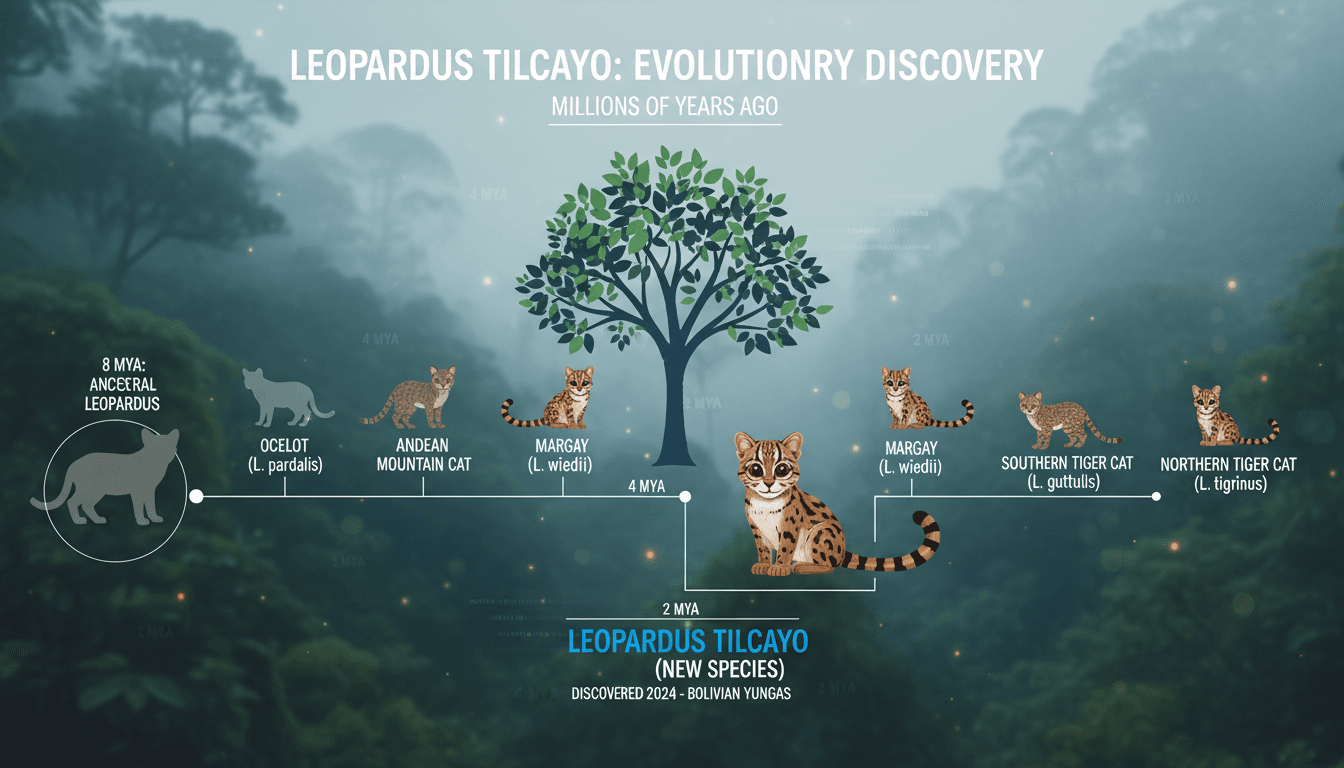
- Genomic analysis revealed a 1.4-million-year divergence from related tiger cats, confirming its status as a distinct species.
- The species was identified in Bolivia's Yungas cloud forest, with local communities having long recognized it as the tilcayo.
The context you actually need
- The last new felid species was described in 1923, making this discovery significant in the field of taxonomy.
- Genomic tools have revolutionized species identification, allowing for more accurate classifications than traditional morphological methods.
- Local Bolivian communities had long used the name tilcayo, indicating a rich cultural connection to the species that was previously overlooked scientifically.
What's really happening
The formal description of Leopardus tilcayo marks a pivotal moment in wildlife conservation and biodiversity research. This discovery stems from a series of observations that began in 2017 when a local resident brought a kitten to the Senda Verde sanctuary in Bolivia. Biologist Paola Nogales-Ascarrunz noted discrepancies between this kitten and known tiger cat references, prompting further investigation.
By 2019, as part of a project to create a Bolivian cat species booklet, researchers intensified their efforts. Collaborating with geneticists, they applied whole-genome sequencing to both living animals and museum specimens. This advanced technique revealed that what was once thought to be a single species of tiger cat in South America was, in fact, five distinct species. The formal recognition of Leopardus tilcayo not only adds to the biodiversity catalog but also underscores the evolutionary history of these felids, with a divergence of 1.4 million years from their closest relatives.
The implications of this discovery extend beyond taxonomy. It highlights the importance of preserving habitats like the Yungas cloud forest, which are critical for the survival of not just the tilcayo but potentially many other undiscovered species. The scientific community has expressed surprise at the rarity of new felid descriptions, suggesting that there may be additional small cat species yet to be identified in South America. This discovery could catalyze further research and conservation efforts in the region, emphasizing the need for ongoing ecological studies.
While there are currently no immediate governmental policy changes or market shifts reported, the ongoing care for the sole known captive individual at the sanctuary and planned field surveys signal a commitment to understanding and protecting this newly recognized species. The excitement surrounding Leopardus tilcayo serves as a reminder of the rich biodiversity that still exists and the urgent need to protect it.
Who feels it first (and how)
- Conservationists: Increased focus on habitat preservation and species protection efforts.
- Local communities: Potential for ecotourism and cultural recognition tied to the tilcayo.
- Researchers and biologists: Opportunities for further studies and discoveries in biodiversity.
What to watch next
- Field surveys: Ongoing research efforts to locate additional wild populations of Leopardus tilcayo will be crucial for understanding its ecological role.
- Conservation initiatives: Watch for new policies or funding aimed at protecting the Yungas cloud forest and its biodiversity.
- Public interest: Increased awareness and engagement in biodiversity issues could lead to more support for conservation efforts globally.
Leopardus tilcayo is a distinct species with a significant evolutionary history.
Additional undiscovered small cat species may exist in South America.
The long-term impact of this discovery on conservation policies and local economies.
Frequently Asked Questions
- Why it matters?
- The discovery of a new wild cat species highlights the ongoing need for biodiversity conservation and the potential for undiscovered species that could influence ecological balance.
- What happened (in 30 seconds)?
- On September 17, 2026, scientists formally described Leopardus tilcayo, the first new wild cat species in over a century. Genomic analysis revealed a 1.4-million-year divergence from related tiger cats, confirming its status as a distinct species. The species was identified in Bolivia's Yungas cloud forest, with local communities having long recognized it as the tilcayo.
- What's really happening?
- The formal description of Leopardus tilcayo marks a pivotal moment in wildlife conservation and biodiversity research. This discovery stems from a series of observations that began in 2017 when a local resident brought a kitten to the Senda Verde sanctuary in Bolivia. Biologist Paola Nogales-Ascarrunz noted discrepancies between this kitten and known tiger cat references, prompting further investigation. By 2019, as part of a project to create a Bolivian cat species booklet, researchers intensi
- Who feels it first (and how)?
- Conservationists: Increased focus on habitat preservation and species protection efforts. Local communities: Potential for ecotourism and cultural recognition tied to the tilcayo. Researchers and biologists: Opportunities for further studies and discoveries in biodiversity.
- What to watch next?
- Field surveys: Ongoing research efforts to locate additional wild populations of Leopardus tilcayo will be crucial for understanding its ecological role. Conservation initiatives: Watch for new policies or funding aimed at protecting the Yungas cloud forest and its biodiversity. Public interest: Increased awareness and engagement in biodiversity issues could lead to more support for conservation efforts globally.
News across North, Central, and South America including politics and economics.
"France 24 is viewed as a globally focused outlet with balanced coverage and a European perspective."
— A47 Editor
Scientists discover first new wild cat in more than 100 years
Scientists have identified a new species of wild cat, named Leopardus tilcayo, in Bolivia's Yungas forest, marking the first formal description of a new feline species in over a century. This small, spotted cat had been living at a wildlife sanctuary...
Global news coverage with extensive reporting on Middle Eastern conflicts and geopolitics.
"Al Jazeera is a Qatar-based broadcaster known for wide regional coverage and alternative perspectives."
— A47 Editor
New cat species found, first in more than 100 years
A new species of living cat has been identified for the first time in over a century, marking a significant discovery in the field of zoology. This finding highlights the ongoing exploration and understanding of biodiversity in the animal kingdom.
Comprehensive coverage of Middle Eastern and global issues.
"Al Jazeera is a prominent voice from the Global South, especially the Middle East, with an emphasis on underreported stories."
— A47 Editor
New cat species found, first in more than 100 years
A new species of living cat has been identified for the first time in over a century, marking a significant discovery in the field of zoology. This finding highlights the ongoing exploration and understanding of biodiversity in the animal kingdom.
Tech industry news, innovation, gadgets, and startups from a UK broadcaster.
"Sky News is often seen as a center-right outlet in the UK, known for its rolling coverage and breaking stories."
— A47 Editor
New species of wild cat identified in Bolivia - first for more than 100 years
A new species of wild cat, named Leopardus tilcayo, has been identified in Bolivia's Yungas forest, marking the first formal description of a new feline species in over a century. This small wild cat, measuring approximately 18 inches long and weighi...
International news, politics, and culture.
"Sky News is a UK-based 24-hour channel known for fast-breaking news and political coverage."
— A47 Editor
New species of wild cat identified in Bolivia - first for more than 100 years
A new species of wild cat, named Leopardus tilcayo, has been identified in Bolivia's Yungas forest, marking the first formal description of a new feline species in over a century. This small wild cat, measuring approximately 18 inches long and weighi...