
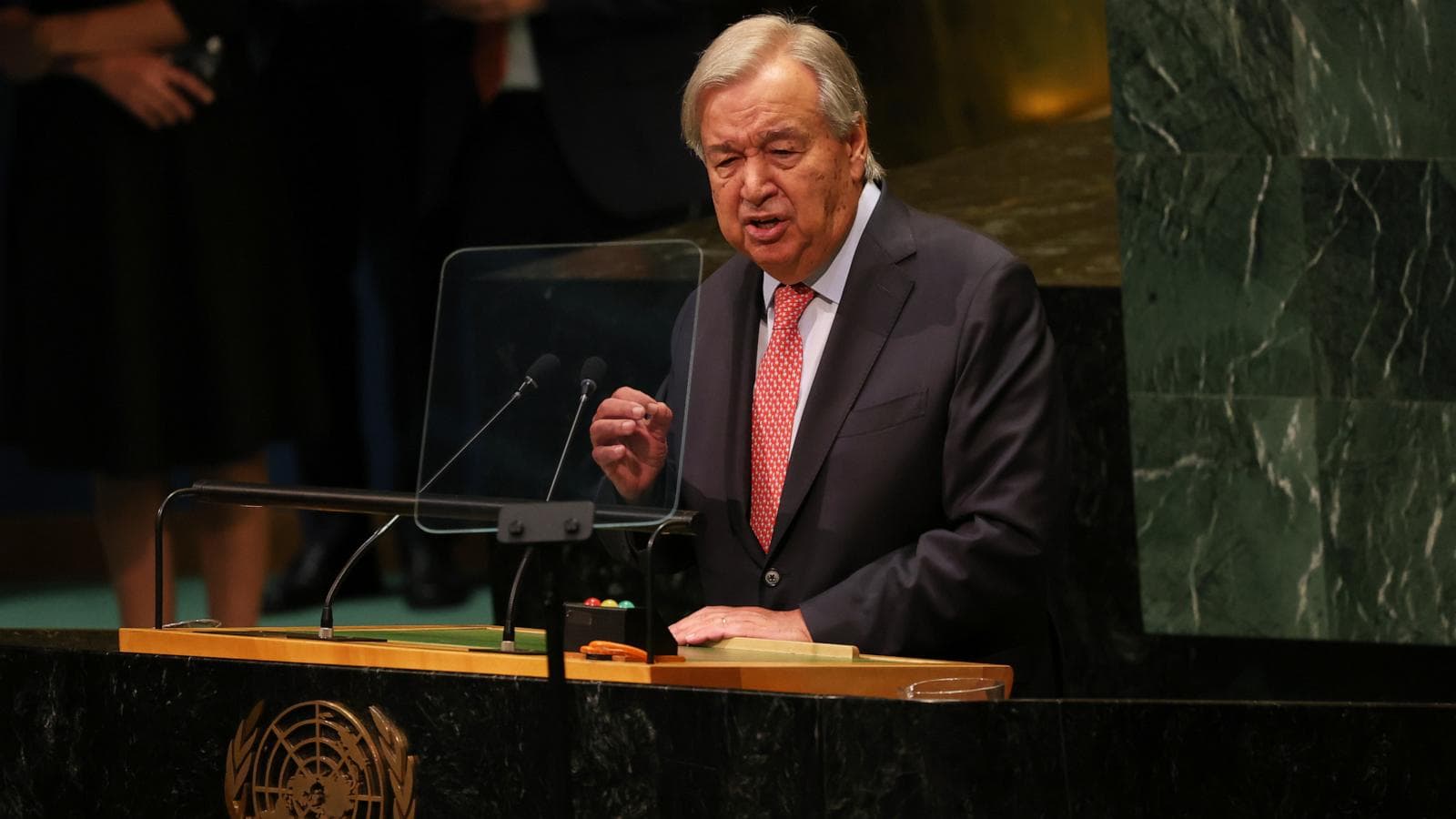
Guterres Urges Global Cooperation in Farewell Address at UN General Assembly
Why it matters
The address underscores the urgent need for collaborative frameworks to tackle global challenges, affecting economic stability and social equity.
What happened (in 30 seconds)
- Guterres delivered a farewell address at the UN General Assembly, emphasizing the need for cooperation amid rising global fragmentation.
- He identified key power shifts including the rise of multipolarity, influence of private entities, and the role of AI in exacerbating inequalities.
- The speech concluded with a call to action for leaders to reject rival blocs and uphold international law to address existential threats.
The context you actually need
- Geopolitical fragmentation is intensifying, with ongoing conflicts in Ukraine, the Middle East, and other regions, complicating international relations.
- Climate change impacts are accelerating, with a near-certain breach of the 1.5°C threshold, threatening global stability and economic systems.
- The UN is undergoing reform discussions to adapt to 21st-century realities, moving away from outdated post-World War II structures.
What's really happening
Guterres' farewell address at the 81st UN General Assembly highlights a critical juncture in global governance. The world is witnessing a shift from a unipolar to a multipolar landscape, where power is increasingly diffused among various state and non-state actors. This fragmentation poses significant risks, including the potential for rival blocs to emerge, which could lead to economic and security divides.
The Secretary-General articulated four primary tests of power: war and peace, climate chaos, artificial intelligence, and wealth concentration. Each of these areas reflects systemic vulnerabilities that require coordinated international responses. For instance, the ongoing conflicts in Ukraine and the Middle East illustrate the limitations of military power in resolving disputes, while the climate crisis demands urgent collective action to mitigate its impacts.
Moreover, the rapid development of artificial intelligence presents both opportunities and challenges. Guterres called for accountability in AI governance, emphasizing the need for regulations to prevent misuse, particularly concerning lethal autonomous weapons. This is crucial as AI continues to reshape industries and labor markets, potentially exacerbating existing inequalities.
The address also touched on intergenerational equity, highlighting how climate change disproportionately affects younger generations. This aspect is particularly relevant for Dubai residents, who face climate risks such as extreme heat and rising sea levels. The lack of international cooperation on emissions reductions could have direct consequences on the UAE's economy and social fabric.
Guterres' emotional appeal to uphold international law and human rights resonates in a world where these principles are increasingly under threat. His call for reform of the UN Charter-based system reflects a broader recognition that existing frameworks may not adequately address contemporary challenges. The urgency of these reforms is underscored by the ongoing debates within the UN regarding its structure and effectiveness.
In summary, Guterres' farewell address serves as a clarion call for global leaders to prioritize collaboration over competition. The implications of this shift are profound, affecting everything from international trade to climate policy and technological governance.
Who feels it first (and how)
- Global leaders: They must navigate the complexities of a multipolar world and respond to calls for cooperation.
- Businesses in tech and climate sectors: They face regulatory changes and market shifts influenced by international agreements.
- Youth and future generations: They will bear the brunt of climate impacts and inequality if current trends continue.
- Residents of Dubai: As part of a global hub, they may experience indirect effects from stalled international cooperation on emissions and economic policies.
What to watch next
- UN reform discussions: Monitoring the outcomes of these discussions will indicate how effectively the UN adapts to current global realities.
- International climate agreements: Watch for developments in global emissions reduction commitments, particularly in light of Guterres' warnings.
- AI governance frameworks: The establishment of regulations around AI will shape the future of technology and its impact on labor markets.
The world is facing significant challenges related to climate change and geopolitical fragmentation.
Increased calls for multilateral cooperation and reform of international institutions will emerge.
The specific outcomes of ongoing conflicts and their impact on global stability remain uncertain.
Frequently Asked Questions
- Why it matters?
- The address underscores the urgent need for collaborative frameworks to tackle global challenges, affecting economic stability and social equity.
- What happened (in 30 seconds)?
- Guterres delivered a farewell address at the UN General Assembly, emphasizing the need for cooperation amid rising global fragmentation. He identified key power shifts including the rise of multipolarity, influence of private entities, and the role of AI in exacerbating inequalities. The speech concluded with a call to action for leaders to reject rival blocs and uphold international law to address existential threats.
- What's really happening?
- Guterres' farewell address at the 81st UN General Assembly highlights a critical juncture in global governance. The world is witnessing a shift from a unipolar to a multipolar landscape, where power is increasingly diffused among various state and non-state actors. This fragmentation poses significant risks, including the potential for rival blocs to emerge, which could lead to economic and security divides. The Secretary-General articulated four primary tests of power: war and peace, climate c
- Who feels it first (and how)?
- Global leaders: They must navigate the complexities of a multipolar world and respond to calls for cooperation. Businesses in tech and climate sectors: They face regulatory changes and market shifts influenced by international agreements. Youth and future generations: They will bear the brunt of climate impacts and inequality if current trends continue. Residents of Dubai: As part of a global hub, they may experience indirect effects from stalled international cooperation on emissions and
- What to watch next?
- UN reform discussions: Monitoring the outcomes of these discussions will indicate how effectively the UN adapts to current global realities. International climate agreements: Watch for developments in global emissions reduction commitments, particularly in light of Guterres' warnings. AI governance frameworks: The establishment of regulations around AI will shape the future of technology and its impact on labor markets.
Major U.S. developments and regional news.
"ABC News delivers broad national coverage with a mainstream editorial stance, focusing on accessibility and balanced reporting."
— A47 Editor
UN chief says power has polarized the world and urges leaders to cooperate
U.N. Secretary-General Antonio Guterres has called on global leaders to collaborate in addressing critical challenges such as the climate crisis, the rapid advancement of artificial intelligence, and growing inequalities. He emphasized that the curre...
Global business headlines with AI angles.
"General business outlet that frequently covers AI."
— A47 Editor
Antonio Guterres Delivered His Final UNGA Address. He Called For AI Regulation.
Antonio Guterres delivered his final address at the United Nations General Assembly (UNGA), emphasizing the urgent need for global cooperation in regulating artificial intelligence (AI). He called for countries leading the technological revolution to...
24/7 international news from a French perspective in multiple languages.
"France 24 is viewed as a globally focused outlet with balanced coverage and a European perspective."
— A47 Editor
REPLAY: UN chief Guterres makes final address to the General Assembly
United Nations Secretary-General Antonio Guterres delivered his final address to the General Assembly, emphasizing the urgent need for global leaders to regulate artificial intelligence, end ongoing conflicts, and prioritize climate change. He also c...
News and features on AI from The Guardian.
"Progressive-leaning international outlet with critical AI coverage."
— A47 Editor
Superpowers cannot solve world’s problems, UN chief says in final general assembly address
In his final address to the UN General Assembly, António Guterres highlighted the inability of superpowers to address global challenges, emphasizing the unprecedented convergence of threats that humanity faces. He lamented the ongoing wars, human rig...
Tech culture, product news, and critical takes on the tech industry's social impact.
"The Guardian's tech coverage blends mainstream news, critical analysis, and cultural commentary on emerging technologies and digital trends."
— A47 Editor
Superpowers cannot solve world’s problems, UN chief says in final general assembly address
In his final address to the UN General Assembly, António Guterres highlighted the inability of superpowers to address global challenges, emphasizing the unprecedented convergence of threats that humanity faces. He lamented the ongoing wars, human rig...
Top international stories selected by The Guardian editors.
"The Guardian is known for its progressive editorial stance and in-depth analysis."
— A47 Editor
Superpowers cannot solve world’s problems, UN chief says in final general assembly address
In his final address to the UN General Assembly, António Guterres highlighted the inability of superpowers to address global challenges, emphasizing the unprecedented convergence of threats that humanity faces. He lamented the ongoing wars, human rig...