
Trump Offers US Support to Russia Amid Pneumonic Plague Concerns
Why it matters
This incident highlights the interconnectedness of global health security and international relations, potentially affecting public health policies worldwide.
What happened (in 30 seconds)
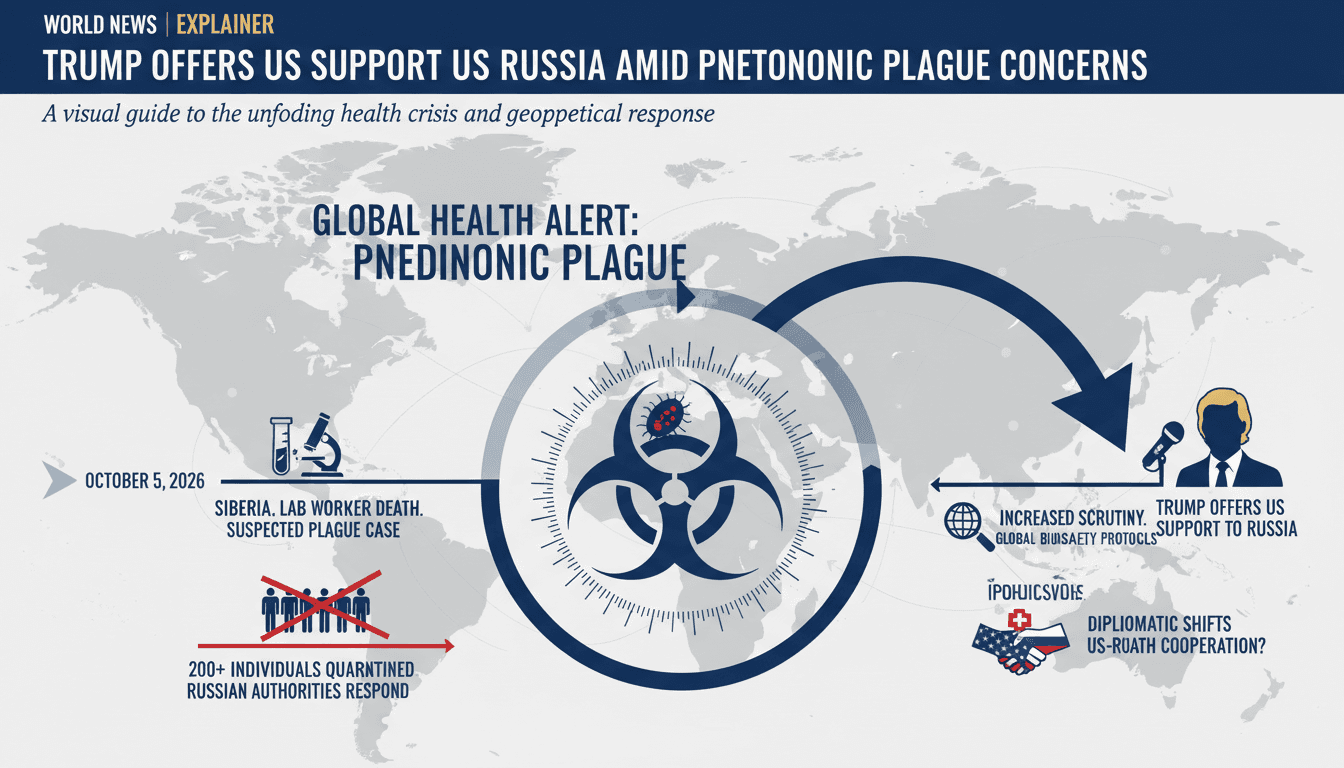
- On October 5, 2026, President Trump offered US assistance to Russia following the death of a lab worker in Siberia, suspected to be linked to pneumonic plague.
- Russian authorities quarantined nearly 200 individuals who had contact with the deceased, while denying any lab accident involving pathogens.
- The World Health Organization assessed the public risk as low, despite ongoing monitoring and calls for transparency from US officials.
The context you actually need
- Pneumonic plague, caused by Yersinia pestis, is a rare but treatable bacterial infection, with natural cases occurring in regions like Siberia.
- US-Russia relations are strained due to geopolitical tensions, particularly over the war in Ukraine, complicating collaborative health responses.
- Laboratory biosafety has come under scrutiny globally, especially following past pandemic-related lab-leak hypotheses, raising concerns about pathogen management.
What's really happening
The recent incident in Siberia underscores a complex interplay of public health, international diplomacy, and scientific oversight. The death of Darya Shipilova, a 28-year-old technician at the Irkutsk Anti-Plague Research Institute, has raised alarms not only in Russia but also in the United States, where officials are closely monitoring the situation. Shipilova reportedly fell ill after possible exposure to plague bacteria, leading to her death from pneumonia of unknown etiology.
Russian media speculated about a potential lab accident involving test-tube breakage, prompting authorities to quarantine a hospital and observe nearly 200 individuals who had contact with her. However, Russian officials have firmly denied any link to a lab accident, attributing her death to unrelated pneumonia. This denial reflects a broader trend of governmental reluctance to acknowledge potential biosafety failures, particularly in a politically charged environment.
President Trump’s comments, made during a press briefing, indicate a willingness to assist Russia, which could be seen as an attempt to foster cooperation amid ongoing tensions. His remarks about microbes becoming "stronger and smarter" highlight a growing concern among health officials regarding antibiotic resistance and the evolving nature of infectious diseases. The US State Department has echoed these sentiments, emphasizing the need for transparency and information sharing from Russian authorities.
The World Health Organization has also weighed in, stating that the cause of the illness remains unconfirmed and that the public risk is low. This assessment is crucial, as it helps to mitigate panic and maintain public confidence in health systems. However, the situation remains fluid, with ongoing monitoring and calls for clarity from both US and international health officials.
The incident serves as a reminder of the vulnerabilities inherent in global health systems, particularly in regions where laboratory safety protocols may be under scrutiny. As the world grapples with the aftermath of the COVID-19 pandemic, the need for robust biosafety measures and transparent communication becomes increasingly critical. The potential for a public health crisis stemming from a laboratory incident could have far-reaching implications, not only for Russia but for global health security as a whole.
Who feels it first (and how)
- Public health officials: Increased scrutiny on laboratory safety and pathogen management protocols.
- Travel and tourism sectors: Potential shifts in travel advisories and public perception of safety in affected regions.
- International relations experts: Heightened focus on US-Russia diplomatic interactions and their implications for global health cooperation.
What to watch next
- Monitoring updates from the WHO: Their assessments will guide public health responses and inform travel advisories.
- US-Russia diplomatic communications: Any shifts in cooperation could signal changes in global health strategies.
- Emerging reports on antibiotic resistance: Increased focus on microbial threats could reshape health policies and funding.
The death of a lab worker in Russia has raised international health concerns.
Continued monitoring and calls for transparency from health authorities will persist.
The long-term implications for US-Russia relations and global health security remain uncertain.
Frequently Asked Questions
- Why it matters?
- This incident highlights the interconnectedness of global health security and international relations, potentially affecting public health policies worldwide.
- What happened (in 30 seconds)?
- On October 5, 2026, President Trump offered US assistance to Russia following the death of a lab worker in Siberia, suspected to be linked to pneumonic plague. Russian authorities quarantined nearly 200 individuals who had contact with the deceased, while denying any lab accident involving pathogens. The World Health Organization assessed the public risk as low, despite ongoing monitoring and calls for transparency from US officials.
- What's really happening?
- The recent incident in Siberia underscores a complex interplay of public health, international diplomacy, and scientific oversight. The death of Darya Shipilova, a 28-year-old technician at the Irkutsk Anti-Plague Research Institute, has raised alarms not only in Russia but also in the United States, where officials are closely monitoring the situation. Shipilova reportedly fell ill after possible exposure to plague bacteria, leading to her death from pneumonia of unknown etiology. Russian med
- Who feels it first (and how)?
- Public health officials: Increased scrutiny on laboratory safety and pathogen management protocols. Travel and tourism sectors: Potential shifts in travel advisories and public perception of safety in affected regions. International relations experts: Heightened focus on US-Russia diplomatic interactions and their implications for global health cooperation.
- What to watch next?
- Monitoring updates from the WHO: Their assessments will guide public health responses and inform travel advisories. US-Russia diplomatic communications: Any shifts in cooperation could signal changes in global health strategies. Emerging reports on antibiotic resistance: Increased focus on microbial threats could reshape health policies and funding.
Capitol Hill news, legislation, and policy insight.
"The Hill specializes in U.S. politics and policy, with a focus on Capitol Hill developments and a reputation for insider reporting."
— A47 Editor
Trump says Russia plague reports concerning: Microbes 'stronger and smarter'
President Trump expressed concern over a suspected case of pneumonic plague in Irkutsk Oblast, Russia, stating that the U.S. is monitoring the situation closely. This follows the death of a 28-year-old woman working at an anti-plague laboratory, whic...
Global news coverage with extensive reporting on Middle Eastern conflicts and geopolitics.
"Al Jazeera is a Qatar-based broadcaster known for wide regional coverage and alternative perspectives."
— A47 Editor
Trump says US ready to aid Russia with plague outbreak in Siberia
U.S. President Donald Trump announced that the United States is prepared to assist Russia in response to a suspected pneumonic plague outbreak in Siberia, where a hospital has been quarantined following the death of a female laboratory worker at the ...
Comprehensive coverage of Middle Eastern and global issues.
"Al Jazeera is a prominent voice from the Global South, especially the Middle East, with an emphasis on underreported stories."
— A47 Editor
Trump says US ready to aid Russia with plague outbreak in Siberia
U.S. President Donald Trump announced that the United States is prepared to assist Russia in response to a suspected pneumonic plague outbreak in Siberia, where a hospital has been quarantined following the death of a female laboratory worker at the ...
Tech industry news, innovation, gadgets, and startups from a UK broadcaster.
"Sky News is often seen as a center-right outlet in the UK, known for its rolling coverage and breaking stories."
— A47 Editor
US 'closely monitoring' after Russian lab worker 'dies of suspected plague'
The U.S. government is closely monitoring the situation following the death of a female laboratory worker in Russia, who may have been exposed to pneumonic plague. The worker was employed at an anti-plague laboratory, and her death has raised concern...
International news, politics, and culture.
"Sky News is a UK-based 24-hour channel known for fast-breaking news and political coverage."
— A47 Editor
US 'closely monitoring' after Russian lab worker 'dies of suspected plague'
The U.S. government is closely monitoring the situation following the death of a female laboratory worker in Russia, who may have been exposed to pneumonic plague. The worker was employed at an anti-plague laboratory, and her death has raised concern...