
Teghaza 001 Martian Meteorite Dated to 4.11 Billion Years Reveals Ancient Crust and Early Hydrothermal Activity on Mars
Why it matters
The discovery of a 4.11-billion-year-old crustal rock proves that ancient, water-altered Martian material can survive impact ejection to Earth, shifting baseline geological models that guide multi-billion-dollar planetary exploration programs.
What happened (in 30 seconds)
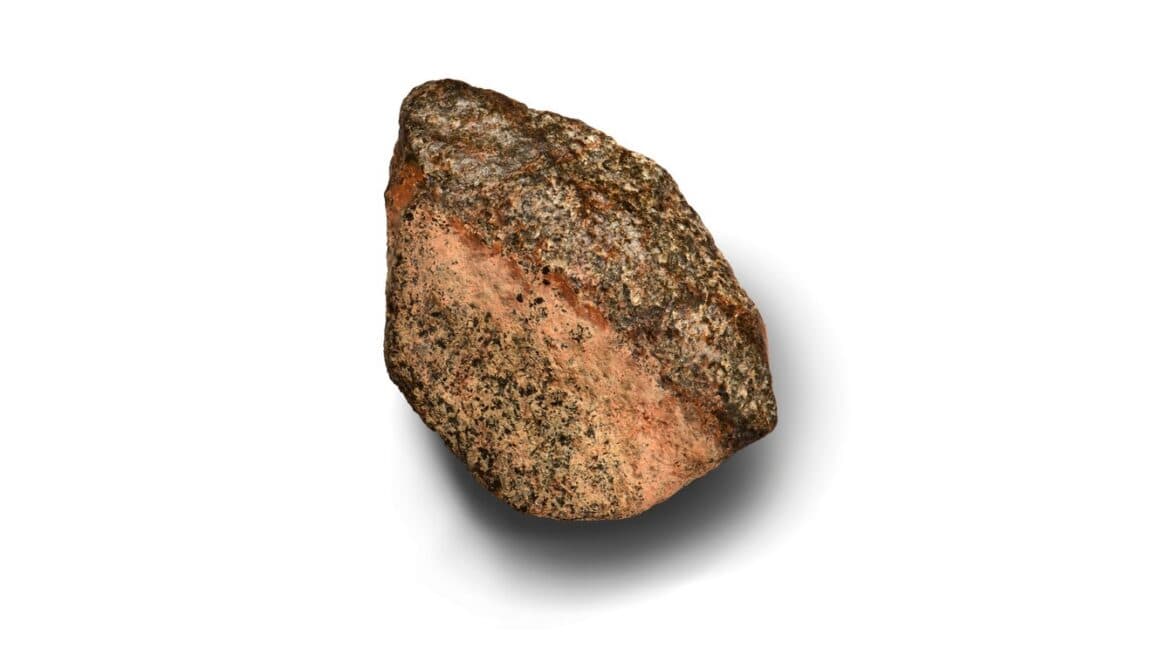
- A rare ancient sample was identified: Researchers analyzed Teghaza 001, a 799-gram Martian meteorite collected in Mali across eight fragments, confirming its origin via oxygen isotope analysis.
- Radiometric dating established a 4.11-billion-year age: Zircon crystal analyses directed by Yang Liu of NASA's Jet Propulsion Laboratory dated the rock to Mars' primordial era, making it one of only three known specimens from this period.
- Hydrothermal signatures were verified: The plagioclase-rich gabbroic diorite displays definitive chemical evidence of pre-ejection water-rock interactions within the slowly cooled early Martian crust.
The context you actually need
- Younger specimens dominate existing collections: The majority of Martian meteorites found on Earth belong to younger classifications—shergottites, nakhlites, and chassignites—dated under 2.4 billion years old.
- Surface data conflicts with physical inventory: Orbital crater-counting shows over 50 percent of the Martian surface exceeds 3 billion years in age, exposing an enduring historical bias in Earth's meteorite record.
- Only two comparable rocks existed prior: Before Teghaza 001, Allan Hills 84001 and the polymict breccia Northwest Africa 7034 ("Black Beauty") served as the sole physical benchmarks for Mars' earliest epoch.
What's really happening
The physical inventory of Martian geology accessible in Earth laboratories has long been skewed by the physics of dynamic impact events. When asteroids strike Mars, the shockwaves selectively eject younger, structurally coherent volcanic rocks into escape trajectories while obliterating or filtering out softer, heavily fractured ancient crust. As a result, the primary geological models governing early planetary formation have relied heavily on remote sensing from orbital probes, with direct laboratory calibration constrained by just two ancient specimens: Allan Hills 84001 and the polymict breccia Northwest Africa 7034.
Teghaza 001 alters that empirical baseline. Recovered north of Taghaza, Mali, and classified as a plagioclase-rich gabbroic diorite, the rock cooled slowly as an intrusive igneous body deep within Mars' primordial crust. By deploying multiple radiometric systems, including U-Pb dating of zircon crystals, the research team led by Yang Liu alongside co-authors Carl Agee, Karen Ziegler, Lee Saper, and Francois Tissot established a precise weighted average age of 4.11 billion years.
This dating places the formation of Teghaza 001 squarely in the Noachian era. Crucially, the petrographic and isotopic analysis reveals clear traces of aqueous alteration that occurred before the rock was launched into interplanetary space. This demonstrates that volatile-rich hydrothermal fluids circulated through the deep Martian crust during its formative window, directly corroborating models of an early planetary environment capable of sustaining liquid water networks.
For planetary scientists and mission planners, physical rocks provide analytical resolutions that rovers cannot replicate. Laboratory instruments can isolate mineral phases at the sub-micron scale, measuring isotopic ratios that quantify exact temperatures, pressures, and fluid chemistries. The presence of unaltered zircon grains within an intact gabbroic matrix provides an uncorrupted geochemical timeline. It confirms that intact fragments of the primordial Noachian crust can remain structurally viable through violent spallation processes, survive millions of years of space exposure, and endure atmospheric transit through Earth's atmosphere.
Who feels it first (and how)
- Planetary geochemists and laboratory networks: Research teams gain access to an intact 799-gram intrusive rock that delivers direct baseline data on early planetary differentiation and volatile distribution.
- Space agency mission architects: Program designers at organizations evaluating surface targets can refine remote sensor calibrations against confirmed ground-truth physical chemistry.
- Academic and institutional collections: Curators and analytical facilities face renewed incentives to re-screen unidentified desert finds for ancient isotopic anomalies previously assumed to be standard shergottites.
What to watch next
- Secondary mineral geochemical releases: Forthcoming isotopic datasets tracking secondary alteration minerals will measure the exact temperature and fluid-rock ratios of ancient Martian hydrothermal systems.
- Impact-ejection modeling revisions: Dynamic simulations of spallation physics will incorporate gabbroic diorite shear strengths to evaluate how much ancient material successfully leaves Mars during impact events.
- Peer-reviewed comparative studies: Cross-laboratory benchmarking between Teghaza 001, Allan Hills 84001, and Black Beauty will pinpoint whether early water-rock alteration was localized or systemic across Mars' early crust.
Teghaza 001 was recovered in Mali in 2022, weighs roughly 799 grams, holds a zircon U-Pb age of 4.11 billion years, and exhibits verified pre-terrestrial aqueous alteration signatures.
The rock originated from an ancient highland terrane where intrusive igneous bodies cooled at depth before being excavated by an asteroid impact.
The exact geographic crater on Mars from which the rock was ejected, and the total duration of the hydrothermal circulation that left alteration products in its mineral matrix.
Frequently Asked Questions
- Why it matters?
- The discovery of a 4.11-billion-year-old crustal rock proves that ancient, water-altered Martian material can survive impact ejection to Earth, shifting baseline geological models that guide multi-billion-dollar planetary exploration programs.
- What happened (in 30 seconds)?
- A rare ancient sample was identified: Researchers analyzed Teghaza 001, a 799-gram Martian meteorite collected in Mali across eight fragments, confirming its origin via oxygen isotope analysis. Radiometric dating established a 4.11-billion-year age: Zircon crystal analyses directed by Yang Liu of NASA's Jet Propulsion Laboratory dated the rock to Mars' primordial era, making it one of only three known specimens from this period. Hydrothermal signatures were verified: The plagioclase-rich gabbroi
- What's really happening?
- The physical inventory of Martian geology accessible in Earth laboratories has long been skewed by the physics of dynamic impact events. When asteroids strike Mars, the shockwaves selectively eject younger, structurally coherent volcanic rocks into escape trajectories while obliterating or filtering out softer, heavily fractured ancient crust. As a result, the primary geological models governing early planetary formation have relied heavily on remote sensing from orbital probes, with direct labo
- Who feels it first (and how)?
- Planetary geochemists and laboratory networks: Research teams gain access to an intact 799-gram intrusive rock that delivers direct baseline data on early planetary differentiation and volatile distribution. Space agency mission architects: Program designers at organizations evaluating surface targets can refine remote sensor calibrations against confirmed ground-truth physical chemistry. Academic and institutional collections: Curators and analytical facilities face renewed incentives to re-scr
- What to watch next?
- Secondary mineral geochemical releases: Forthcoming isotopic datasets tracking secondary alteration minerals will measure the exact temperature and fluid-rock ratios of ancient Martian hydrothermal systems. Impact-ejection modeling revisions: Dynamic simulations of spallation physics will incorporate gabbroic diorite shear strengths to evaluate how much ancient material successfully leaves Mars during impact events. Peer-reviewed comparative studies: Cross-laboratory benchmarking between Teghaza
Conservative-leaning political and national coverage.
"The Washington Times is a conservative-leaning newspaper known for its political coverage and advocacy of right-of-center viewpoints."
— A47 Editor
Meteorite found in Sahara Desert is from Mars dating back 4 billion years
NASA-funded scientists have determined that a meteorite found four years ago in Mali's Sahara Desert is an ancient piece of Mars crust dating back about 4 billion years, according to reporting by The Washington Times.
Scientific research, space, environment, and health coverage.
"The New York Times is a globally recognized newspaper offering authoritative reporting with a center-left editorial stance."
— A47 Editor
A Meteorite Found in the Sahara Is a 4.1-Billion-Year-Old Piece of Mars
A meteorite recovered in the Sahara Desert has been identified as a roughly 4.1-billion-year-old fragment of Mars, according to reporting by The New York Times. The minerals within the rock offer clues about the early history of the red planet, a per...
In-depth reporting on tech, policy, and science including AI.
"Respected analysis for technically savvy readers, including AI topics."
— A47 Editor
Rare meteorite from Mars gives us a view into its ancient crust
A meteorite discovered in the Sahara Desert has been identified as a rare fragment of Mars' ancient crust, offering scientists a direct look at the planet's early geological composition, as reported by Ars Technica.
In-depth coverage of hardware, software, science, and policy.
"Ars Technica provides expert technology news, hardware reviews, and analysis for a technically savvy audience."
— A47 Editor
Rare meteorite from Mars gives us a view into its ancient crust
A meteorite discovered in the Sahara Desert has been identified as a rare fragment of Mars' ancient crust, offering scientists a direct look at the planet's early geological composition, as reported by Ars Technica.