
US-Iran Tensions Escalate Toward Possible Renewed Military Strikes as Strait of Hormuz Remains Contested
Why it matters
The friction over the Strait of Hormuz directly links Gulf maritime passage with global energy stability and supply chain pricing.
What happened (in 30 seconds)
- High-level military evaluations resumed: On November 5, 2026, President Donald Trump met with national security advisors as CENTCOM finalized operational plans for potential strikes against Iran.
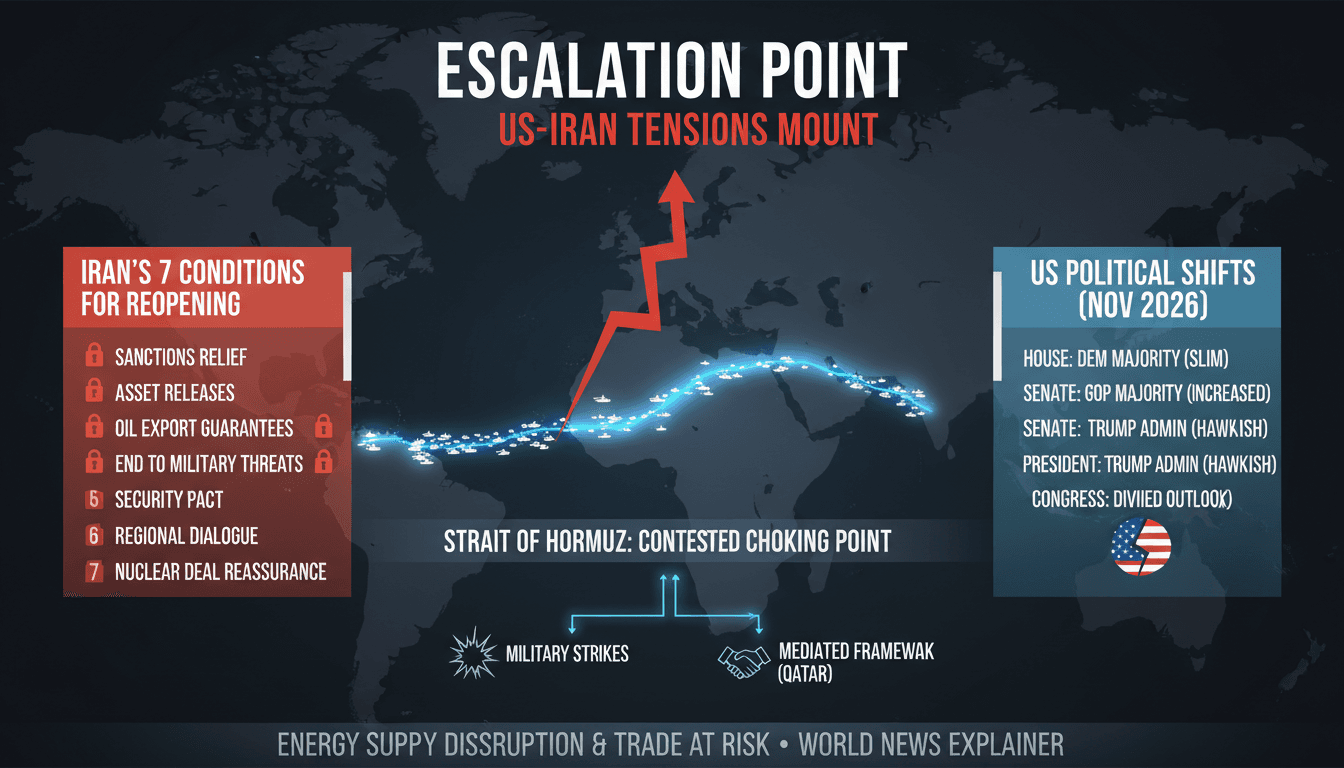
- Tehran tied maritime transit to seven demands: Iranian Supreme Leader Mojtaba Khamenei ordered rapid retaliatory preparations and stated that reopening the Strait of Hormuz requires meeting 7 distinct conditions, including sanctions relief and asset releases.
- Diplomatic channels remain active amid pressure: While Israeli Prime Minister Benjamin Netanyahu urged Washington to launch fresh strikes, an Iranian nuclear proposal was simultaneously conveyed through Qatari mediators.
The context you actually need
- The campaign began nine months prior: Current developments follow military operations launched in February 2026 by the US and Israel, which killed former Supreme Leader Ali Khamenei and degraded Iranian military infrastructure.
- US midterm results reshuffled incentives: November 2026 election outcomes reduced Republican majorities in Congress, altering the legislative cost-benefit calculations for prolonged military engagements.
- Operational control remains contested: Washington asserts that it has controlled key strategic files within Iran since operations escalated seven months ago, while Tehran points to Washington's political and economic exposure.
What's really happening
The standoff between Washington and Tehran operates on dual tracks: active military posturing and structured economic leverage. Following the US midterm elections in early November 2026, both governments face shifting internal incentives. Washington's stated objective remains preventing Iranian nuclear weapon development, with CENTCOM maintaining strike-ready postures. However, reduced congressional majorities introduce legislative friction for sustained, resource-intensive overseas actions, prompting Tehran to factor Washington’s domestic political costs into its strategic calculus.
At the core of the immediate friction is the Strait of Hormuz. By formally conditioning the normal passage of maritime traffic on 7 specific requirements—chief among them the lifting of economic sanctions and the release of frozen capital assets—Tehran is converting regional waterway access into a primary bargaining chip. This mechanism targets global maritime commerce rather than direct US territory, exerting secondary economic pressure on international markets to influence Washington’s negotiating terms.
Simultaneously, the diplomatic track has not closed. The transmission of a nuclear proposal via Qatari mediators indicates that military preparation is serving as leverage for negotiated settlements rather than an inevitable march to full conflict. Tehran's public instructions to respond to any strike signal deterrence to prevent further degradation of its domestic assets. Conversely, calls from Israeli leadership urging the White House to execute further strikes underscore an external push to dismantle Iran’s remaining capabilities before any diplomatic window solidifies.
For the Gulf region, particularly logistics and financial centers like Dubai, this friction translates into practical exposure. Even without active kinetic exchanges, prolonged uncertainty around the Strait of Hormuz directly influences commercial war-risk premiums, bunker fuel pricing, and vessel routing timetables. The strategy relies not on closing the waterway indefinitely through direct confrontation, but on raising the risk profile of transit high enough that international stakeholders pressure all parties toward a settlement. The fundamental mechanism is an exchange of risk: Washington leverages potential asset destruction to curb nuclear enrichment, while Tehran leverages commercial shipping vulnerability to secure economic relief.
Who feels it first (and how)
- Maritime logistics operators and cargo carriers: Encountering rising war-risk insurance premiums, altered vessel schedules, and heightened operational screening in Gulf waters.
- Dubai-based trading houses and import-export firms: Managing fluctuating regional freight rates and potential supply chain re-routing costs tied to Strait of Hormuz access.
- Energy sector procurement heads: Navigating short-term spot market volatility and fuel surcharge adjustments driven by regional security announcements.
- Corporate treasury teams in regional financial hubs: Balancing currency and commodity exposure against potential sudden shifts in regional trade continuity.
What to watch next
- Response to the Qatari diplomatic channel: Monitoring whether Washington formally reviews Tehran's 7 conditions or rejects the framework entirely, establishing whether negotiation or escalation takes precedence.
- Commercial maritime transit volumes: Tracking vessel traffic density and war-risk insurance rate revisions through the Strait of Hormuz to measure commercial market confidence.
- Congressional committee posture on military authorizations: Observing how the newly balanced US Congress responds to CENTCOM operational readiness and executive defense spending requests.
CENTCOM has finalized plans for potential strikes, Iran has established 7 conditions for normalized Strait of Hormuz transit, and diplomatic proposals have been submitted through Qatar.
Energy prices and regional maritime insurance rates will experience localized volatility as long as operational strike preparations remain active without a formal diplomatic ceasefire.
Whether the newly structured US Congress will seek to constrain executive military action, or if mediator efforts will bridge the gap between nuclear disarmament and sanctions relief.
Frequently Asked Questions
- Why it matters?
- The friction over the Strait of Hormuz directly links Gulf maritime passage with global energy stability and supply chain pricing.
- What happened (in 30 seconds)?
- High-level military evaluations resumed: On November 5, 2026, President Donald Trump met with national security advisors as CENTCOM finalized operational plans for potential strikes against Iran. Tehran tied maritime transit to seven demands: Iranian Supreme Leader Mojtaba Khamenei ordered rapid retaliatory preparations and stated that reopening the Strait of Hormuz requires meeting 7 distinct conditions, including sanctions relief and asset releases. Diplomatic channels remain active amid press
- What's really happening?
- The standoff between Washington and Tehran operates on dual tracks: active military posturing and structured economic leverage. Following the US midterm elections in early November 2026, both governments face shifting internal incentives. Washington's stated objective remains preventing Iranian nuclear weapon development, with CENTCOM maintaining strike-ready postures. However, reduced congressional majorities introduce legislative friction for sustained, resource-intensive overseas actions, pro
- Who feels it first (and how)?
- Maritime logistics operators and cargo carriers: Encountering rising war-risk insurance premiums, altered vessel schedules, and heightened operational screening in Gulf waters. Dubai-based trading houses and import-export firms: Managing fluctuating regional freight rates and potential supply chain re-routing costs tied to Strait of Hormuz access. Energy sector procurement heads: Navigating short-term spot market volatility and fuel surcharge adjustments driven by regional security announcements
- What to watch next?
- Response to the Qatari diplomatic channel: Monitoring whether Washington formally reviews Tehran's 7 conditions or rejects the framework entirely, establishing whether negotiation or escalation takes precedence. Commercial maritime transit volumes: Tracking vessel traffic density and war-risk insurance rate revisions through the Strait of Hormuz to measure commercial market confidence. Congressional committee posture on military authorizations: Observing how the newly balanced US Congress respon
Arabic-language coverage of political affairs and current events.
"Okaz political coverage typically follows mainstream Saudi framing on national and regional affairs."
— A47 Editor
ترمب يهدد.. خامنئي يستنفر.. هل اقتربت الحرب بين واشنطن وطهران؟
Reports cite US officials saying President Donald Trump held a meeting with senior national security advisers to discuss Iran, while US Central Command (CENTCOM) finalizes military preparations in case combat operations resume; officials say the mili...
Pan-Arab political news and analysis.
"Al-Quds Al-Arabi is a London-based Arabic newspaper known for political coverage."
— A47 Editor
ترامب يجتمع مع فريق الأمن القومي ويقول إن قرار استئناف الحرب على إيران سيُتخذ “قريباً”
U.S. President Donald Trump said on Thursday that he will decide "soon" whether to resume the full-scale war on Iran, following a meeting with his senior national security advisers, according to a report by Axios cited by Al-Quds Al-Arabi. His remark...
Arabic-language coverage of Saudi, regional, and international affairs.
"Al Bilad offers mainstream Saudi newspaper coverage across domestic and broader Arab topics."
— A47 Editor
طهران تهدد بتوسيع نطاق التصعيد.. وترمب: حرب إيران سبب خسارة الجمهوريين بالكونغرس
Iran has threatened to widen the scope of any future military confrontation, warning that its response would not be limited to the sources of an attack but would extend further, while U.S. President Donald Trump acknowledged that the war with Iran pa...