
Iran Intensifies Internal Repression and Regime Rhetoric Following Republican Midterm Losses Amid Ongoing US-Israel Military Campaign
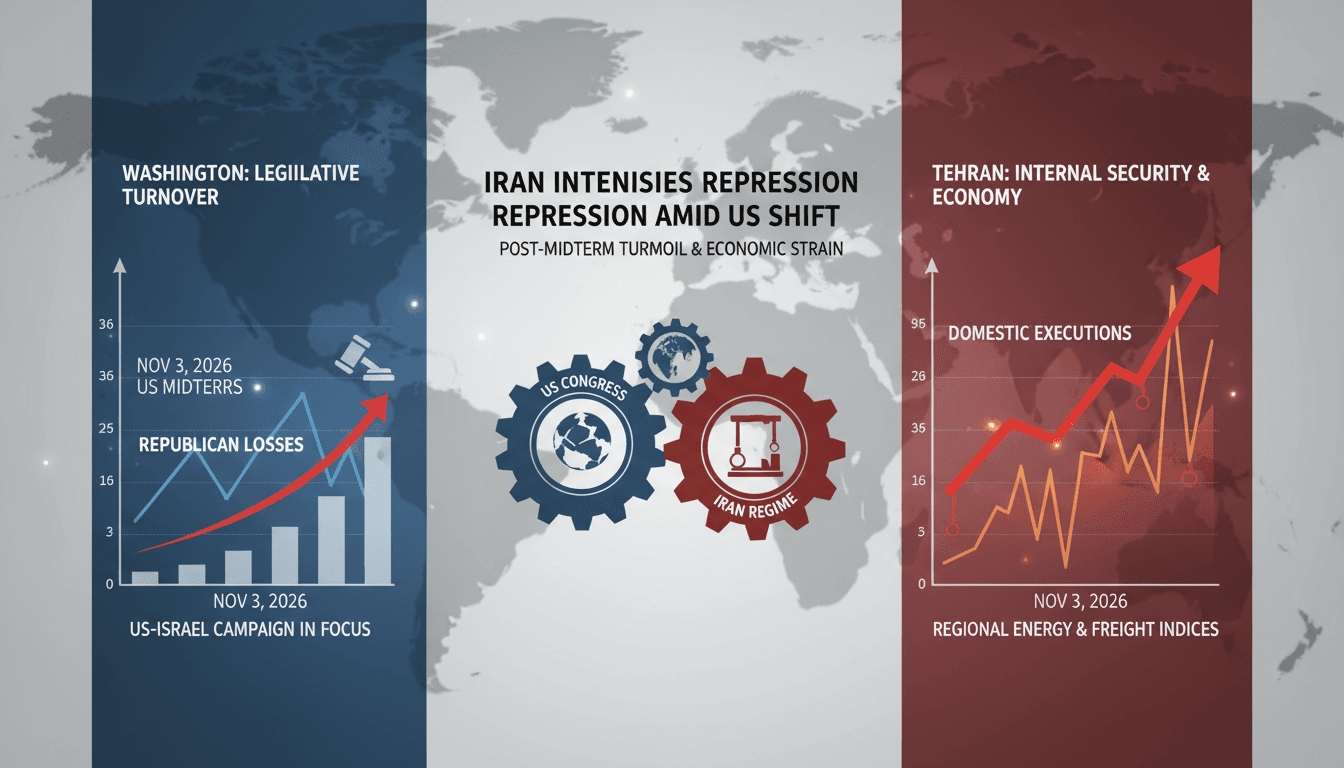
Regional security recalculations across Gulf transport lanes and energy corridors remain unresolved as domestic political incentives in Washington and Tehran diverge rather than de-escalate.
Why it matters
Shifts in domestic electoral control alter external military timelines, but they rarely ease internal pressure points in heavily sanctioned economies facing structural conflict.
What happened (in 30 seconds)
* Democratic victories reshaped Washington: The November 3, 2026, US midterm elections resulted in a decisive Democratic victory and Republican seat losses, driven largely by voter dissatisfaction with the eight-month US-Israel military campaign against Iran and its associated economic costs. * Tehran projected symbolic defiance: Pro-government groups staged demonstrations burning banners of US and Israeli leadership, while Supreme Leader Mojtaba Khamenei publicly characterized the election results as confirmation of accelerating American internal strain. * Domestic pressure remained unchanged: Civilians across Iranian metropolitan centers reported ongoing economic degradation and persistent domestic coercion, operating alongside at least 696 executions recorded in the country throughout 2026.
The context you actually need
* An eight-month kinetic campaign preceded the vote: The current posture follows sustained military operations launched in February 2026, which included strikes resulting in the death of former Supreme Leader Ali Khamenei and elevated regional tensions. * Energy pricing altered US voter tolerance: Public reaction in the United States hardened against extended foreign military entanglements as household balance sheets absorbed sustained pressure from elevated fuel costs and broader regional market volatility. * Leadership transition solidified internal controls: Following the succession to Mojtaba Khamenei, state institutions maintained aggressive internal security procedures to manage civic stability while facing international financial isolation and infrastructure risks.
What's really happening
The post-election environment does not indicate an immediate reduction in operational friction. Instead, it exposes a fundamental disconnect between external democratic feedback loops and domestic authoritarian incentives.
In representative political systems, sustained resource allocation toward external military conflicts carries high political liabilities. The November 3 US midterm results demonstrated that voter sensitivity to energy expenditures and regional entanglements can enforce rapid checks on governing parties. This shift introduces a transitional phase between the election date and the formal seating of the incoming Congress, creating short-term tactical windows where executive leadership evaluates whether to negotiate terms or accelerate kinetic operations before legislative oversight tightens.
Inside Iran, the operational incentives run in the opposite direction. Authoritarian governance under external military threat requires domestic consolidation rather than liberalization. State authorities have framed the electoral outcome as an ideological and tactical vindication of their resistant posture. However, this outward political confidence is paired with strict internal containment. The verified metric of at least 696 executions carried out in 2026 by domestic authorities reflects a baseline strategy designed to deter unrest amid failing infrastructure and compounding economic stress.
For international commerce and Gulf operations, this divergence eliminates the prospect of rapid stabilization. When an external adversary faces legislative constraints, an embattled regime does not automatically moderate; it frequently hardens its negotiating leverage. Meanwhile, civilians inside Iran continue adjusting daily operational routines to hedge against public utility failures and localized economic deterioration.
Because external strikes have eliminated senior political leadership earlier in 2026, the current governing apparatus prioritizes institutional continuity above all else. This dynamic incentivizes the regime to extract compliance through legal and physical enforcement domestically, while keeping external maritime and regional threat postures active to preserve geopolitical bargaining power. The structural conflict therefore transitions from an active expansion phase into an asymmetrical, high-friction baseline.
Who feels it first (and how)
* Gulf maritime transport and energy logistics: Tanker operators, port hubs, and maritime insurers navigating the Strait of Hormuz must price ongoing baseline security risks despite shifting political majorities in Washington. * Iranian urban middle-class and professional sectors: Writers, journalists, and civic professionals face compounded risks from domestic surveillance and legal enforcement, coupled with the erosion of local purchasing power. * Cross-border risk and compliance managers: International financial institutions and supply-chain planners operating in proximity to regional trade hubs must maintain heightened compliance scrutiny amid potential executive policy maneuvers before the new US Congress convenes.
What to watch next
* Executive decision windows in Washington: Track direct actions or sudden policy directives from President Trump before the newly elected legislative branch assumes office, which will signal whether the administration leans toward rapid deal-making or temporary operational escalation. * Strait of Hormuz commercial traffic data: Monitor daily cargo movements and maritime insurance premiums through southern Gulf transit routes to evaluate whether Tehran translates political rhetoric into maritime disruption. * Domestic enforcement tracking from independent observers: Review regular reporting from organizations like Iran Human Rights to measure whether municipal crackdowns expand further during winter utility strains.
Democrats secured control in the 2026 US midterm elections; at least 696 individuals were executed by Iranian authorities in 2026; the US-Israel military campaign has operated for eight months following strikes that killed Ali Khamenei.
The incoming US legislative composition will increase institutional friction against open-ended defense expenditures in the Middle East, constraining extended conventional deployment plans.
Whether the outgoing political dynamic will prompt executive authorities in Washington to execute aggressive off-ramp negotiations or execute rapid, targeted kinetic actions before January 2027.
Frequently Asked Questions
- Why it matters?
- Shifts in domestic electoral control alter external military timelines, but they rarely ease internal pressure points in heavily sanctioned economies facing structural conflict.
- What happened (in 30 seconds)?
- Democratic victories reshaped Washington: The November 3, 2026, US midterm elections resulted in a decisive Democratic victory and Republican seat losses, driven largely by voter dissatisfaction with the eight-month US-Israel military campaign against Iran and its associated economic costs. Tehran projected symbolic defiance: Pro-government groups staged demonstrations burning banners of US and Israeli leadership, while Supreme Leader Mojtaba Khamenei publicly characterized the election results
- What's really happening?
- The post-election environment does not indicate an immediate reduction in operational friction. Instead, it exposes a fundamental disconnect between external democratic feedback loops and domestic authoritarian incentives. In representative political systems, sustained resource allocation toward external military conflicts carries high political liabilities. The November 3 US midterm results demonstrated that voter sensitivity to energy expenditures and regional entanglements can enforce rapid
- Who feels it first (and how)?
- Gulf maritime transport and energy logistics: Tanker operators, port hubs, and maritime insurers navigating the Strait of Hormuz must price ongoing baseline security risks despite shifting political majorities in Washington. Iranian urban middle-class and professional sectors: Writers, journalists, and civic professionals face compounded risks from domestic surveillance and legal enforcement, coupled with the erosion of local purchasing power. Cross-border risk and compliance managers: Internati
- What to watch next?
- Executive decision windows in Washington: Track direct actions or sudden policy directives from President Trump before the newly elected legislative branch assumes office, which will signal whether the administration leans toward rapid deal-making or temporary operational escalation. Strait of Hormuz commercial traffic data: Monitor daily cargo movements and maritime insurance premiums through southern Gulf transit routes to evaluate whether Tehran translates political rhetoric into maritime dis
Top international stories selected by The Guardian editors.
"The Guardian is known for its progressive editorial stance and in-depth analysis."
— A47 Editor
‘We’ve been preparing for the worst all year’: uncertainty grips Iran after Trump midterms defeat
Pro-regime crowds in Tehran's Enghelab Square burned a giant banner depicting Donald Trump, JD Vance, Steve Witkoff and Benjamin Netanyahu hours after US midterm results delivered a crushing defeat to the Republican party. Iranian officials issued st...
Regional coverage and analysis focused on politics, diplomacy, and business across the Middle East.
"Al-Monitor is known for analytical reporting on Middle East politics and policy developments."
— A47 Editor
Analysis-Pakistan's leaders dread US Democrats' win but its households are praying for it
Pakistan's leaders, who spent two years courting US President Donald Trump, are preparing for closer scrutiny of their access to the White House after Democrats won control of Congress in the November 3 midterm elections, according to a Reuters analy...
Regional coverage and analysis focused on politics, diplomacy, and business across the Middle East.
"Al-Monitor is known for analytical reporting on Middle East politics and policy developments."
— A47 Editor
Analysis-Midterms upended Congress but Trump still commands foreign policy
Democrats won control of both the US House and Senate in the November 3 midterm elections, a result that left President Donald Trump diminished in Washington and facing tougher congressional oversight, according to Reuters analysis published via Al-M...
Regional coverage and analysis focused on politics, diplomacy, and business across the Middle East.
"Al-Monitor is known for analytical reporting on Middle East politics and policy developments."
— A47 Editor
Tankers hit in Hormuz as Iran keeps up pressure after US vote
Reuters reported on November 5 that Iran said three more tankers were damaged in the Strait of Hormuz, indicating shipping will stay at risk while the Gulf war remains unresolved. The incidents came after US voters handed Republicans a sweeping defea...
English-language digital publication covering business, politics, technology, and current affairs.
"The Arabian Post mixes original and syndicated-style coverage with a broad regional and global business-news orientation."
— A47 Editor
Middle East governments assess Iran war after US vote
Middle Eastern governments are assessing the risk of renewed American strikes against Iran after Democrats won control of both the House and the Senate in the November 3 midterm elections, weakening President Donald Trump politically while leaving hi...