
IRGC Navy Strikes Omani Didamar Island Navigation Systems in Strait of Hormuz Escalation
Supply chains skirting the Strait of Hormuz will face recalculations on maritime insurance risk, even as oil shipments continue navigating through alternate territorial channels.
Why it matters
Targeting navigation aids within Omani territorial waters demonstrates a deliberate attempt to degrade commercial vessel routing without crossing the threshold of direct tanker interdiction.
What happened (in 30 seconds)
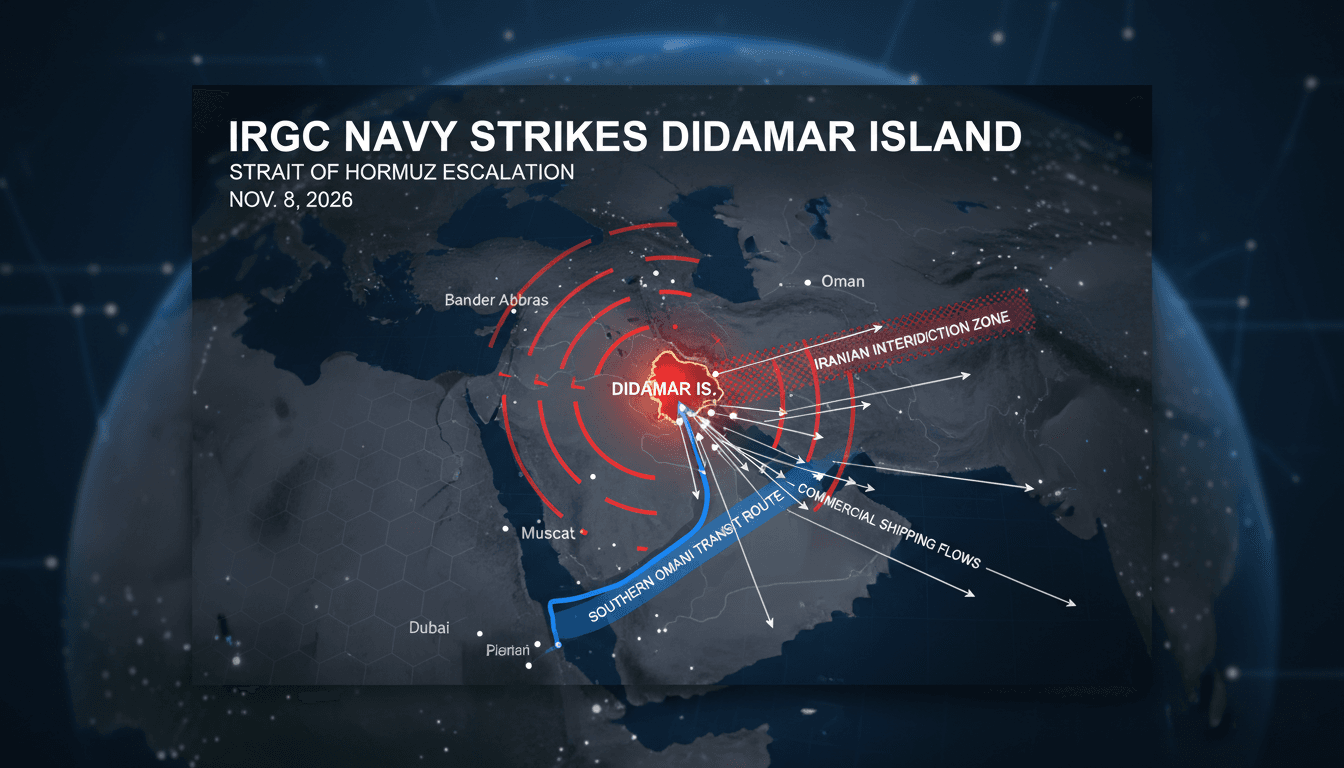
- Infrastructure targeted: On November 8, 2026, the IRGC Navy struck maritime navigation aids, radar, and communications arrays on Didamar Island (Little Quoin Island), an uninhabited Omani outcrop inside the Strait of Hormuz.
- Tehran's justification: Iranian state media claimed on November 10 that the installation facilitated unauthorized vessel transits and oil movements operating outside Iranian regulatory oversight and maritime inspections.
- Operational reality: Commercial traffic on the designated southern shipping route continued to flow, with satellite imagery showing scorch marks near communications infrastructure but limited structural damage to broader navigation capacity.
The context you actually need
- A volatile 2026 corridor: The Strait of Hormuz has experienced recurrent operational interruptions throughout 2026, moving from an Iranian closure in February to U.S. port blockades in April, a brief June ceasefire, and a reinstatement of blockades in July.
- Preceding military exchanges: The Didamar strike occurred six days after U.S. forces conducted defensive strikes on Iranian positions on Qeshm Island on November 2, specifically aiming to neutralize surface-to-air missile installations.
- The volume baseline: Despite recurring maritime security incidents, regional crude oil exports rebounded to exceed 80% of pre-conflict baselines through September and October 2026.
What's really happening
The November 8 strike on Didamar Island is an incentive-driven maneuver targeting the logistical framework of modern tanker traffic rather than the hulls of commercial ships. By focusing on stationary, uninhabited sensory and navigational nodes rather than attacking active tankers, the operating actor avoids immediate, kinetic escalation with escorting forces while systematically increasing the friction of maritime transit.
Didamar Island hosts foundational navigation systems, including an established lighthouse dating back to 1914, and feeds essential tracking telemetry to the Hormuz Control Centre. When commercial operators rerouted to the southern corridor within Omani territorial waters to insulate themselves from northern interdictions, they created an operational workaround under U.S. Central Command (CENTCOM) protective coverage. This southern passage successfully facilitated the recovery of regional oil exports to more than 80% of prewar levels across September and October 2026.
For Iranian planners, this traffic diversion represented a structural circumvention of their geographic leverage over maritime choke points. Rather than directly engaging CENTCOM naval assets or seizing merchant vessels—actions that previously invited immediate defensive counter-strikes, such as the November 2 operation on Qeshm Island—the strike on Didamar seeks to impair the technical infrastructure supporting the alternative route. Disabling shore-based radar and communications increases the operational difficulty of vessel tracking, traffic separation, and coordinated escorting within confined territorial straits.
For Omani authorities, the challenge is maintaining neutrality while sovereign installations experience cross-border military action. Muscat acknowledged the explosion on Didamar but withheld further public pronouncements, balancing sovereignty concerns against the incentive to avoid wider regional entrapment. Meanwhile, commercial freight operators have adapted through decentralization: conducting offshore fuel and cargo transfers near UAE waters, optimizing automated vessel management, and sustaining transit volumes as long as escort coverage remains viable.
This creates an operational impasse. Deterrence actions on static land-based sensors allow one party to demonstrate disruptive capability, while shipping consortiums treat the damage as an acceptable operating friction, preserving crude export volumes despite degraded navigational margins.
Who feels it first (and how)
- Maritime logistics operators: Vessel masters and fleet coordinators navigating the southern Hormuz channel face degraded terrestrial telemetry, increasing reliance on onboard navigation suites and naval escort data links.
- Energy trading desks: Arbitrage desks tracking crude transit through the Gulf must monitor whether route-specific insurance surcharges rise, potentially shifting net margins on long-haul charter fixtures.
- Port management authorities in the Gulf: Terminals coordinating offshore transfers near UAE waters absorb higher procedural workloads to sustain oil flows outside standard routing protocols.
What to watch next
- Insurers' war-risk adjustments: Whether marine underwriters expand Joint War Committee breach areas to recalibrate premiums for vessels operating inside Omani territorial passages.
- Hormuz Control Centre operational redundancy: Announcements regarding the deployment of mobile or floating radar platforms to replace degraded fixed hardware on Didamar Island.
- Escort density shifts: Changes in CENTCOM surface fleet deployments between northern transit boundaries and the southern passage through Omani waters.
An explosion occurred on Didamar Island on November 8, 2026, causing scorch marks near communications infrastructure; the IRGC claimed responsibility on November 10; commercial tankers continue utilizing the southern shipping route.
Kinetic focus will remain on non-human technical assets—sensors, tracking arrays, and navigational nodes—to assert geographic leverage without triggering direct fleet engagements.
The exact operational degradation suffered by the Hormuz Control Centre's regional tracking grid, and whether Omani authorities will install replacement tracking equipment on the island.
Frequently Asked Questions
- Why it matters?
- Targeting navigation aids within Omani territorial waters demonstrates a deliberate attempt to degrade commercial vessel routing without crossing the threshold of direct tanker interdiction.
- What happened (in 30 seconds)?
- Infrastructure targeted: On November 8, 2026, the IRGC Navy struck maritime navigation aids, radar, and communications arrays on Didamar Island (Little Quoin Island), an uninhabited Omani outcrop inside the Strait of Hormuz. Tehran's justification: Iranian state media claimed on November 10 that the installation facilitated unauthorized vessel transits and oil movements operating outside Iranian regulatory oversight and maritime inspections. Operational reality: Commercial traffic on the designa
- What's really happening?
- The November 8 strike on Didamar Island is an incentive-driven maneuver targeting the logistical framework of modern tanker traffic rather than the hulls of commercial ships. By focusing on stationary, uninhabited sensory and navigational nodes rather than attacking active tankers, the operating actor avoids immediate, kinetic escalation with escorting forces while systematically increasing the friction of maritime transit. Didamar Island hosts foundational navigation systems, including an esta
- Who feels it first (and how)?
- Maritime logistics operators: Vessel masters and fleet coordinators navigating the southern Hormuz channel face degraded terrestrial telemetry, increasing reliance on onboard navigation suites and naval escort data links. Energy trading desks: Arbitrage desks tracking crude transit through the Gulf must monitor whether route-specific insurance surcharges rise, potentially shifting net margins on long-haul charter fixtures. Port management authorities in the Gulf: Terminals coordinating offshore
- What to watch next?
- Insurers' war-risk adjustments: Whether marine underwriters expand Joint War Committee breach areas to recalibrate premiums for vessels operating inside Omani territorial passages. Hormuz Control Centre operational redundancy: Announcements regarding the deployment of mobile or floating radar platforms to replace degraded fixed hardware on Didamar Island. Escort density shifts: Changes in CENTCOM surface fleet deployments between northern transit boundaries and the southern passage through Omani
Conservative-leaning coverage of current events.
"Fox News is a highly influential conservative news outlet known for right-leaning political commentary and coverage."
— A47 Editor
Iran escalates in Hormuz, claims strike on Omani island it says 'enemy' uses for US military ops
Iran's Revolutionary Guard said it struck navigation equipment on Oman's Didamar Island in the Strait of Hormuz, claiming the island is used by an 'enemy' for US military operations, while Omani officials dispute that any damage occurred.
Global business headlines with AI angles.
"General business outlet that frequently covers AI."
— A47 Editor
Iran Reportedly Attacked Shipping Navigation Systems in Oman. Oil Prices Are Climbing.
Iranian state media reported that the Islamic Revolutionary Guard Corps destroyed what it described as "enemy navigation systems" on Oman's Didamar island, according to International Business Times. The report, which the base article attributes to st...
Oil, metals, and agriculture: supply/demand headlines, OPEC chatter, inventories, and price action.
"Solid tape for energy and metals traders tracking macro and micro catalysts."
— A47 Editor
Iran attacks shipping navigation systems on Oman’s Didamar island, sources say
Sources say Iran attacked shipping navigation systems on Oman's Didamar island, according to a Investing.com report that characterizes the development as negative for markets. The incident is part of a wider escalation of maritime confrontation invol...
Breaking news, politics, business, and entertainment from the U.S. and around the world.
"The New York Post is a tabloid-format newspaper known for its sensationalist headlines and conservative-leaning editorial tone."
— A47 Editor
Iran strikes Oman island the US uses to help ships sail through Hormuz
Iran attacked an Omani island base on Tuesday, which state media said was helping the United States conduct military escorts for tankers moving through the Strait of Hormuz. The strike, reported by the New York Post, comes amid a broader escalation o...
Global political, business, and cultural coverage from WSJ international desks.
"The Wall Street Journal offers extensive international reporting with a reputation for financial insight and a center-right editorial stance."
— A47 Editor
U.S., Iran Exchange Strikes on Islands as They Fight for Control of Strait
U.S. and Iranian forces have exchanged strikes on islands in and around the Strait of Hormuz as both sides contest control of the vital waterway, with reported explosions on Qeshm Island and attacks on shipping, according to The Wall Street Journal's...