
IAEA Reports Loss of Verification Over Iran's Undeclared Isfahan Enrichment Plant and 440.9 kg of Highly Enriched Uranium
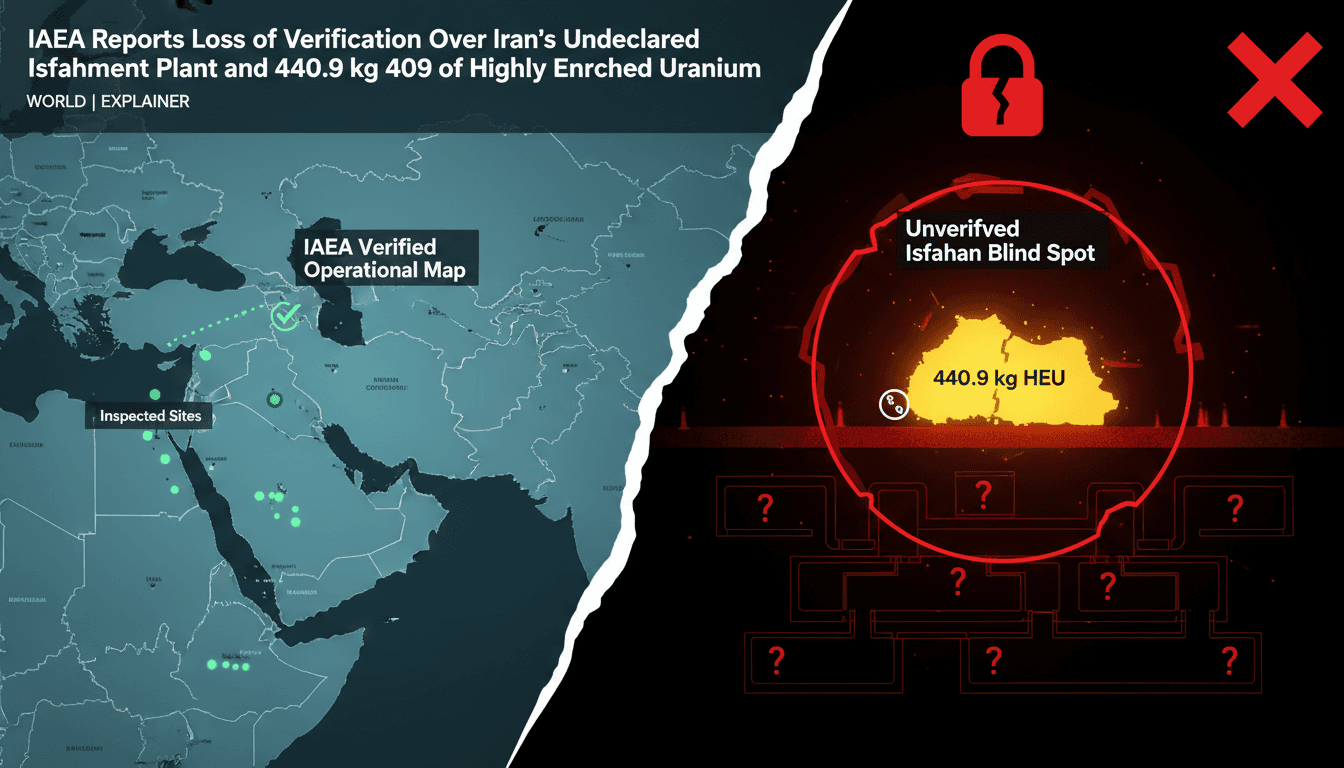
Persistent verification gaps in regional nuclear infrastructure elevate baseline geopolitical risk premiums across Middle East logistics, energy supply chains, and sovereign financing.
Why it matters
The breakdown in institutional monitoring over refined nuclear stockpiles creates an unquantifiable structural blind spot for global commodities and regional risk models.
What happened (in 30 seconds)
- Safeguards blind spot confirmed: On November 13, 2026, the International Atomic Energy Agency (IAEA) issued a confidential report stating it cannot confirm the exact location, safeguards status, or contents of the underground Isfahan Fuel Enrichment Plant (IFEP).
- Material tracking broken: IAEA Director General Rafael Grossi confirmed the agency has lost continuity of knowledge regarding critical nuclear inventories, leaving 440.9 kg of near weapons-grade highly enriched uranium unverified.
- Access remains barred: Following joint US-Israeli military strikes on Iranian nuclear sites in June 2025, Iranian authorities have sustained a complete lockout of international inspectors from declared and undeclared enrichment facilities.
The context you actually need
- The declaration timeline: Iran officially declared the existence of the underground IFEP facility on June 12, 2025, but scheduled international inspections were preempted by the military strikes later that month.
- The 17-month data blackout: The agency has now spent over a year without physical access or electronic continuity across key facilities, preventing any independent verification that material has not been diverted from peaceful activities.
- Hardened negotiating posture: Iranian officials, including National Security Chief Mohsen Rezaei, have rejected external demands to inspect or remove enriched material, conditioning future cooperation on the complete cessation of foreign security threats.
What's really happening
The core mechanism at play is the complete dissolution of the institutional verification loop that has anchored non-proliferation tracking for decades. When an oversight body loses continuity of knowledge over fissile inventory, the problem shifts from standard compliance verification to strategic game theory.
The physical asset in question—an underground enrichment site situated within the tunnel networks of Isfahan—was formally acknowledged by Iranian authorities in mid-2025. However, because military strikes occurred before baseline verification procedures could be completed, the IAEA never established an initial material accounting ledger. The resulting operational vacuum leaves 440.9 kg of highly enriched uranium effectively off the international balance sheet. Without direct physical inspection, remote telemetry, or chain-of-custody tracking, international monitors cannot determine whether this inventory remains housed in damaged storage sites, has been redistributed across reinforced subterranean networks, or has been altered.
This verification void introduces distinct strategic incentives for all participants. For Iranian security planners, maintaining ambiguity around the location, enrichment level, and physical control of the material functions as an asymmetric deterrent. By conditioning inspection access on the cessation of military threats, Tehran leverages the unverified status of the Isfahan plant as primary diplomatic leverage. Iranian leadership has explicitly stated that no material will be transferred outside the country, reinforcing domestic control over the existing stockpile.
Conversely, for external intelligence agencies and multilateral monitors, the absence of verified data creates an intelligence deficit that increases the likelihood of operational miscalculation. The United States has resorted to financial incentives and reward programs to gather actionable intelligence on nuclear workflows, reflecting the limits of standard diplomatic and satellite monitoring. Meanwhile, negotiations remain deadlocked because re-establishing verification requires an initial concession on security guarantees that neither side is incentivized to grant unilaterally. For regional trade hubs, the net result is a persistent, non-zero risk of abrupt regional escalation, pricing in long-term frictional costs for maritime transit, commercial aviation, and cross-border underwriting.
Who feels it first (and how)
- Regional Commodity Traders and Energy Desks: Face persistent uncertainty premiums in Middle Eastern crude benchmarks and liquefied natural gas futures due to the constant threat of localized maritime disruptions.
- Marine Insurers and Freight Operators: Navigate variable underwriting terms and volatile war-risk surcharges for vessels moving through the Strait of Hormuz and regional Gulf waters.
- Gulf-Based Enterprise Risk Officers: Must model sudden supply chain contingencies and regional security alerts without reliable baseline data on non-proliferation timelines.
- International Non-Proliferation Institutions: Experience institutional friction as the inability to verify the non-diversion of nuclear materials weakens the operational authority of the global safeguards framework.
What to watch next
- IAEA Board of Governors Resolutions: Watch for whether member states escalate the confidential report into a formal resolution demanding immediate compliance, which would dictate the pace of diplomatic confrontation.
- Pre-Negotiation Concessions: Monitor whether diplomatic channels shift from demanding full facility access to targeted verification deals focused strictly on accounting for the 440.9 kg stockpile.
- Regional Defense Posturing: Track alterations in forward-deployed military assets and intelligence collection efforts in the Gulf, which signal how regional actors are internally calculating the likelihood of secondary strikes.
The IAEA does not know the exact coordinates, physical operational status, or material presence at the Isfahan Fuel Enrichment Plant; 440.9 kg of highly enriched uranium remains unaccounted for by international monitors; access has been denied since June 2025.
The diplomatic deadlock will persist without external political intervention, maintaining elevated baseline risk assessments for regional corporate operations.
The actual physical condition of the Isfahan site following the 2025 strikes, whether the 440.9 kg of material remains within the Isfahan perimeter, and what verification compromises Iran would accept to lift economic or security pressure.
Frequently Asked Questions
- Why it matters?
- The breakdown in institutional monitoring over refined nuclear stockpiles creates an unquantifiable structural blind spot for global commodities and regional risk models.
- What happened (in 30 seconds)?
- Safeguards blind spot confirmed: On November 13, 2026, the International Atomic Energy Agency (IAEA) issued a confidential report stating it cannot confirm the exact location, safeguards status, or contents of the underground Isfahan Fuel Enrichment Plant (IFEP). Material tracking broken: IAEA Director General Rafael Grossi confirmed the agency has lost continuity of knowledge regarding critical nuclear inventories, leaving 440.9 kg of near weapons-grade highly enriched uranium unverified. Acces
- What's really happening?
- The core mechanism at play is the complete dissolution of the institutional verification loop that has anchored non-proliferation tracking for decades. When an oversight body loses continuity of knowledge over fissile inventory, the problem shifts from standard compliance verification to strategic game theory. The physical asset in question—an underground enrichment site situated within the tunnel networks of Isfahan—was formally acknowledged by Iranian authorities in mid-2025. However, becaus
- Who feels it first (and how)?
- Regional Commodity Traders and Energy Desks: Face persistent uncertainty premiums in Middle Eastern crude benchmarks and liquefied natural gas futures due to the constant threat of localized maritime disruptions. Marine Insurers and Freight Operators: Navigate variable underwriting terms and volatile war-risk surcharges for vessels moving through the Strait of Hormuz and regional Gulf waters. Gulf-Based Enterprise Risk Officers: Must model sudden supply chain contingencies and regional security
- What to watch next?
- IAEA Board of Governors Resolutions: Watch for whether member states escalate the confidential report into a formal resolution demanding immediate compliance, which would dictate the pace of diplomatic confrontation. Pre-Negotiation Concessions: Monitor whether diplomatic channels shift from demanding full facility access to targeted verification deals focused strictly on accounting for the 440.9 kg stockpile. Regional Defense Posturing: Track alterations in forward-deployed military assets and
UAE-based English-language newspaper covering regional politics, economics, and global affairs.
"The National reflects Emirati policy perspectives while maintaining international editorial standards."
— A47 Editor
IAEA expresses concern over Iranian underground uranium-enrichment plant
The International Atomic Energy Agency (IAEA) has expressed growing concern about an underground uranium-enrichment plant in Iran, stating it cannot verify whether the facility contains nuclear material. The UN nuclear watchdog's concern is reflected...
Global news coverage with extensive reporting on Middle Eastern conflicts and geopolitics.
"Al Jazeera is a Qatar-based broadcaster known for wide regional coverage and alternative perspectives."
— A47 Editor
UN watchdog calls on Iran to reopen nuclear facilities to inspection
The UN nuclear watchdog, the IAEA, has called on Iran to reopen its nuclear facilities to inspection, stating it cannot verify whether an underground Iranian uranium enrichment plant contains nuclear material. The call follows the agency's growing co...
Regional coverage and analysis focused on politics, diplomacy, and business across the Middle East.
"Al-Monitor is known for analytical reporting on Middle East politics and policy developments."
— A47 Editor
IAEA increasingly concerned about Iranian enrichment plant, its report says
The UN nuclear watchdog, the International Atomic Energy Agency (IAEA), said in a confidential report seen by Reuters on Friday that it is "increasingly concerned" about a uranium-enrichment plant at Isfahan, which Iran declared to the agency last ye...
Global coverage of politics, crises, and international affairs.
"HuffPost provides progressive-oriented reporting on international developments, often focusing on humanitarian and social justice issues."
— A47 Editor
U.N. Nuclear Watchdog Increasingly Concerned About Iranian Enrichment Plant, Its Report Says
The U.N. nuclear watchdog, the International Atomic Energy Agency (IAEA), reports growing concern over an Iranian uranium enrichment plant, with Iran still barring inspectors from returning to nuclear facilities bombed by Israel and the United States...
Macro commentary, policy analysis, growth/inflation themes, and global outlooks.
"Contextual macro coverage that complements day-to-day market headlines."
— A47 Editor
IAEA “increasingly concerned” over Iran’s uninspected uranium enrichment facility
The International Atomic Energy Agency has expressed growing concern over an uranium enrichment facility in Iran that remains outside its inspection regime, according to a report published by Investing.com. The base story carries a negative sentiment...
Arabic-language coverage of international news and geopolitics.
"RT Arabic is a Russian state-funded outlet often criticized for promoting Kremlin-aligned narratives."
— A47 Editor
الوكالة الذرية تحذر من منشأة أصفهان لتخصيب اليورانيوم
The International Atomic Energy Agency expressed concern over an underground uranium enrichment facility in Isfahan, which Iran had announced but has not allowed inspectors to visit. The warning, reported by RT Arabic, highlights the lack of access t...