
IAEA Flags Uninspected Isfahan Enrichment Plant as Unverified Proliferation Risk in Iran
Why it matters
A breakdown in atomic safeguards verification introduces baseline structural uncertainty into regional logistics, cross-border capital flows, and international security governance.
What happened (in 30 seconds)
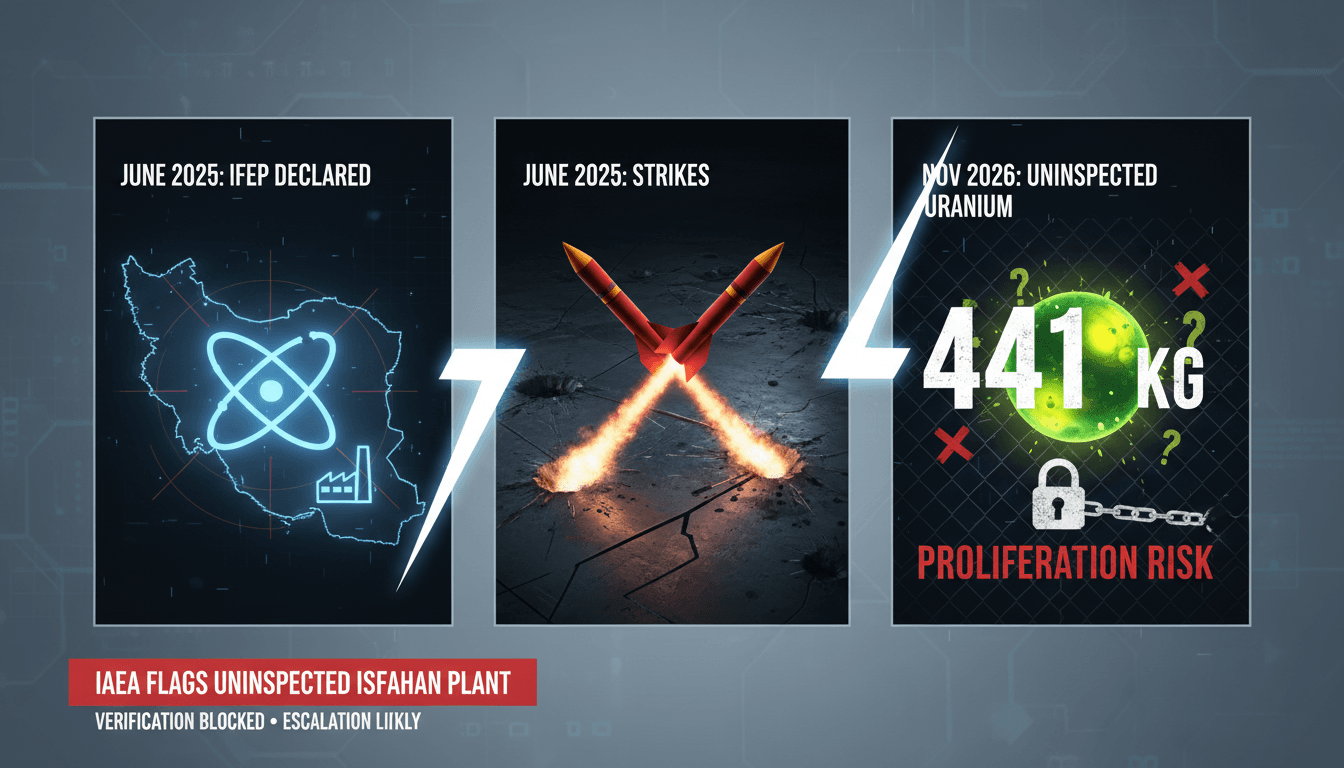
- Monitoring access lapsed: On November 13, 2026, the International Atomic Energy Agency (IAEA) reported it lacks data on the location, safeguards status, and material inventory of the Isfahan Fuel Enrichment Plant (IFEP).
- Inspections halted after kinetic conflict: Initial arrangements to inspect the underground facility were cancelled following Israeli strikes on June 13, 2025, which were followed by United States military strikes later that month.
- Stockpiles remain unverified: Access restrictions imposed across targeted facilities have prevented inspectors from verifying Iran’s enriched uranium reserves, which stood at an estimated 441 kg enriched to 60% purity prior to the June 2025 strikes.
The context you actually need
- JCPOA baselines were surpassed: Under the 2015 Joint Comprehensive Plan of Action, enrichment was restricted to 3.67% purity with a 300 kg cap; those parameters were subsequently exceeded, culminating in a June 2025 IAEA non-compliance resolution.
- The facility was announced ahead of strikes: Iran formally declared plans for the underground IFEP on June 12, 2025, just one day prior to military operations targeting nuclear infrastructure across the country.
- Satellite data indicates site movement: While international inspectors have only visited select unaffected installations, orbital imagery has captured ongoing surface activity near tunnel entrances in Isfahan, where material had historically been positioned.
What's really happening
The standoff over the Isfahan Fuel Enrichment Plant (IFEP) reflects an institutional verification breakdown driven by divergent strategic incentives. Following military strikes by Israel and the United States in June 2025, physical infrastructure verification ceased across affected facilities. For the IAEA, the absence of continuous safeguards monitoring creates an evidentiary vacuum: without physical access, environmental sampling, or surveillance camera feeds, the agency cannot legally verify whether nuclear materials remain in peaceful civilian channels or have been diverted.
From an institutional perspective, the mechanics of non-proliferation depend on uninterrupted accounting. The 2015 JCPOA framework restricted enrichment purity to 3.67% and maintained a 300 kg total inventory cap. Prior to the June 2025 operations, international assessments documented 441 kg of uranium enriched up to 60% purity—an enrichment concentration technically proximate to the 90% threshold defined as weapons-grade. Because the underground Isfahan installation was declared mere hours before kinetic strikes occurred, the IAEA never established a baseline inventory or verified containment boundaries.
The core operational tension rests on post-strike facility sovereignty versus international legal mandates. Iran attributes access restrictions directly to security realities following the June 2025 strikes, while asserting that its atomic activity remains strictly peaceful. Conversely, the IAEA Board of Governors referred the file to the UN Security Council in early 2026, citing non-compliance with statutory safeguards obligations.
This verification impasse alters regional risk models. When international monitors are blocked from inspecting sites that hold critical stockpiles, neighboring states and trading counterparties must price policy and security decisions on worst-case assumptions rather than empirical audits. Commercial shipping, energy infrastructure, and multinational corporate balance sheets across the Middle East operate on the stability of maritime choke points and airspace. While direct local retail markets show no immediate disruption, the persistent lack of verified safeguards maintains elevated regional security baselines, raising insurance considerations and requiring enterprise contingency planning for unexpected geopolitical escalation.
Who feels it first (and how)
- Regional enterprise risk officers: Must model sustained baseline geopolitical volatility and adjust security exposure for operations adjacent to critical transport routes.
- Maritime and aviation logistics operators: Face fluctuating war-risk insurance premiums and potential rerouting contingencies across Middle Eastern corridors.
- Multinational corporate treasurers in the Gulf: Required to factor diplomatic escalation scenarios into regional liquidity models and capital deployment schedules.
- International trade and compliance attorneys: Forced to navigate potential secondary legal frameworks or sanctions adjustments stemming from UN Security Council review.
What to watch next
- UN Security Council procedural steps: Any formal diplomatic resolutions or policy directives following the IAEA's non-compliance referral will clarify the international regulatory trajectory.
- Satellite-detected tunnel activity: Commercial orbital monitoring around Isfahan’s subterranean portals serves as the primary external barometer of physical operational movement.
- IAEA quarterly safeguard updates: Future reporting will signal whether bilateral negotiations succeed in restoring inspector access to contested sites.
The IAEA does not know the exact coordinates, inventory, or operational status of the underground Isfahan Fuel Enrichment Plant, and has had restricted access to targeted nuclear sites since June 2025.
Regional security premiums will remain elevated so long as the 441 kg stockpile of 60% enriched uranium remains outside verifiable international oversight.
Whether diplomatic frameworks can negotiate technical inspector access to underground sites without broader political and security agreements between all parties involved.
Frequently Asked Questions
- Why it matters?
- A breakdown in atomic safeguards verification introduces baseline structural uncertainty into regional logistics, cross-border capital flows, and international security governance.
- What happened (in 30 seconds)?
- Monitoring access lapsed: On November 13, 2026, the International Atomic Energy Agency (IAEA) reported it lacks data on the location, safeguards status, and material inventory of the Isfahan Fuel Enrichment Plant (IFEP). Inspections halted after kinetic conflict: Initial arrangements to inspect the underground facility were cancelled following Israeli strikes on June 13, 2025, which were followed by United States military strikes later that month. Stockpiles remain unverified: Access restriction
- What's really happening?
- The standoff over the Isfahan Fuel Enrichment Plant (IFEP) reflects an institutional verification breakdown driven by divergent strategic incentives. Following military strikes by Israel and the United States in June 2025, physical infrastructure verification ceased across affected facilities. For the IAEA, the absence of continuous safeguards monitoring creates an evidentiary vacuum: without physical access, environmental sampling, or surveillance camera feeds, the agency cannot legally verify
- Who feels it first (and how)?
- Regional enterprise risk officers: Must model sustained baseline geopolitical volatility and adjust security exposure for operations adjacent to critical transport routes. Maritime and aviation logistics operators: Face fluctuating war-risk insurance premiums and potential rerouting contingencies across Middle Eastern corridors. Multinational corporate treasurers in the Gulf: Required to factor diplomatic escalation scenarios into regional liquidity models and capital deployment schedules. Inter
- What to watch next?
- UN Security Council procedural steps: Any formal diplomatic resolutions or policy directives following the IAEA's non-compliance referral will clarify the international regulatory trajectory. Satellite-detected tunnel activity: Commercial orbital monitoring around Isfahan’s subterranean portals serves as the primary external barometer of physical operational movement. IAEA quarterly safeguard updates: Future reporting will signal whether bilateral negotiations succeed in restoring inspector acce
International coverage of politics, culture, and current affairs.
"BBC News is widely regarded as a reputable international news organization, known for its impartial tone and public service mandate."
— A47 Editor
UN watchdog 'increasingly concerned' over uninspected Iran nuclear site
The UN nuclear watchdog, the International Atomic Energy Agency, says it is increasingly concerned because it has never been able to visit a uranium enrichment plant at Isfahan in Iran, a facility Iran announced more than a year ago. The base report,...
UAE-based English-language newspaper covering regional politics, economics, and global affairs.
"The National reflects Emirati policy perspectives while maintaining international editorial standards."
— A47 Editor
IAEA expresses concern over Iranian underground uranium-enrichment plant
The International Atomic Energy Agency (IAEA) has expressed growing concern over an underground uranium-enrichment plant in Iran, stating it cannot verify whether the facility contains nuclear material. The agency has called on Iran to reopen its nuc...
Global news coverage with extensive reporting on Middle Eastern conflicts and geopolitics.
"Al Jazeera is a Qatar-based broadcaster known for wide regional coverage and alternative perspectives."
— A47 Editor
UN watchdog calls on Iran to reopen nuclear facilities to inspection
The UN nuclear watchdog, the IAEA, has called on Iran to reopen its nuclear facilities to inspection, stating it cannot verify whether an underground Iranian uranium enrichment plant contains nuclear material. The call follows the agency's growing co...
Regional coverage and analysis focused on politics, diplomacy, and business across the Middle East.
"Al-Monitor is known for analytical reporting on Middle East politics and policy developments."
— A47 Editor
IAEA increasingly concerned about Iranian enrichment plant, its report says
The UN nuclear watchdog, the International Atomic Energy Agency (IAEA), said in a confidential report seen by Reuters on Friday that it is "increasingly concerned" about a uranium-enrichment plant at Isfahan, which Iran declared to the agency last ye...
Global coverage of politics, crises, and international affairs.
"HuffPost provides progressive-oriented reporting on international developments, often focusing on humanitarian and social justice issues."
— A47 Editor
U.N. Nuclear Watchdog Increasingly Concerned About Iranian Enrichment Plant, Its Report Says
The U.N. nuclear watchdog, the International Atomic Energy Agency (IAEA), reports growing concern over an Iranian uranium enrichment plant, with Iran still barring inspectors from returning to nuclear facilities bombed by Israel and the United States...
Macro commentary, policy analysis, growth/inflation themes, and global outlooks.
"Contextual macro coverage that complements day-to-day market headlines."
— A47 Editor
IAEA “increasingly concerned” over Iran’s uninspected uranium enrichment facility
The International Atomic Energy Agency has expressed growing concern over an uranium enrichment facility in Iran that remains outside its inspection regime, according to a report published by Investing.com. The base story carries a negative sentiment...