
China Russia and United States Issue Joint Declaration Reaffirming Nuclear War Cannot Be Won
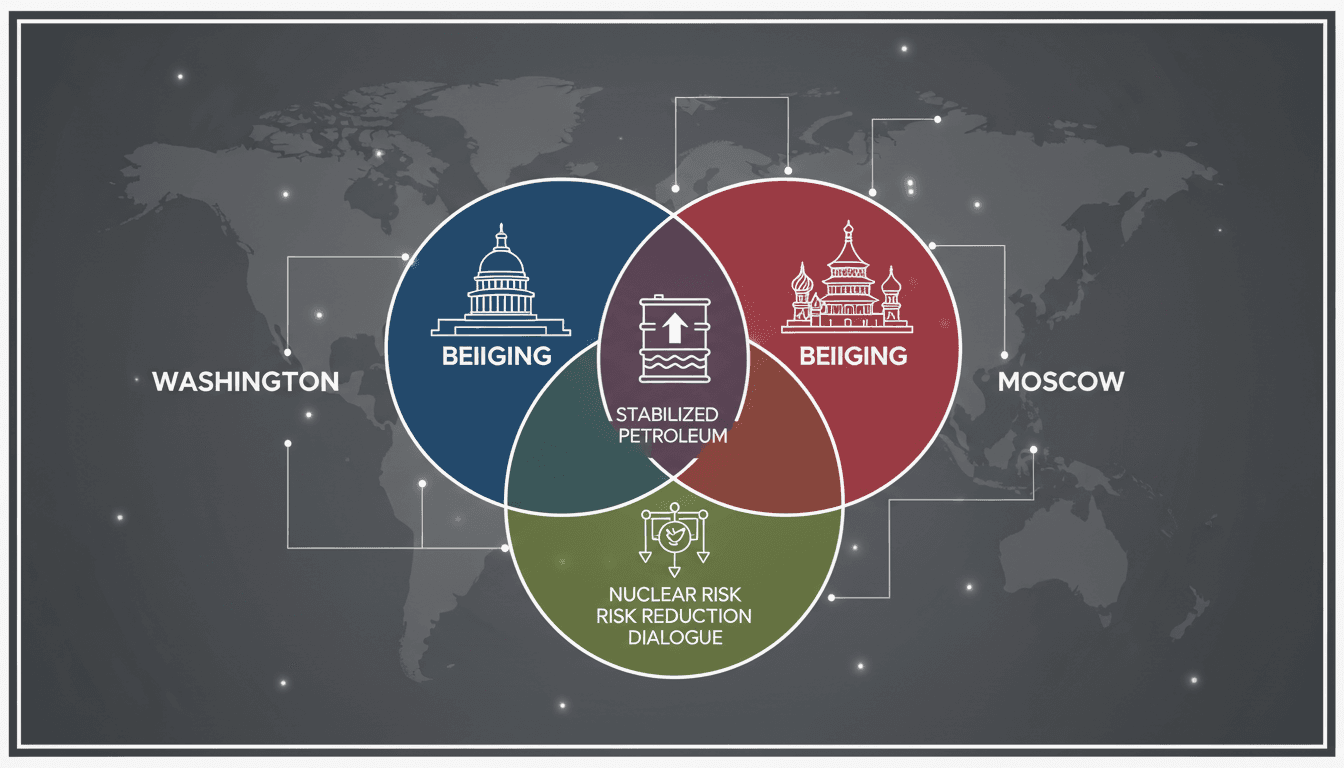
The commitment to petroleum supply predictability and direct strategic de-escalation stabilizes operational risk across cross-border trade, capital allocation, and regional logistics.
Why it matters
The formal alignment between the world's three largest military powers establishes a baseline framework for energy security and nuclear containment following the lapse of previous bilateral treaty architectures.
What happened (in 30 seconds)
- The trilateral summit: On November 19, 2026, Chinese President Xi Jinping, Russian President Vladimir Putin, and US President Donald Trump convened for approximately 80 minutes at Kylin Villa in Shenzhen on the sidelines of the APEC leaders' forum.
- The joint declaration: The leaders issued the "China-Russia-US Heads of State Declaration toward Peace," explicitly reaffirming that a nuclear war cannot be won and must never be fought.
- The four-point consensus: The signed document committed all three permanent UN Security Council members to institutional UN reform, stable global flows of refined petroleum, mutual recognition of state immunities, and renewed dialogue on risk reduction and non-proliferation.
The context you actually need
- The post-treaty vacuum: Bilateral arms controls deteriorated following the expiration of the New START treaty in February 2025, leaving global strategic arsenals without formal monitoring limits for 21 months.
- China’s changing posture: Beijing previously maintained a smaller strategic nuclear force and resisted trilateral control structures, making this the first formal trilateral pledge involving China on nuclear risk reduction.
- Energy architecture priorities: The explicit inclusion of refined petroleum production in a high-level security communique links raw geopolitical de-escalation directly to commercial market continuity.
What's really happening
The Shenzhen meeting was fundamentally an alignment of sovereign incentives rather than an ideological reset. Over an 80-minute window at Kylin Villa, the three leaders bypassed conventional diplomatic channels to address structural bottlenecks threatening domestic economic stability: systemic risk pricing, maritime supply chain friction, and energy market volatility.
The mechanics of the four-point declaration focus heavily on lowering systemic downside risks for all three participants. The commitment to increased refined petroleum production and supply stability provides immediate structural relief for global macro planners. Energy supply shocks disrupt long-term infrastructure investment, industrial manufacturing margins, and sovereign balance sheets. By explicitly anchoring refined product supply inside a high-level heads-of-state peace declaration, the three powers signaled that commercial energy flows will be shielded from operational crossfire. For international hubs like Dubai and regional import-export centers, this commitment protects baseline logistics margins by preserving predictability across baseline shipping and distribution lanes.
Simultaneously, the strategic dimension resolves a prolonged period of regulatory ambiguity. Following the February 2025 lapse of New START, enterprise capital had to price in the tail risk of an unconstrained, multipolar nuclear buildup. By formally codifying that a nuclear war cannot be won and must never be fought, the trio re-established a floor under global sovereign risk assessments. This was China’s first trilateral commitment to nuclear risk dialogue, marking a transition from historical bilateral US-Russia architectures to a three-way strategic stabilization mechanism.
The declaration also addresses state sovereignty and institutional immunities, explicitly seeking to limit the jurisdiction of external supranational legal bodies such as the International Criminal Court (ICC). For global operators, this component outlines the legal operational parameters favored by the three powers: intergovernmental cooperation will occur strictly through state-sanctioned, consent-based frameworks rather than supranational arbitration. In total, the summit establishes a transactional, multipolar protocol designed to keep core trade, energy corridors, and diplomatic communication operational despite persistent regional frictions.
Who feels it first (and how)
- Commodity traders and energy procurement officers: Experience reduced hedging premiums as the joint pledge to maintain refined petroleum production curbs systemic volatility.
- Cross-border enterprise CFOs: Benefit from lower geopolitical tail-risk pricing in long-term strategic investments and cross-border supply chain models.
- Logistics and maritime operators in hub economies: Trade infrastructure across transshipment nodes, including the UAE, gains extended volume predictability with stabilized energy trade flows.
- Sovereign debt and macro risk analysts: Gain a tangible diplomatic baseline to calibrate sovereign credit spreads and systemic stability models.
What to watch next
- Working-group formation on nuclear dialogue: Watch for official dates establishing lower-level technical talks on risk reduction; this confirms whether the summit declaration translates into active institutional frameworks.
- Refined petroleum production quotas: Monitor regional output data and shipping manifests from major energy hubs to assess whether the promised supply stability holds.
- UN Security Council reform agendas: Observe upcoming diplomatic proposals within the Security Council to see how the three permanent members seek to adjust multilateral response mechanisms.
The three leaders met for 80 minutes in Shenzhen on November 19, 2026, and issued a verified four-point declaration covering UN reform, refined petroleum stability, state immunities, and nuclear non-proliferation.
Bilateral and trilateral working-level delegations will be established to handle technical follow-ups regarding risk reduction without immediately implementing binding arsenal reductions.
Whether the non-binding declaration will be formalized into a verifiable, inspection-based treaty architecture to permanently replace the New START framework.
Frequently Asked Questions
- Why it matters?
- The formal alignment between the world's three largest military powers establishes a baseline framework for energy security and nuclear containment following the lapse of previous bilateral treaty architectures.
- What happened (in 30 seconds)?
- The trilateral summit: On November 19, 2026, Chinese President Xi Jinping, Russian President Vladimir Putin, and US President Donald Trump convened for approximately 80 minutes at Kylin Villa in Shenzhen on the sidelines of the APEC leaders' forum. The joint declaration: The leaders issued the "China-Russia-US Heads of State Declaration toward Peace," explicitly reaffirming that a nuclear war cannot be won and must never be fought. The four-point consensus: The signed document committed all thre
- What's really happening?
- The Shenzhen meeting was fundamentally an alignment of sovereign incentives rather than an ideological reset. Over an 80-minute window at Kylin Villa, the three leaders bypassed conventional diplomatic channels to address structural bottlenecks threatening domestic economic stability: systemic risk pricing, maritime supply chain friction, and energy market volatility. The mechanics of the four-point declaration focus heavily on lowering systemic downside risks for all three participants. The co
- Who feels it first (and how)?
- Commodity traders and energy procurement officers: Experience reduced hedging premiums as the joint pledge to maintain refined petroleum production curbs systemic volatility. Cross-border enterprise CFOs: Benefit from lower geopolitical tail-risk pricing in long-term strategic investments and cross-border supply chain models. Logistics and maritime operators in hub economies: Trade infrastructure across transshipment nodes, including the UAE, gains extended volume predictability with stabilized
- What to watch next?
- Working-group formation on nuclear dialogue: Watch for official dates establishing lower-level technical talks on risk reduction; this confirms whether the summit declaration translates into active institutional frameworks. Refined petroleum production quotas: Monitor regional output data and shipping manifests from major energy hubs to assess whether the promised supply stability holds. UN Security Council reform agendas: Observe upcoming diplomatic proposals within the Security Council to see
Algerian and regional news coverage.
"Echorouk is a major Algerian outlet with broad national reporting."
— A47 Editor
الصين وروسيا وأمريكا يتعهدون بسلام بلا حروب نووية!!
On Thursday, November 19, 2026, the heads of state of China, Russia and the United States issued the "Declaration of Heads of State for Peace" in Shenzhen, China, following a trilateral summit between Xi Jinping, Vladimir Putin and Donald Trump on th...
Arabic-language coverage of international news and geopolitics.
"RT Arabic is a Russian state-funded outlet often criticized for promoting Kremlin-aligned narratives."
— A47 Editor
شي: القمة الثلاثية أسفرت عن تفاهمات حول السلام والأمن الدولي
Chinese President Xi Jinping stated that the meeting among the leaders of Russia, China, and the United States was positive and constructive, producing important results and agreement on promoting global peace, cooperation, and resolving disputes thr...
Arabic-language coverage of international news and geopolitics.
"RT Arabic is a Russian state-funded outlet often criticized for promoting Kremlin-aligned narratives."
— A47 Editor
شي: الحفاظ على السلام الدولي محور قمة شينجين الثلاثية
Chinese President Xi Jinping stated that the main focus of the trilateral summit in Shenzhen with Russian President Vladimir Putin and U.S. President Donald Trump is the preservation of international peace and the enhancement of strategic stability, ...
Arabic-language coverage of international news and geopolitics.
"RT Arabic is a Russian state-funded outlet often criticized for promoting Kremlin-aligned narratives."
— A47 Editor
بوتين: روسيا والولايات المتحدة والصين تجمعها مسؤولية الحفاظ على السلام الدولي
Russian President Vladimir Putin stated that Russia, the United States and China share a joint responsibility for maintaining international peace and the stability of the international legal order, according to RT Arabic. The remarks came as the thre...
Arabic-language coverage of international news and geopolitics.
"RT Arabic is a Russian state-funded outlet often criticized for promoting Kremlin-aligned narratives."
— A47 Editor
شي يدعو خلال اجتماع القمّة مع بوتين وترامب لحظر الأسلحة النووية وإزالتها
Chinese President Xi Jinping, meeting with Russian President Vladimir Putin and U.S. President Donald Trump on the sidelines of the APEC summit in Shenzhen, called for a full ban and elimination of nuclear weapons, stating that there are no winners i...