
US Loses Measles Elimination Status After 26 Years as Outbreak Sustains Transmission
Why it matters
The formal loss of domestic elimination status in the world's largest economy signals an operational breakdown in herd immunity thresholds, shifting measles from a rare imported anomaly back into an endemic baseline risk across globalized supply chains and travel corridors.
What happened (in 30 seconds)
- Status revoked after 26 years: On November 17, 2026, the Pan American Health Organization (PAHO) formally withdrew the United States' measles elimination status following verified, continuous person-to-person transmission of the same viral strain for over 12 months.
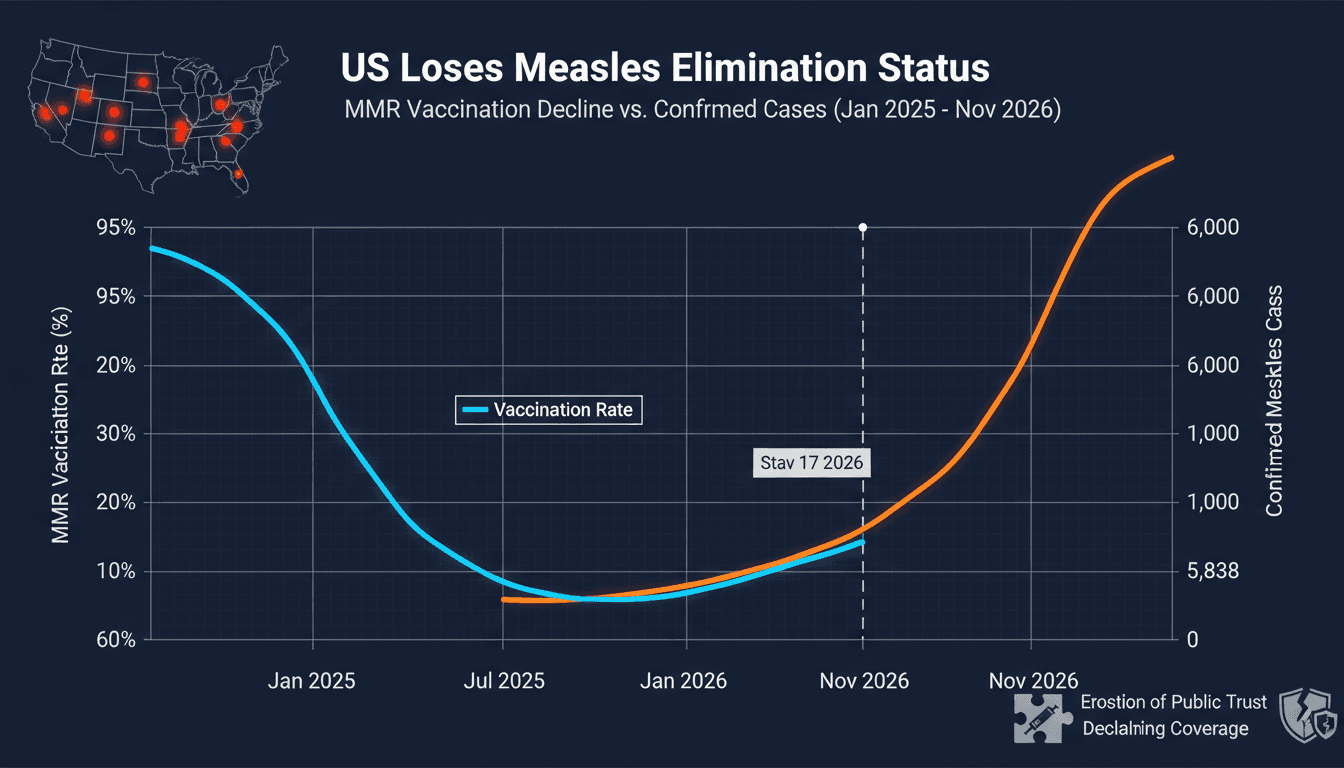
- Widespread multi-state spread: An outbreak sequence that originated in West Texas in January 2025 expanded into 43 distinct outbreaks across states including Pennsylvania, Utah, and Arizona, recording 5,838 confirmed cases and at least 10 deaths by mid-November 2026.
- Regional health classification reset: Alongside Mexico and Bolivia, the U.S. failed to halt ongoing circulation, forcing federal agencies like the Centers for Disease Control and Prevention (CDC) to draft a mandatory corrective action plan under international public health frameworks.
The context you actually need
- The 95% herd immunity barrier breached: Measles was declared eliminated in the U.S. in 2000, but sustained containment requires keeping two-dose MMR (measles, mumps, rubella) coverage at or above 95%—a threshold that eroded over years of policy modifications and rising exemptions.
- Concentrated pocket vulnerabilities: The transmission chain took hold primarily in under-vaccinated clusters, such as specific religious and rural enclaves including Amish and Mennonite communities, where sub-threshold coverage permitted uninterrupted community spread.
- High clinical burden on infrastructure: Clinical records from the 2025–2026 wave revealed that 96% of cases were directly tied to active outbreaks, with approximately one in nine patients requiring inpatient hospitalization, straining regional medical centers in Pennsylvania and Wisconsin.
What's really happening
The revocation of elimination status is an administrative confirmation of an epidemiological reality: the math of herd immunity no longer holds across several critical regions. Measles carries a basic reproduction number (R0) typically estimated between 12 and 18, making it one of the most transmissible respiratory pathogens known. When localized two-dose MMR uptake drops below the 95% barrier, the structural firewall collapses. At that point, sporadic importations stop burning out into dead ends and instead trigger self-sustaining transmission chains.
The economic and institutional incentives surrounding public health maintenance explain how this gap widened. Immunization programs operate under a classic collective action dynamic. When a disease is suppressed for a generation, the perceived individual risk of infection plummets, lowering the immediate urgency for parents and local health networks to prioritize vaccination coverage. Simultaneously, expanded administrative exemptions and shifting state-level mandates made non-compliance frictionless. As localized pockets slipped beneath the 90% and 85% thresholds, the barrier necessary to buffer surrounding populations disappeared.
When the West Texas cluster ignited in January 2025, it did not encounter the wall of immunity that characterized U.S. demographics in the early 2000s. Instead, inter-community mobility linked low-coverage clusters in Texas to under-vaccinated demographic networks in Pennsylvania, Utah, and Arizona. Because transmission persisted uninterrupted for more than 365 days, PAHO's independent verification commission had no technical choice under international guidelines but to classify the pathogen as re-established and endemic.
This reclassification shifts the operational baseline for institutions interacting with the United States. Federal authorities, including Health Secretary Robert F. Kennedy Jr., have publicly recommended MMR vaccination while deploying intensified campaigns in under-covered geographies. However, rebuilding regional herd immunity requires months of sustained distribution, registry reconciliation, and community engagement. Until localized coverage returns to 95%, multinational employers, insurers, and travel regulators must price in measles as an active domestic environmental factor rather than a resolved historical milestone.
Who feels it first (and how)
- International business travelers and flight crews: Personnel transiting high-volume hubs connecting to affected U.S. states now face increased exposure risks, requiring updated personal MMR verifications to avoid travel-related disruptions.
- Multinational HR and mobility directors: Corporate teams managing expatriate assignments or domestic re-locations into hotspot corridors must re-evaluate corporate wellness policies, workplace immunization records, and enterprise healthcare liabilities.
- Regional healthcare networks in affected states: Inpatient facilities and pediatric clinics in hotspots like Pennsylvania, Texas, Wisconsin, and Arizona must bear the direct operating cost of treating severe complications, managing airborne isolation wards, and testing unconfirmed exposures.
- Global travel hubs (including Gulf transit gateways): Hubs like Dubai and European transit centers face no domestic outbreak from this event, but operations teams must maintain rigorous secondary screening and vaccination advisories for inbound passengers arriving from transmission centers.
What to watch next
- The PAHO corrective action plan timeline: Watch for the specific metrics, resource allocations, and federal timelines outlined in the U.S. remediation submission, as this will signal whether regional public health infrastructure can close coverage gaps within 24 months.
- Shifts in state-level school and childcare exemption policies: State legislatures in affected corridors will either tighten non-medical exemption loopholes or keep them open, directly determining whether herd immunity thresholds can mathematically recover.
- International entry requirements and travel health advisories: Monitor whether overseas health ministries begin issuing formal travel advisories or pre-departure vaccination checks for travelers departing designated U.S. outbreak zones.
The United States officially lost its measles elimination status on November 17, 2026, after recording over 5,800 cases, at least 10 deaths, and more than 12 months of unbroken community transmission across multiple states.
Healthcare operational costs and clinical triage workloads will remain elevated in under-vaccinated areas through 2027 as cold-weather seasonal indoor crowding amplifies transmission among unprotected cohorts.
It remains uncertain whether federal initiatives will achieve the uniform 95% uptake required across isolated communities to regain elimination status within the next regulatory review cycle.
Frequently Asked Questions
- Why it matters?
- The formal loss of domestic elimination status in the world's largest economy signals an operational breakdown in herd immunity thresholds, shifting measles from a rare imported anomaly back into an endemic baseline risk across globalized supply chains and travel corridors.
- What happened (in 30 seconds)?
- Status revoked after 26 years: On November 17, 2026, the Pan American Health Organization (PAHO) formally withdrew the United States' measles elimination status following verified, continuous person-to-person transmission of the same viral strain for over 12 months. Widespread multi-state spread: An outbreak sequence that originated in West Texas in January 2025 expanded into 43 distinct outbreaks across states including Pennsylvania, Utah, and Arizona, recording 5,838 confirmed cases and at lea
- What's really happening?
- The revocation of elimination status is an administrative confirmation of an epidemiological reality: the math of herd immunity no longer holds across several critical regions. Measles carries a basic reproduction number (R0) typically estimated between 12 and 18, making it one of the most transmissible respiratory pathogens known. When localized two-dose MMR uptake drops below the 95% barrier, the structural firewall collapses. At that point, sporadic importations stop burning out into dead end
- Who feels it first (and how)?
- International business travelers and flight crews: Personnel transiting high-volume hubs connecting to affected U.S. states now face increased exposure risks, requiring updated personal MMR verifications to avoid travel-related disruptions. Multinational HR and mobility directors: Corporate teams managing expatriate assignments or domestic re-locations into hotspot corridors must re-evaluate corporate wellness policies, workplace immunization records, and enterprise healthcare liabilities. Regio
- What to watch next?
- The PAHO corrective action plan timeline: Watch for the specific metrics, resource allocations, and federal timelines outlined in the U.S. remediation submission, as this will signal whether regional public health infrastructure can close coverage gaps within 24 months. Shifts in state-level school and childcare exemption policies: State legislatures in affected corridors will either tighten non-medical exemption loopholes or keep them open, directly determining whether herd immunity thresholds
Reports on science policy, discoveries, and public debate in the scientific realm.
"The Guardian’s science section is known for thoughtful and critical reporting on global research, ethics, and public understanding of science."
— A47 Editor
Measles is officially back in the USA. Will Maha pay the price? - video
The United States has lost its measles elimination status, an official recognition that the disease is now endemic in the country after being eliminated for 26 years, as reported by The Guardian's Ian Sample with health reporter Jessica Glenza. The s...
Top international stories selected by The Guardian editors.
"The Guardian is known for its progressive editorial stance and in-depth analysis."
— A47 Editor
Measles has come raging back in the US. Robert F Kennedy Jr should be impeached | Judith Levine
Judith Levine, writing in The Guardian, argues that Robert F Kennedy Jr should be impeached over the resurgence of measles in the United States. At least 11 Americans have died of measles since January 2025, the month before Kennedy became secretary ...
Reports on science policy, discoveries, and public debate in the scientific realm.
"The Guardian’s science section is known for thoughtful and critical reporting on global research, ethics, and public understanding of science."
— A47 Editor
Could measles and midterms bring down Maha? – podcast
The United States has lost its measles elimination status, according to global health authorities, an official recognition that the disease is now endemic in the country after being eliminated for 26 years. The development comes amid the worst measle...