
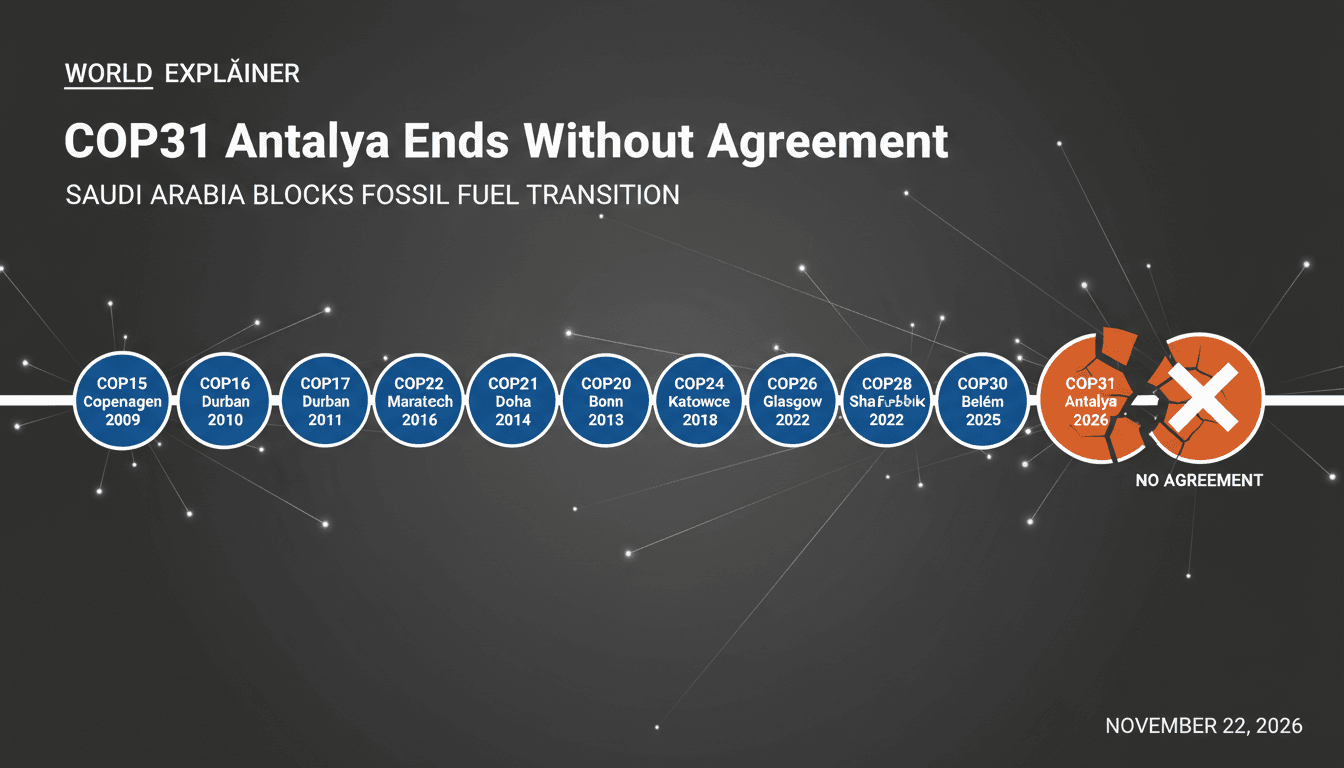
COP31 Antalya Ends Without Agreement as Saudi Arabia Blocks Fossil Fuel Transition Language
Why it matters
The collapse of multilateral consensus in Antalya breaks a 17-year streak of unified climate pacts, shifting regulatory risk directly onto corporate operators and sovereign balance sheets.
What happened (in 30 seconds)
- Deadlock over language: On November 22, 2026, COP31 in Antalya, Turkey, concluded without an overarching political text after Saudi Arabia and allied oil producers refused references to transitioning away from fossil fuels, opposing a coalition of over 130 countries.
- Historic overtime: The summit ran more than 40 hours past its scheduled close, setting a record for the longest UN climate conference without adopting a final cover decision.
- Fragmented output: While voluntary commitments emerged around electrification, methane mitigation, and forestry, core deliberations regarding formal emissions pathways and climate finance were deferred to COP32 in Ethiopia.
The context you actually need
- The baseline shift: Explicit commitments to shift energy systems away from fossil fuels were formally established at COP26 in Glasgow (2021) and codified at COP28 in Dubai (2023), making Antalya the first rollback of that baseline.
- Diplomatic power vacuums: The complete absence of active United States leadership, paired with muted coordination between Washington and Beijing, removed the bilateral counterweight that historically brokered compromise at prior climate summits.
- Consensus mechanics: Under United Nations Framework Convention on Climate Change (UNFCCC) protocols, a single sovereign party can withhold consensus, granting commodity-exporting nations leverage when high-ambition blocs push for binding phase-out language.
What's really happening
The Antalya impasse illustrates the mechanical limits of the UNFCCC's consensus framework when underlying economic incentives diverge sharply.
For commodity exporters led by Saudi Arabia, explicit language committing states to transition away from fossil fuels poses structural risks to long-dated sovereign balance sheets, state capital expenditure pipelines, and core fiscal revenue models. The diplomatic priority in Antalya was not to walk away from decarbonization entirely, but to channel the global policy dialogue toward carbon capture, utilization, and storage (CCUS) rather than the absolute phase-out of hydrocarbon extraction. By backing technology-focused abatement over fuel substitution, fossil-fuel producers aim to defend upstream asset valuations while remaining compliant with broad emissions-intensity targets.
Conversely, a bloc of more than 130 nations—anchored by the European Union and low-lying island states such as Tuvalu—treated the Dubai Consensus from COP28 as an irreversible baseline. For these jurisdictions, weakening or omitting the transition roadmap compromises domestic regulatory regimes, such as the EU Carbon Border Adjustment Mechanism (CBAM), which rely on predictable, rising international standards to avoid competitive leakage. When the Turkish-Australian joint presidency presented drafts omitting fossil fuel transitions, these states determined that walking away without an overarching declaration carried lower operational and policy risk than endorsing a diluted compromise that reversed established precedents.
This strategic division was amplified by structural governance imbalances inside the venue. With the United States sidelined and broad US-China bilateral engagement absent, the procedural ecosystem shifted. When negotiating groups faced canceled sessions while producer delegations held direct access to the presidency, the structural incentives to reach a middle ground evaporated.
The net operational result is the decentralization of global climate governance. Rather than waiting for harmonized UN cover decisions, decarbonization mandates will increasingly flow through unilateral market mechanisms, bilateral trade conditionalities, and regional policy levers. For capital allocators, this confirms that macroeconomic policy signals will not arrive as a neat, universal standard, but as a mosaic of regional trade barriers, bilateral energy compacts, and disparate reporting demands.
Who feels it first (and how)
- Global energy developers: Companies allocating capital across renewables, hydrogen, and carbon management face an uncertain pricing horizon as explicit international policy timelines stall.
- Export-oriented industrial manufacturers: Producers in emerging economies face higher trade friction if regional trading blocs, particularly the EU, apply unilateral carbon penalties to compensate for the absence of a global agreement.
- Financial institutions and asset managers: Compliance and ESG teams must manage diverging disclosure standards across multiple jurisdictions instead of aligning with a single UN-backed mitigation schedule.
- The Dubai and GCC commercial ecosystem: Regional hubs navigating economic transformation must balance hydrocarbon export dependencies against exposure to physical climate risks and fluctuating global demand patterns.
What to watch next
- COP32 agenda-setting in Ethiopia: The preparatory meetings in early 2027 will show whether host Ethiopia and major negotiating blocs can revive the Dubai transition framework or if mitigation will permanently fragment into regional compacts.
- Unilateral regulatory actions by the European Union: Watch for accelerated implementation or expansion of European trade-linked climate penalties to offset the lack of a binding multilateral cover decision.
- Capital flows into carbon management: Corporate investment volumes in CCUS infrastructure will serve as an indicator of whether markets are pricing in prolonged hydrocarbon usage supported by abatement technology.
COP31 ended without a political cover decision, representing the first total failure to adopt a consensus text at a UN climate summit since COP15 in Copenhagen in 2009.
Clean energy investments will increasingly track regional industrial policy incentives rather than global UN diplomatic milestones over the next 12 to 24 months.
Whether the UNFCCC consensus structure can endure without reform, or if climate diplomacy will permanently pivot to minilateral coalitions and voluntary sectoral pacts.
Frequently Asked Questions
- Why it matters?
- The collapse of multilateral consensus in Antalya breaks a 17-year streak of unified climate pacts, shifting regulatory risk directly onto corporate operators and sovereign balance sheets.
- What happened (in 30 seconds)?
- Deadlock over language: On November 22, 2026, COP31 in Antalya, Turkey, concluded without an overarching political text after Saudi Arabia and allied oil producers refused references to transitioning away from fossil fuels, opposing a coalition of over 130 countries. Historic overtime: The summit ran more than 40 hours past its scheduled close, setting a record for the longest UN climate conference without adopting a final cover decision. Fragmented output: While voluntary commitments emerged ar
- What's really happening?
- The Antalya impasse illustrates the mechanical limits of the UNFCCC's consensus framework when underlying economic incentives diverge sharply. For commodity exporters led by Saudi Arabia, explicit language committing states to transition away from fossil fuels poses structural risks to long-dated sovereign balance sheets, state capital expenditure pipelines, and core fiscal revenue models. The diplomatic priority in Antalya was not to walk away from decarbonization entirely, but to channel the
- Who feels it first (and how)?
- Global energy developers: Companies allocating capital across renewables, hydrogen, and carbon management face an uncertain pricing horizon as explicit international policy timelines stall. Export-oriented industrial manufacturers: Producers in emerging economies face higher trade friction if regional trading blocs, particularly the EU, apply unilateral carbon penalties to compensate for the absence of a global agreement. Financial institutions and asset managers: Compliance and ESG teams must m
- What to watch next?
- COP32 agenda-setting in Ethiopia: The preparatory meetings in early 2027 will show whether host Ethiopia and major negotiating blocs can revive the Dubai transition framework or if mitigation will permanently fragment into regional compacts. Unilateral regulatory actions by the European Union: Watch for accelerated implementation or expansion of European trade-linked climate penalties to offset the lack of a binding multilateral cover decision. Capital flows into carbon management: Corporate inv
Regional coverage and analysis focused on politics, diplomacy, and business across the Middle East.
"Al-Monitor is known for analytical reporting on Middle East politics and policy developments."
— A47 Editor
Saudi Arabia's influence loomed large over failed COP31 deal
The COP31 UN climate summit in Antalya, Turkey, ended without a final agreement after talks ran into overtime, with negotiators divided over fossil fuels and climate finance. Reuters reporting based on negotiators from Europe, small island states, La...
Oil, metals, and agriculture: supply/demand headlines, OPEC chatter, inventories, and price action.
"Solid tape for energy and metals traders tracking macro and micro catalysts."
— A47 Editor
Saudi Arabia’s influence loomed large over failed COP31 deal
The COP31 UN climate summit in Antalya, Turkey, ended without an agreement after fractious talks stalled over fossil fuel wording, leaving the outcome of a new global climate deal in the balance. Investing.com's base report frames Saudi Arabia's infl...
Oil, metals, and agriculture: supply/demand headlines, OPEC chatter, inventories, and price action.
"Solid tape for energy and metals traders tracking macro and micro catalysts."
— A47 Editor
COP31 climate talks collapse as EU and others reject deal
COP31, the UN climate summit held in Antalya, Turkey, ended without an agreement after talks over fossil fuel wording stalled, with the EU and others rejecting the deal as it stood, according to Investing.com. The breakdown left the outcome of a new ...
Reports on climate change, environmental science, sustainability, and nature.
"BBC News is widely regarded as a reputable international news organization, known for its impartial tone and public service mandate."
— A47 Editor
COP31 fails to reach major climate deal as talks expose deep divisions
The COP31 UN climate summit in Antalya, Turkey, concluded without a new global climate deal after negotiators remained deadlocked over a draft text that made no mention of fossil fuels, the leading driver of global warming, with talks running into ov...
International coverage of politics, culture, and current affairs.
"BBC News is widely regarded as a reputable international news organization, known for its impartial tone and public service mandate."
— A47 Editor
COP31 fails to reach major climate deal as talks expose deep divisions
The COP31 UN climate summit in Antalya, Turkey, ended without a major agreement after negotiators became deadlocked over a draft text that made no mention of fossil fuels, the leading driver of global warming. The talks ran into overtime as divisions...
24/7 international news from a French perspective in multiple languages.
"France 24 is viewed as a globally focused outlet with balanced coverage and a European perspective."
— A47 Editor
COP31 climate talks in Turkey collapse
COP31 climate talks in Antalya, Turkey, ended without a final agreement after the European Union and other nations rejected a draft text that made no mention of fossil fuels, the leading driver of global warming. The summit, attended by some 200 coun...