
ADNOC Expands Escorted Crude Shuttle Through Strait of Hormuz Amid Iranian Attacks on Shipping
Why it matters
By stepping into the vacuum left by private commercial shippers, state-backed logistics are establishing a precedent where sovereign balance sheets absorb maritime security risks to protect international energy supplies and domestic export volumes.
What happened (in 30 seconds)
- ADNOC expanded tanker transits under military escort: The Abu Dhabi National Oil Company ramped up state-directed shuttle operations through the Strait of Hormuz, moving crude under US military escort despite continuous regional security threats.
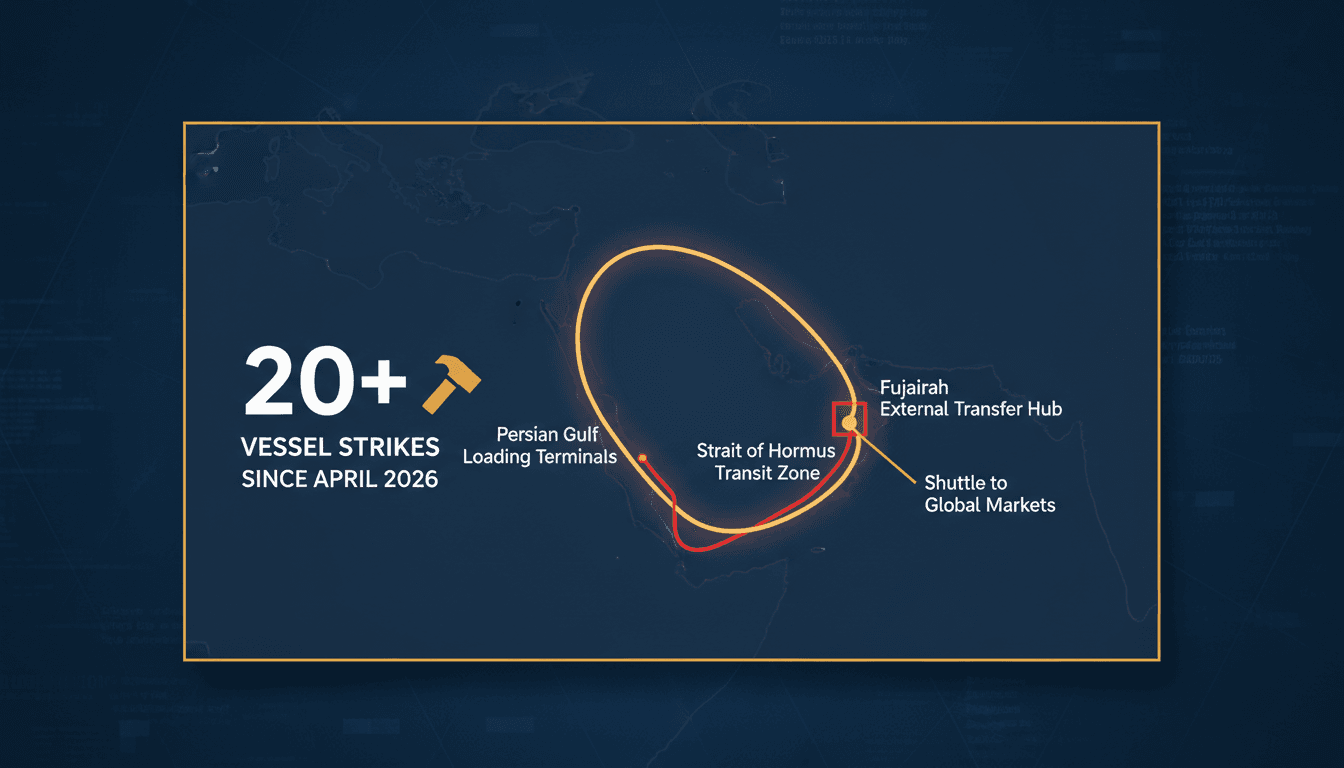
- Vessel strikes have mounted consistently: More than 20 ADNOC-operated tankers have been struck since April 2026, with an attack around November 19 leaving 11 crew members injured and one missing.
- The shuttle now serves third-party regional producers: Beyond clearing domestic production, the UAE expanded its fleet operations to collect and move crude for neighboring producers to offshore transfer hubs like Fujairah.
The context you actually need
- Conflict disrupted commercial maritime routes: Following hostilities involving Iran in early 2026, standard commercial maritime operators largely abandoned the Strait of Hormuz due to prohibitive risk profiles and hostile strikes.
- The "Zero Hormuz" strategy runs on parallel tracks: The UAE continues deploying bypass assets—principally the operational Habshan-Fujairah pipeline alongside a planned West-East link targeted for 2027—while relying on shuttle runs to cover volumes that pipelines cannot yet clear.
- Crude benchmarks reflect persistent friction: Global oil markets have held prices elevated above $92 per barrel, reflecting both the disruption of regular commercial lanes and the operational costs required to maintain supply continuity.
What's really happening
The mechanics of maritime energy transit have fundamentally shifted from commercial logistics to state-underwritten risk absorption. Commercial tanker operators run on clean margins and private insurance structures. When attacks began in early 2026, commercial fleets did what private capital always does under asymmetric physical risk: they withdrew.
This dynamic created an immediate physical bottleneck for Gulf energy producers. The economic calculation for the UAE, however, differs entirely from that of a private shipowner. Shutting in upstream production creates reservoir management complications, terminates cash inflows, and damages market share relationships across key Asian consumption hubs. Consequently, the UAE deployed ADNOC to convert maritime transport from an outsourced commercial service into an active sovereign priority.
To sustain this throughput, ADNOC adopted tactical modifications, including dark transits—turning off transponders during sensitive transit legs—and operating under coordinated US naval escort. The incentive structure extends beyond internal output: ADNOC has expanded its mandate to shuttle oil for other regional producers. By acting as a consolidated carrier of last resort, the UAE aggregates crude inside the Persian Gulf and delivers it outside the chokepoint to eastern terminals such as Fujairah.
This approach carries direct physical and financial consequences. Absorbing more than 20 vessel strikes since April 2026 proves that naval escorts mitigate total fleet attrition but do not eliminate precision strikes. The human and capital toll is substantial, evidenced by vessel damage and crew casualties, such as the November 19 incident resulting in 11 injured and one missing crew member.
Strategically, this shuttle network operates as an interim bridge. The Habshan-Fujairah pipeline provides existing capacity that bypasses the strait entirely, but total regional production exceeds its intake limit. A second West-East pipeline corridor is slated for completion in 2027 to scale non-chokepoint throughput. Until those fixed physical pipes are commissioned, the UAE's state fleet must absorb maritime risk to maintain export volumes, defend regional supply obligations, and preserve the non-oil trade links that drove record UAE commercial activity earlier in 2026.
Who feels it first (and how)
- Logistics and supply chain executives in Dubai: You face secondary freight inflation, higher regional maritime insurance rates, and rerouted container scheduling around northern Gulf routes.
- Port and bunkering operators in Fujairah: You see an immediate influx of vessel activity, lightering runs, and bunkering operations as the hub takes on shuttle volume transferred outside the strait.
- Commercial maritime crews and tanker operators: You face direct operational hazards in the Gulf of Oman and the Strait of Hormuz, with standard maritime transit giving way to tactical, convoy-based fleet movements.
- Global industrial energy buyers: You avoid sudden physical crude stockouts due to sovereign fleet interventions, but you absorb a structural price floor anchored above $92 per barrel.
What to watch next
- Throughput rates at Fujairah transfer terminals: Track transshipment and lightering volumes at eastern UAE anchorages to measure whether ADNOC's shuttle capacity is expanding or plateauing under threat.
- West-East bypass pipeline construction milestones: Progress updates on the new 2027 bypass line will signal when the UAE can structurally scale down its reliance on maritime chokepoints.
- Commercial tanker return or complete state monopolization: Monitor whether non-state commercial operators resume self-insured transits, or if ADNOC remains the only functioning crude carrier inside the passage.
ADNOC is operating tanker convoys under US military protection; more than 20 vessels have been hit since April 2026; crude benchmarks remain above $92 per barrel; a secondary pipeline bypass is targeted for 2027.
The operational expense of maintaining naval escorts and dark runs will keep transport cost components elevated for regional cargoes through the medium term.
Whether continued tactical strikes on shuttle vessels will outpace ADNOC's fleet replacement capacity before the new pipeline bypass is completed.
Frequently Asked Questions
- Why it matters?
- By stepping into the vacuum left by private commercial shippers, state-backed logistics are establishing a precedent where sovereign balance sheets absorb maritime security risks to protect international energy supplies and domestic export volumes.
- What happened (in 30 seconds)?
- ADNOC expanded tanker transits under military escort: The Abu Dhabi National Oil Company ramped up state-directed shuttle operations through the Strait of Hormuz, moving crude under US military escort despite continuous regional security threats. Vessel strikes have mounted consistently: More than 20 ADNOC-operated tankers have been struck since April 2026, with an attack around November 19 leaving 11 crew members injured and one missing. The shuttle now serves third-party regional producers: Be
- What's really happening?
- The mechanics of maritime energy transit have fundamentally shifted from commercial logistics to state-underwritten risk absorption. Commercial tanker operators run on clean margins and private insurance structures. When attacks began in early 2026, commercial fleets did what private capital always does under asymmetric physical risk: they withdrew. This dynamic created an immediate physical bottleneck for Gulf energy producers. The economic calculation for the UAE, however, differs entirely fr
- Who feels it first (and how)?
- Logistics and supply chain executives in Dubai: You face secondary freight inflation, higher regional maritime insurance rates, and rerouted container scheduling around northern Gulf routes. Port and bunkering operators in Fujairah: You see an immediate influx of vessel activity, lightering runs, and bunkering operations as the hub takes on shuttle volume transferred outside the strait. Commercial maritime crews and tanker operators: You face direct operational hazards in the Gulf of Oman and th
- What to watch next?
- Throughput rates at Fujairah transfer terminals: Track transshipment and lightering volumes at eastern UAE anchorages to measure whether ADNOC's shuttle capacity is expanding or plateauing under threat. West-East bypass pipeline construction milestones: Progress updates on the new 2027 bypass line will signal when the UAE can structurally scale down its reliance on maritime chokepoints. Commercial tanker return or complete state monopolization: Monitor whether non-state commercial operators resu
Conservative-leaning political and national coverage.
"The Washington Times is a conservative-leaning newspaper known for its political coverage and advocacy of right-of-center viewpoints."
— A47 Editor
UAE steps up efforts to shuttle oil through Strait of Hormuz
The UAE's state-owned oil company has reportedly found a way to shuttle crude oil out of the Gulf despite dangerous conditions imposed by Iran in the Strait of Hormuz, a move aimed at keeping exports flowing and improving revenue.
U.S. business news, corporate developments, and economy.
"The Wall Street Journal is respected for deep financial and economic reporting with a center-right editorial perspective."
— A47 Editor
The U.A.E. Is Shuttling Oil Past Iran in Risky Hormuz Operation
The United Arab Emirates is reportedly shuttling oil tankers past Iran in a high-risk operation through the Strait of Hormuz, with U.S. military assistance, as part of efforts to break Iran's grip on the waterway, according to The Wall Street Journal...
Global political, business, and cultural coverage from WSJ international desks.
"The Wall Street Journal offers extensive international reporting with a reputation for financial insight and a center-right editorial stance."
— A47 Editor
The U.A.E. Is Shuttling Oil Past Iran in Risky Hormuz Operation
The Wall Street Journal reports that the United Arab Emirates is running a risky shuttle operation that moves oil past Iran through the Strait of Hormuz, with U.S. military support, as part of efforts to break Iran's grip on the waterway.