
Broadcom Secures $63 Billion Debt Financing for Anthropic AI Chip Deployment After Bank Hesitation
Why it matters
The transaction establishes structured debt, vendor-backed guarantees, and special purpose vehicles as the primary mechanism to fund capital-intensive computing clusters when institutional debt syndicates grow risk-averse.
What happened (in 30 seconds)
- Hock Tan intervened to close a stalled deal: The Broadcom CEO led weekend negotiations on October 24–25, 2026, to rescue Project North Star after Bank of America, Citigroup, and Morgan Stanley weighed exiting over risk-reward calculations.
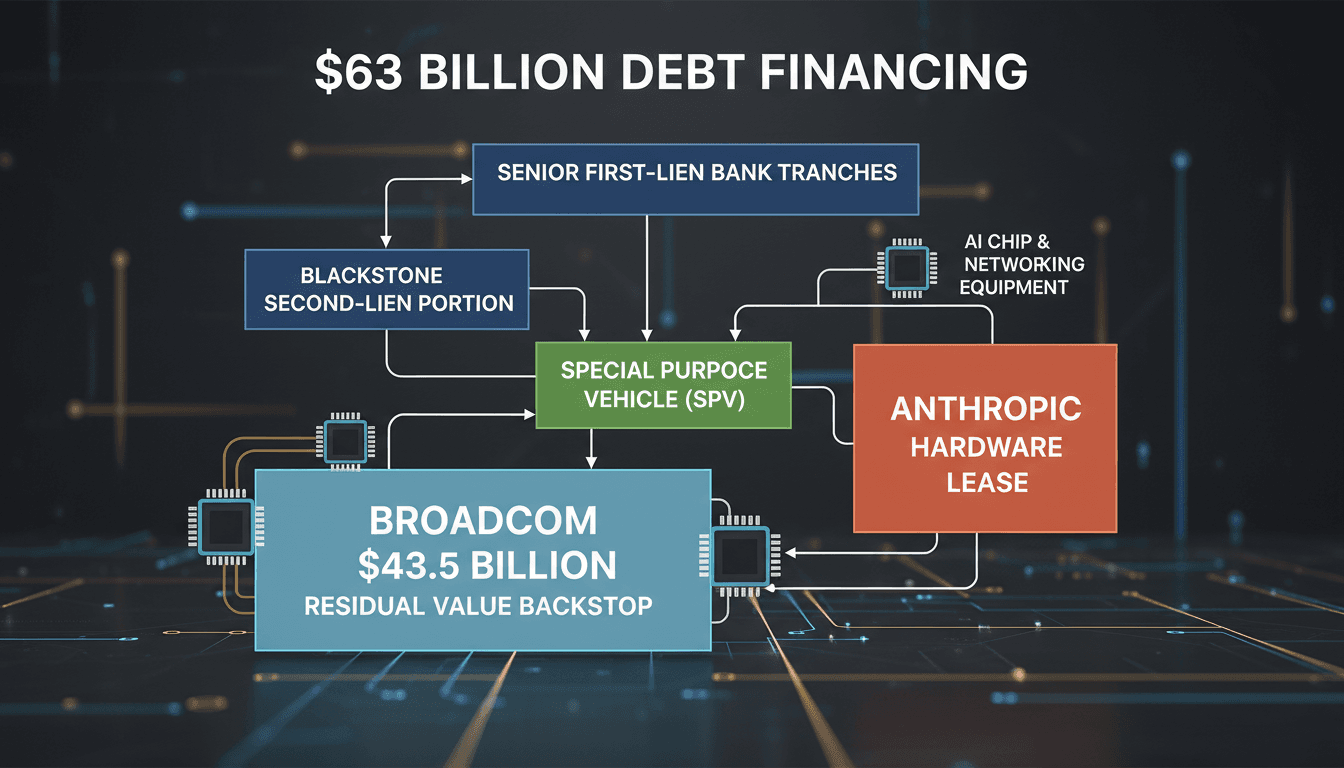
- A $63 billion package was secured: The final structure relies on a newly formed special purpose vehicle (SPV) that will purchase Broadcom-engineered AI chips and networking gear, leasing them directly to Anthropic with deliveries starting in 2027.
- Hardware vendor backstops replaced standard bank terms: To satisfy participating lenders, Broadcom agreed to higher coupon rates and provided residual value support covering roughly $43.5 billion in senior first-lien financing, alongside second-lien commitments from Blackstone.
The context you actually need
- Compute commitments collided with macro headwinds: Anthropic required specialized processor deployment following a strategic framework with Broadcom and Google centered on 3.5 gigawatts of tensor processing units, arriving right as rising interest rates dampened bank appetite for corporate leverage.
- Vendor leadership signaled capital constraints early: On October 12, 2026, Hock Tan publicly highlighted that debt market availability, rather than manufacturing throughput or data center capacity, had become the defining constraint on sector expansion.
- The timing aligns with public equity debuts: Broadcom finalized and unveiled the financing framework alongside Anthropic's initial public offering filing on October 26–27, 2026, offering institutional investors balance-sheet clarity for upcoming capital expenditures.
What's really happening
The mechanics behind Project North Star expose a structural reality in digital infrastructure: Tier-1 investment banks are no longer willing to underwrite multi-tens-of-billions in compute commitments on unhedged corporate balance sheets. For almost two months, Broadcom pursued more than $40 billion in traditional bank syndication. When Bank of America, Citigroup, and Morgan Stanley stepped back due to market volatility and collateral uncertainty, the transaction required financial engineering to survive.
The resulting structure relies on an off-balance-sheet special purpose vehicle. By moving the assets into an SPV, the syndicate avoids uncollateralized corporate exposure to an AI lab undergoing an IPO. However, the SPV structure alone was insufficient for senior lenders. Hock Tan had to alter Broadcom’s risk posture, exchanging cash-and-carry vendor economics for credit enhancement. Broadcom provided residual value support on approximately $43.5 billion of senior first-lien loans. In simple terms: if the leased silicon depreciates faster than scheduled, or if Anthropic faces distress, Broadcom absorbs the hardware downside to make the senior lenders whole.
At the same time, private credit bridged the mezzanine gap. Blackstone entered the capital stack to finance the second-lien tranche, demanding risk-adjusted spreads that conventional commercial banks refused to hold. The compromise reveals the actual clearing price of modern compute. Hyperscale expansion is no longer funded through cheap corporate paper; it requires layered debt, vendor equity or asset protection, and higher coupons that price in hardware obsolescence.
For Broadcom, the incentive is straightforward. Hardware designers cannot recognize high-margin silicon revenue if their primary enterprise buyers lack the liquidity to deploy gigawatt-scale infrastructure. By absorbing default risk via residual value guarantees, Broadcom essentially acts as a captive finance unit. The manufacturer provides the balance sheet protection that commercial institutions demand, ensuring that Anthropic remains positioned to accept physical deliveries across 2027 without draining cash reserves prior to its public listing.
Who feels it first (and how)
- Enterprise debt and infrastructure syndicates: Commercial desks now use Project North Star’s structure—explicit vendor residual value guarantees and tiered private credit—as the baseline requirement before underwriting high-volume compute packages.
- Semiconductor and networking balance-sheet officers: Competing chip manufacturers face growing pressure from enterprise buyers to provide comparable credit enhancements or captive leasing vehicles to secure multi-gigawatt purchase orders.
- AI software developers and compute buyers: Model builders face higher effective lease costs, as the elevated interest rates accepted by Broadcom and Anthropic flow directly into operational infrastructure expenses.
What to watch next
- High-grade bond issuance execution: Watch for up to $21 billion in planned investment-grade bond sales in early 2027, which will signal whether public institutional markets are willing to absorb the senior SPV debt at reasonable yields.
- Hardware delivery timelines in 2027: Track Broadcom’s initial delivery milestones against the 3.5-gigawatt TPU framework to verify whether supply chains convert committed debt into operational capacity on schedule.
- Replication of residual value guarantees: Monitor whether other silicon suppliers agree to backstop second-hand hardware values in order to close pending infrastructure deals.
A $63 billion SPV-structured debt package was finalized on October 26–27, 2026; Broadcom provided residual value support on roughly $43.5 billion of senior first-lien debt; Blackstone took the second-lien tranche; and equipment deliveries begin in 2027.
The participating banking syndicate will attempt to offload their senior first-lien exposure into broader corporate credit markets via debt repackaging during the first half of 2027.
The exact terminal value of custom AI processors and networking silicon after a multi-year lease term, which dictates how much financial liability Broadcom ultimately retains under its residual guarantee.
Frequently Asked Questions
- Why it matters?
- The transaction establishes structured debt, vendor-backed guarantees, and special purpose vehicles as the primary mechanism to fund capital-intensive computing clusters when institutional debt syndicates grow risk-averse.
- What happened (in 30 seconds)?
- Hock Tan intervened to close a stalled deal: The Broadcom CEO led weekend negotiations on October 24–25, 2026, to rescue Project North Star after Bank of America, Citigroup, and Morgan Stanley weighed exiting over risk-reward calculations. A $63 billion package was secured: The final structure relies on a newly formed special purpose vehicle (SPV) that will purchase Broadcom-engineered AI chips and networking gear, leasing them directly to Anthropic with deliveries starting in 2027. Hardware ven
- What's really happening?
- The mechanics behind Project North Star expose a structural reality in digital infrastructure: Tier-1 investment banks are no longer willing to underwrite multi-tens-of-billions in compute commitments on unhedged corporate balance sheets. For almost two months, Broadcom pursued more than $40 billion in traditional bank syndication. When Bank of America, Citigroup, and Morgan Stanley stepped back due to market volatility and collateral uncertainty, the transaction required financial engineering t
- Who feels it first (and how)?
- Enterprise debt and infrastructure syndicates: Commercial desks now use Project North Star’s structure—explicit vendor residual value guarantees and tiered private credit—as the baseline requirement before underwriting high-volume compute packages. Semiconductor and networking balance-sheet officers: Competing chip manufacturers face growing pressure from enterprise buyers to provide comparable credit enhancements or captive leasing vehicles to secure multi-gigawatt purchase orders. AI software
- What to watch next?
- High-grade bond issuance execution: Watch for up to $21 billion in planned investment-grade bond sales in early 2027, which will signal whether public institutional markets are willing to absorb the senior SPV debt at reasonable yields. Hardware delivery timelines in 2027: Track Broadcom’s initial delivery milestones against the 3.5-gigawatt TPU framework to verify whether supply chains convert committed debt into operational capacity on schedule. Replication of residual value guarantees: Monito
Stock market news, investing ideas, and trading analysis.
"TheStreet provides market news and retail-investor-focused analysis."
— A47 Editor
Broadcom CEO says capital is ‘available’ after banks wavered
Broadcom CEO Hock Tan has said capital is "available" for the company's Anthropic chip financing after some lenders reportedly weighed walking away from the arrangement. Reports from The Wall Street Journal and Investing.com describe a roughly $63 bi...
Global markets, investing, and macroeconomics from a premier financial newsroom.
"Bloomberg is respected for in-depth financial reporting and data-driven analysis."
— A47 Editor
Banks Eye $21 Billion Bonds for Broadcom Chip-Financing Deal
Banks are planning to sell as much as about $21 billion of high-grade bonds as soon as early next year, as part of a $63 billion funding package Broadcom Inc. has assembled to help finance chips for AI developer Anthropic PBC.
Curated tech headlines including AI stories.
"Influential aggregator surfacing the day’s top tech/AI links."
— A47 Editor
Sources: Broadcom CEO Hock Tan held 11th-hour talks and agreed to higher rates and loan guarantees to secure bank participation in the $63B Anthropic debt deal (Wall Street Journal)
Broadcom CEO Hock Tan held last-minute talks and agreed to higher interest rates and loan guarantees to secure bank participation in a $63 billion debt deal tied to Anthropic, according to Wall Street Journal sources; the financing, announced Monday,...
Tech business coverage, major deals, product launches, and Silicon Valley trends.
"WSJ’s tech section offers authoritative reporting on the intersection of technology and business, including exclusive industry analysis."
— A47 Editor
Broadcom CEO Intervened to Seal $63 Billion Anthropic Debt Deal
Broadcom's chief executive personally intervened to finalize a $63 billion debt deal tied to Anthropic, according to WSJ Tech reporting. Banks and Blackstone are lining up the financing for a vehicle that will buy AI computing infrastructure from Bro...
Markets desk coverage, trading insights, and investor updates.
"WSJ’s markets reporting provides in-depth analysis and context for investors."
— A47 Editor
Broadcom CEO Intervened to Seal $63 Billion Anthropic Debt Deal
Broadcom's chief executive personally intervened to help close a roughly $63 billion financing deal tied to AI computing infrastructure for Anthropic, according to The Wall Street Journal, with the transaction announced on Monday and described as the...
Market-moving headlines impacting equities, bonds, and related risk assets.
"Real-time catalysts and volatility drivers across indices and sectors."
— A47 Editor
Wall Street banks, Blackstone line up $63 billion to finance Broadcom AI chips for Anthropic
Wall Street banks and Blackstone have lined up roughly $63 billion in financing to fund Broadcom AI chips for Anthropic, according to Investing.com. The deal builds on a record $60 billion syndication launched by Wall Street banks earlier in October,...
Curated tech headlines including AI stories.
"Influential aggregator surfacing the day’s top tech/AI links."
— A47 Editor
Broadcom arranges a $63B deal with BofA, Blackstone, Citi, and Morgan Stanley to finance the purchase of chips for Anthropic via a new special purpose vehicle (Lynn Doan/Bloomberg)
Broadcom has arranged a $63 billion financing package with Bank of America, Blackstone, Citigroup and Morgan Stanley to fund the purchase of chips for Anthropic, structured through a new special purpose vehicle, according to Bloomberg.
Tech business coverage, major deals, product launches, and Silicon Valley trends.
"WSJ’s tech section offers authoritative reporting on the intersection of technology and business, including exclusive industry analysis."
— A47 Editor
Banks, Blackstone Form $63 Billion Financing Vehicle for Broadcom AI Tech
Banks and Blackstone are lining up $63 billion in financing for a vehicle that will buy artificial-intelligence computing infrastructure from Broadcom and lease it to Anthropic, according to WSJ Tech reporting. The arrangement is described in neutral...
Markets desk coverage, trading insights, and investor updates.
"WSJ’s markets reporting provides in-depth analysis and context for investors."
— A47 Editor
Banks, Blackstone Form $63 Billion Financing Vehicle for Broadcom AI Tech
Banks and Blackstone are lining up roughly $63 billion in financing to purchase artificial-intelligence computing infrastructure from Broadcom and lease it to Anthropic, according to The Wall Street Journal and Investing.com, building on a record $60...
Technology business news, market impacts, and innovation trends.
"Bloomberg is a premier financial and tech news provider, respected for its in-depth reporting and analytical rigor."
— A47 Editor
Broadcom Arranges $63 Billion Deal to Finance Anthropic’s Chips
Broadcom has arranged a $63 billion financing package with Bank of America, Blackstone, Citigroup and Morgan Stanley to fund the purchase of chips by AI developer Anthropic PBC, according to Bloomberg Technology.
Technology business and AI-related headlines.
"Data-driven tech newsroom with global scope."
— A47 Editor
Broadcom Arranges $63 Billion Deal to Finance Anthropic’s Chips
Broadcom has arranged a $63 billion financing package with Bank of America, Blackstone, Citigroup and Morgan Stanley to fund the purchase of chips by AI developer Anthropic PBC, according to Bloomberg Technology.