
Saudi Arabia to Store Crude in Singapore Jurong Rock Caverns from 2027 Amid Houthi Attacks on Oil Infrastructure
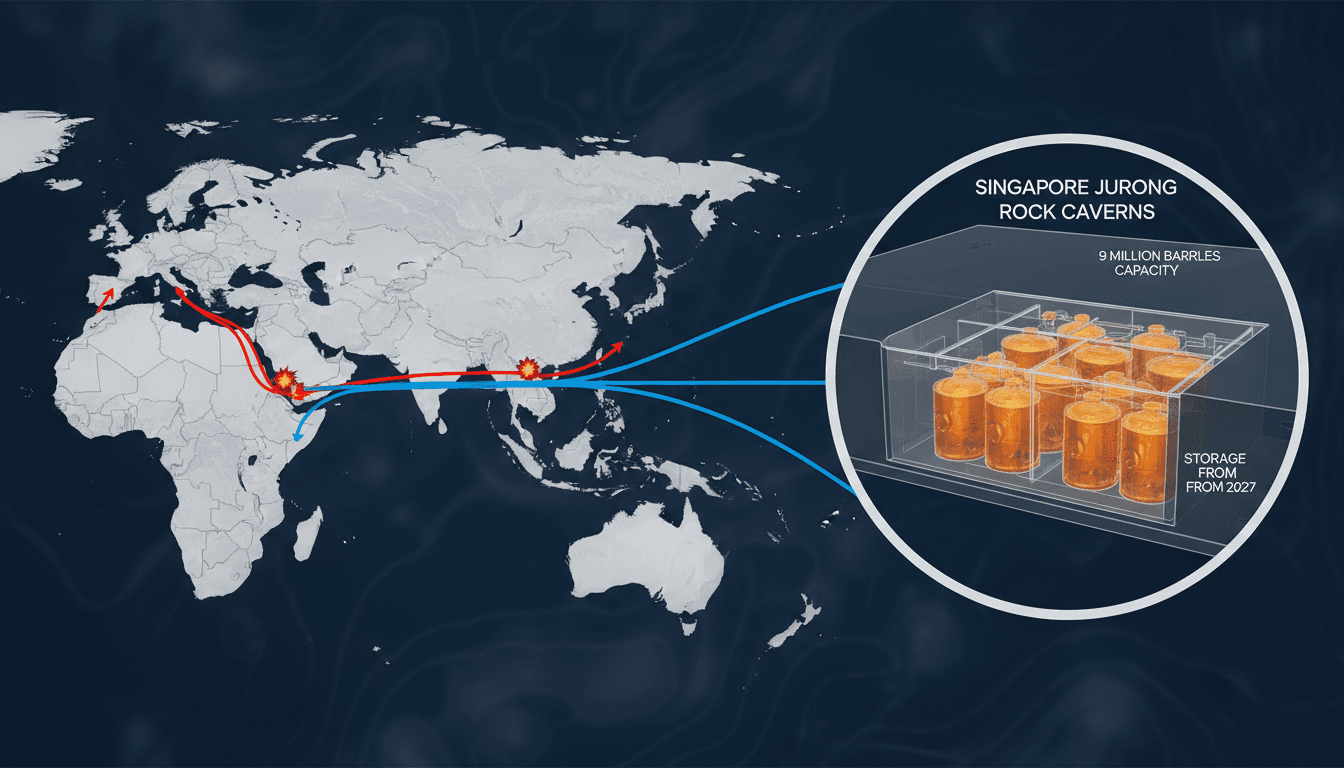
Why it matters
By securing 9 million barrels of underground storage in Southeast Asia, the world's largest crude exporter is fundamentally re-engineering its export architecture to hedge against persistent maritime disruptions along the Bab el-Mandeb and the Strait of Hormuz.
What happened (in 30 seconds)
- The Singapore agreement: On October 26, 2026, Saudi Arabia and Singapore announced at the Singapore International Energy Week that Saudi crude will be stored in Singapore’s Jurong Rock Caverns starting in the second half of 2027.
- The operational volume: The Jurong Rock Caverns facility provides underground liquid hydrocarbon capacity of up to 9 million barrels, creating an off-site commercial reserve near primary Asian refining hubs.
- The primary catalyst: The decision follows intensified Houthi attacks targeting Saudi energy assets, including the East-West pipeline, Yanbu and Rabigh refineries, and critical maritime shipping lanes along Yemen's Red Sea coast.
The context you actually need
- Choke point vulnerability: Saudi Arabia historically leveraged its East-West pipeline to bypass Gulf choke points and export via the Red Sea, but ongoing attacks on pumping stations and coastal terminals have compromised the corridor's reliability.
- Asian market dependency: Because the vast majority of Gulf crude heads east, maintaining uninterruptible flows to Asian buyers requires moving inventory physically past contested waters before localized security events occur.
- Singapore's strategic role: Singapore operates as Asia's primary pricing and physical distribution clearinghouse, making its deep underground rock caverns an ideal physical buffer for Saudi Aramco's long-term delivery commitments.
What's really happening
The decision to position crude inside Singapore's Jurong Rock Caverns represents an operational transition from point-of-origin distribution to forward-deployed commercial storage.
For decades, the standard Saudi export model relied on centralized storage at domestic terminals, dispatching supertankers through the Strait of Hormuz or pumping oil across the kingdom to Red Sea ports like Yanbu. This mechanism assumed that domestic infrastructure and dual-coast egress offered sufficient redundancy against localized conflict.
That assumption has been challenged by asymmetric operational threats. Since mid-2026, intensified Houthi strikes have targeted the East-West pipeline infrastructure, coastal refineries at Yanbu and Rabigh, and adjacent transport hubs. With Houthi forces expanding territorial control toward the Bab el-Mandeb Strait and broader tensions lingering around the Strait of Hormuz, the two primary maritime exits for Gulf crude face simultaneous operational friction.
By leasing capacity inside Singapore’s Jurong Rock Caverns—a subterranean complex holding up to 9 million barrels—Saudi Arabia is relocating a critical buffer beyond the reach of regional drone, missile, and naval interdiction. This shifts the point of supply risk.
For the buyer in Tokyo, Seoul, or Singapore, crude stored in Southeast Asia eliminates the transit risk across contested Middle Eastern waterways. If a regional escalation temporarily closes or delays tanker transits through the Bab el-Mandeb or the Strait of Hormuz, Saudi Aramco can fulfill immediate contracts directly from its Southeast Asian reserves.
The economic incentive is clear: moving 9 million barrels downstream allows Aramco to preserve market share in Asia against competing Atlantic Basin or Russian barrels that do not cross Middle Eastern choke points. For Singapore, hosting Saudi inventories solidifies its position as the premier energy trading hub in the Asia-Pacific while improving domestic refining access. Rather than absorbing higher maritime insurance premiums and convoy delays during periods of conflict, Saudi Arabia is embedding logistics resilience directly into its pricing and delivery mechanism.
Who feels it first (and how)
- Asia-Pacific refiners: Processors across Southeast and East Asia gain direct access to a stable, localized crude reserve, lowering supply chain disruption premiums starting in late 2027.
- Maritime logistics operators and insurers: Tanker fleets operating between the Persian Gulf and the Malacca Strait will see shifted shipping cadences as bulk storage transfers replace some spot-chartered, single-run deliveries.
- Regional corporate planners in Dubai and the Gulf: Operators managing cross-border logistics will see commercial energy security decoupled from localized Red Sea incidents, mitigating regional fuel cost spikes.
What to watch next
- Cavern injection timelines in late 2027: The pace at which Saudi Aramco fills the 9-million-barrel allocation will indicate whether this is an active commercial blending facility or a static emergency buffer.
- Houthi targeting shifts: Monitoring whether pipeline and pumping station attacks along the East-West corridor increase as maritime transit interdictions persist near the Bab el-Mandeb.
- Parallel Gulf state storage deals: Whether other Gulf energy producers follow Aramco's lead by securing dedicated commercial storage footprints in Asian distribution hubs like Singapore or South Korea.
Saudi Arabia and Singapore have formally agreed to store crude in the Jurong Rock Caverns starting in the second half of 2027, utilizing a site with up to 9 million barrels of total hydrocarbon capacity.
The storage buffer will reduce spot volatility for Asian refiners by bypassing shipment delays associated with the Red Sea and the Strait of Hormuz.
The exact volume allocation Aramco will maintain at any given time, and whether commercial lease terms include options to expand beyond the initial caverns framework.
Frequently Asked Questions
- Why it matters?
- By securing 9 million barrels of underground storage in Southeast Asia, the world's largest crude exporter is fundamentally re-engineering its export architecture to hedge against persistent maritime disruptions along the Bab el-Mandeb and the Strait of Hormuz.
- What happened (in 30 seconds)?
- The Singapore agreement: On October 26, 2026, Saudi Arabia and Singapore announced at the Singapore International Energy Week that Saudi crude will be stored in Singapore’s Jurong Rock Caverns starting in the second half of 2027. The operational volume: The Jurong Rock Caverns facility provides underground liquid hydrocarbon capacity of up to 9 million barrels, creating an off-site commercial reserve near primary Asian refining hubs. The primary catalyst: The decision follows intensified Houthi
- What's really happening?
- The decision to position crude inside Singapore's Jurong Rock Caverns represents an operational transition from point-of-origin distribution to forward-deployed commercial storage. For decades, the standard Saudi export model relied on centralized storage at domestic terminals, dispatching supertankers through the Strait of Hormuz or pumping oil across the kingdom to Red Sea ports like Yanbu. This mechanism assumed that domestic infrastructure and dual-coast egress offered sufficient redundanc
- Who feels it first (and how)?
- Asia-Pacific refiners: Processors across Southeast and East Asia gain direct access to a stable, localized crude reserve, lowering supply chain disruption premiums starting in late 2027. Maritime logistics operators and insurers: Tanker fleets operating between the Persian Gulf and the Malacca Strait will see shifted shipping cadences as bulk storage transfers replace some spot-chartered, single-run deliveries. Regional corporate planners in Dubai and the Gulf: Operators managing cross-border lo
- What to watch next?
- Cavern injection timelines in late 2027: The pace at which Saudi Aramco fills the 9-million-barrel allocation will indicate whether this is an active commercial blending facility or a static emergency buffer. Houthi targeting shifts: Monitoring whether pipeline and pumping station attacks along the East-West corridor increase as maritime transit interdictions persist near the Bab el-Mandeb. Parallel Gulf state storage deals: Whether other Gulf energy producers follow Aramco's lead by securing de
Global business headlines with AI angles.
"General business outlet that frequently covers AI."
— A47 Editor
Saudi Arabia Keeps Getting Hit by the Houthis. It Will Move Oil Elsewhere to Keep it Safer.
Saudi Arabia plans to store oil at Singapore's Jurong Rock Caverns starting in 2027, a move aimed at strengthening supply security as the kingdom continues to be targeted by Houthi rebel attacks in the region.
English-language reporting on Saudi politics, policy, and society.
"Saudi Gazette reflects mainstream Saudi institutional perspectives."
— A47 Editor
Saudi Arabia, Singapore announce plans for crude oil storage facility by 2027
Saudi Arabia and Singapore's energy ministries announced a joint intention to establish a crude oil storage arrangement in Singapore, with Saudi crude to be stored at the Jurong Rock Caverns on Jurong Island, with operations expected to begin in the ...
English-language reporting focused on Saudi Arabia and regional affairs.
"Saudi Gazette provides English-language coverage that often aligns with mainstream Saudi news priorities."
— A47 Editor
Saudi Arabia, Singapore announce plans for crude oil storage facility by 2027
Saudi Arabia and Singapore's energy ministries announced a joint intention to establish a crude oil storage arrangement in Singapore, with Saudi crude to be stored at the Jurong Rock Caverns on Jurong Island, with operations expected to begin in the ...
English-language digital publication covering business, politics, technology, and current affairs.
"The Arabian Post mixes original and syndicated-style coverage with a broad regional and global business-news orientation."
— A47 Editor
Singapore secures Saudi crude storage plan for 2027
Singapore and Saudi Arabia have agreed to pursue underground crude oil storage on Jurong Island from the second half of 2027, a proposed arrangement announced as Saudi Aramco signed a memorandum of understanding with Singapore's Energy Market Authori...
Editor-curated FT homepage stories spanning markets, business, world, and opinion.
"The Financial Times is a globally respected business publication with a centrist/center-left tone and strong markets focus."
— A47 Editor
Singapore to store Saudi oil in underground caverns
Singapore has agreed with Saudi Aramco to store Saudi crude oil in underground caverns, a arrangement aimed at securing energy supplies for south-east Asia as disruption from the Middle East war affects global flows. The Financial Times reported the ...
Oil, metals, and agriculture: supply/demand headlines, OPEC chatter, inventories, and price action.
"Solid tape for energy and metals traders tracking macro and micro catalysts."
— A47 Editor
Saudi Arabia to store crude oil in Singapore from mid-2027
Saudi Arabia plans to begin storing crude oil in Singapore from mid-2027, according to the base report published by Investing.com, which frames the move as a neutral development in the oil markets. The report centers on the Saudi-Singapore storage ar...