
Alphabet Posts Record Market Cap Loss After Earnings Miss as Microsoft Launches $25 Billion AI Bond Sale
Why it matters
The divergent market reception of Alphabet's earnings contraction and Microsoft's $25 billion debt placement marks the end of blanket investor patience for artificial intelligence outlays without direct cash-flow returns.
What happened (in 30 seconds)
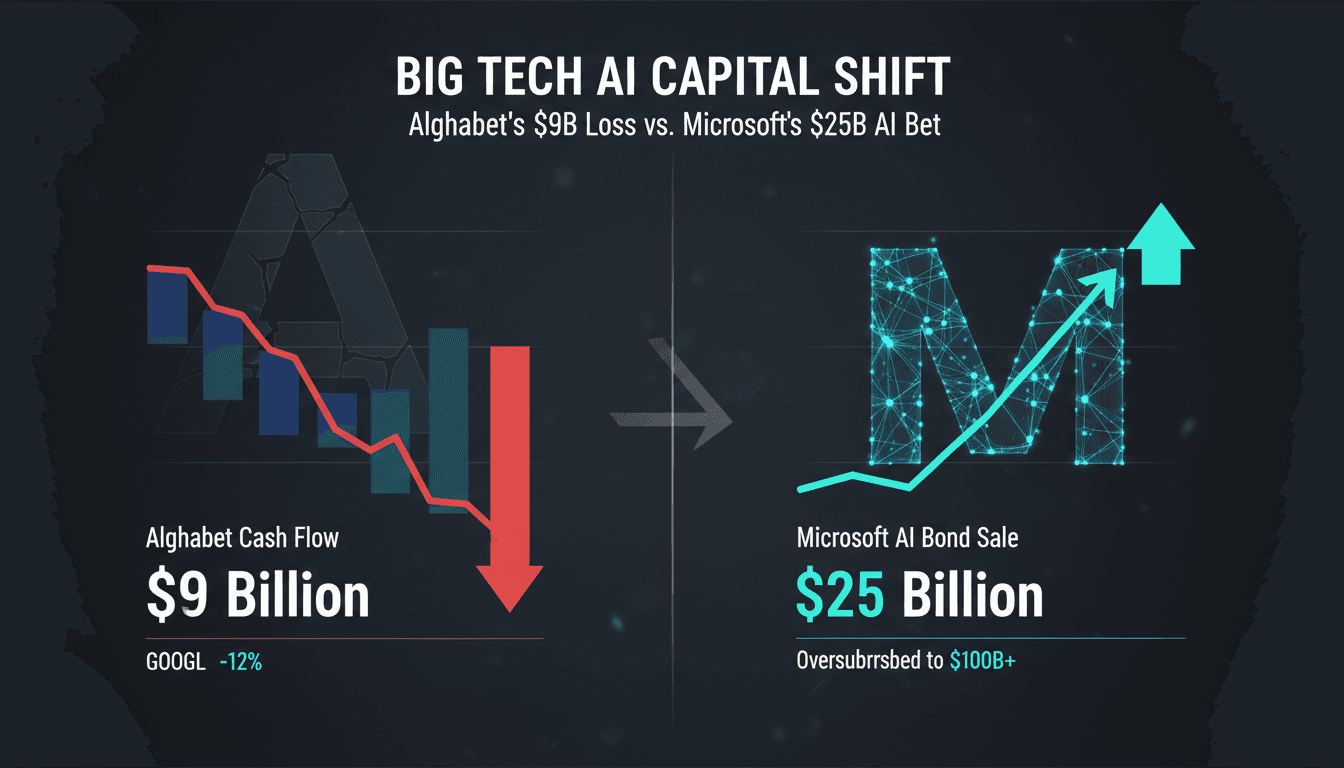
- Alphabet missed revenue targets by reporting $111.2 billion for the quarter, weighed down by search advertising growth slowing to 12% and negative free cash flow exceeding $9 billion.
- Alphabet lost roughly $500 billion in market value as its shares dropped between 10% and 13% during extended trading on October 29, 2026.
- Microsoft issued a $25 billion bond sale, marking its first debt offering since 2017 to fund artificial intelligence infrastructure, which drew over $100 billion to $115 billion in institutional orders backed by $18.6 billion in quarterly free cash flow.
The context you actually need
- Capital spending has surged since 2023, with major technology operators committing hundreds of billions of dollars to data center expansion, computing clusters, and specialized hardware.
- Monetization timelines remain uneven, as cloud computing segments report steady growth while generative tools risk cannibalizing core search and advertising margins.
- Supply constraints continue to bite, with delivery delays for enterprise-grade processors complicating the rollout schedule for multi-billion-dollar compute facilities.
What's really happening
The simultaneous market response to Alphabet's third-quarter earnings report and Microsoft's debt issuance reveals a fundamental shift in how institutional allocators value the generative infrastructure cycle.
For three years, equity markets rewarded sheer expenditure volume, treating capital outlays as proxies for long-term category dominance. Alphabet's performance disrupted that thesis. The company recorded $111.2 billion in revenue, missing analyst targets primarily due to a deceleration in search advertising growth down to 12%. Compounding this, operational spending and continued asset accumulation pushed Alphabet's free cash flow into a deficit exceeding $9 billion. The resulting equity repricing—a decline of 10% to 13%, wiping out approximately $500 billion in market capitalization—demonstrates that investors now evaluate whether artificial intelligence workflows are eroding legacy revenue channels before substitute monetization engines mature. When generative responses displace traditional sponsored links, the underlying cost-to-serve rises while ad conversion rates experience transition friction.
In contrast, Microsoft navigated its infrastructure demands by accessing fixed-income markets rather than relying solely on balance-sheet liquidity. The company announced a $25 billion corporate debt sale—its first borrowing program since 2017—to finance cloud network expansion. Institutional investors submitted bids exceeding $100 billion, with peak volume surpassing $115 billion. This divergence stems from underlying cash liquidity: Microsoft produced $18.6 billion in free cash flow during the same reporting period. By locking in long-term institutional debt to fund multi-year data center builds, Microsoft preserved its operating cash buffer while securing low-cost capital from fixed-income managers hunting for high-grade yields.
This split creates an incentive realignment across enterprise technology. Firms that maintain robust free cash margins can leverage investment-grade balance sheets to build computational advantages at scale. Conversely, firms forced to subsidize capital-intensive computing clusters directly out of weakening ad margins face direct multiple compression. The market is no longer treating artificial intelligence as a collective sector tailwind; it is penalizing companies whose capital expenditure cycles outpace their organic cash-generation mechanisms.
Who feels it first (and how)
- Global portfolio managers and sovereign allocators: Institutional funds with heavy allocations to large-cap technology indexes absorb the immediate volatility of Alphabet's $500 billion equity drawdown, forcing portfolio rebalancing into debt instruments.
- Corporate chief information officers: Technology leaders planning compute budgets will encounter increased pressure to justify software subscription add-ons as enterprise vendors recalibrate pricing to offset infrastructure costs.
- Regional asset owners in Dubai: Family offices and regional funds invested in cross-border equity equities experience mark-to-market fluctuations from Alphabet's drop, while their direct participation in U.S. investment-grade corporate paper remains bounded.
- Mergers and acquisitions desks: Broader platform transactions, such as DoorDash's proposed acquisition of Instacart, face closer scrutiny from market operators assessing consumer unit economics amid changing market liquidity.
What to watch next
- Free cash flow convergence: Monitor Alphabet's next two quarters to see whether capital spending moderates or if ad monetization recovers enough to reverse the negative $9 billion cash deficit.
- Debt-market appetite for hyperscalers: Track the secondary trading spreads on Microsoft's $25 billion issuance to gauge institutional willingness to finance additional tech-sector debt offerings.
- Search revenue composition: Measure the margin contribution of integrated generative search queries against traditional pay-per-click ad links to determine structural erosion rates.
Alphabet reported quarterly revenue of $111.2 billion, posted a free cash flow deficit exceeding $9 billion, saw ad search growth ease to 12%, and lost approximately $500 billion in market value. Microsoft generated $18.6 billion in free cash flow and raised $25 billion through a bond sale that drew more than $100 billion in bids.
Big Tech competitors will turn increasingly to investment-grade debt markets to finance future data center commitments rather than diluting cash positions or reducing share buybacks.
Whether search advertising margins will permanently contract due to higher inference costs, or if generative search interfaces will eventually yield higher monetizable intent than traditional link-based queries.
Frequently Asked Questions
- Why it matters?
- The divergent market reception of Alphabet's earnings contraction and Microsoft's $25 billion debt placement marks the end of blanket investor patience for artificial intelligence outlays without direct cash-flow returns.
- What happened (in 30 seconds)?
- Alphabet missed revenue targets by reporting $111.2 billion for the quarter, weighed down by search advertising growth slowing to 12% and negative free cash flow exceeding $9 billion. Alphabet lost roughly $500 billion in market value as its shares dropped between 10% and 13% during extended trading on October 29, 2026. Microsoft issued a $25 billion bond sale, marking its first debt offering since 2017 to fund artificial intelligence infrastructure, which drew over $100 billion to $115 billion
- What's really happening?
- The simultaneous market response to Alphabet's third-quarter earnings report and Microsoft's debt issuance reveals a fundamental shift in how institutional allocators value the generative infrastructure cycle. For three years, equity markets rewarded sheer expenditure volume, treating capital outlays as proxies for long-term category dominance. Alphabet's performance disrupted that thesis. The company recorded $111.2 billion in revenue, missing analyst targets primarily due to a deceleration i
- Who feels it first (and how)?
- Global portfolio managers and sovereign allocators: Institutional funds with heavy allocations to large-cap technology indexes absorb the immediate volatility of Alphabet's $500 billion equity drawdown, forcing portfolio rebalancing into debt instruments. Corporate chief information officers: Technology leaders planning compute budgets will encounter increased pressure to justify software subscription add-ons as enterprise vendors recalibrate pricing to offset infrastructure costs. Regional asse
- What to watch next?
- Free cash flow convergence: Monitor Alphabet's next two quarters to see whether capital spending moderates or if ad monetization recovers enough to reverse the negative $9 billion cash deficit. Debt-market appetite for hyperscalers: Track the secondary trading spreads on Microsoft's $25 billion issuance to gauge institutional willingness to finance additional tech-sector debt offerings. Search revenue composition: Measure the margin contribution of integrated generative search queries against tr
Technology business news, market impacts, and innovation trends.
"Bloomberg is a premier financial and tech news provider, respected for its in-depth reporting and analytical rigor."
— A47 Editor
Google Sales Miss Reignites AI Fears, Microsoft Eyes $25B Debt Offering
Alphabet, Google's parent company, saw its shares fall more than 13% after disappointing third-quarter search and advertising sales, erasing roughly $500 billion in market value in what was reported as its worst single-day decline on record, while Mi...
Technology business and AI-related headlines.
"Data-driven tech newsroom with global scope."
— A47 Editor
Google Sales Miss Reignites AI Fears, Microsoft Eyes $25B Debt Offering
Alphabet, Google's parent company, saw its shares fall more than 13% after disappointing third-quarter search and advertising sales, erasing roughly $500 billion in market value in what was reported as its worst single-day decline on record, while Mi...
Technology business news, market impacts, and innovation trends.
"Bloomberg is a premier financial and tech news provider, respected for its in-depth reporting and analytical rigor."
— A47 Editor
Alphabet Plunges by Record With AI Exposure Topping $1 Trillion
Alphabet Inc. shares fell sharply, setting a record decline after the company reported disappointing search and advertising sales, with the market plunge erasing more than $500 billion in market value as investors grew concerned that AI is eroding Go...
Technology business and AI-related headlines.
"Data-driven tech newsroom with global scope."
— A47 Editor
Alphabet Plunges by Record With AI Exposure Topping $1 Trillion
Alphabet Inc. shares fell sharply, setting a record decline after the company reported disappointing search and advertising sales, with the market plunge erasing more than $500 billion in market value as investors grew concerned that AI is eroding Go...
Global markets, investing, and macroeconomics from a premier financial newsroom.
"Bloomberg is respected for in-depth financial reporting and data-driven analysis."
— A47 Editor
Google Debt-Risk Gauge Rises as Earnings Revive AI Debt Jitters
Shares of Alphabet Inc. fell sharply on Thursday, and the cost of insuring against losses on its debt rose, after disappointing earnings intensified fears that its heavy debt-funded spending on artificial intelligence may not generate adequate return...
Technology business and AI-related headlines.
"Data-driven tech newsroom with global scope."
— A47 Editor
Microsoft and Alphabet Earnings Put Focus on AI Cash Flow Drain
Microsoft Corp. and Alphabet Inc. shares have diverged since their most recent earnings reports, as investors increasingly scrutinize how heavy artificial intelligence spending is weighing on corporate cash flow and bottom lines.
Technology business news, market impacts, and innovation trends.
"Bloomberg is a premier financial and tech news provider, respected for its in-depth reporting and analytical rigor."
— A47 Editor
Microsoft and Alphabet Earnings Put Focus on AI Cash Flow Drain
Microsoft Corp. and Alphabet Inc. shares have diverged since their most recent earnings reports, as investors increasingly scrutinize how heavy artificial intelligence spending is weighing on corporate cash flow and bottom lines.