
Wall Street Trading Firms Pay for Millisecond Early Access to Trump Truth Social Posts via Truth API
Why it matters
Financial infrastructure firms are paying up to $100,000 monthly to monetize a sub-second transmission edge on sovereign policy announcements.
What happened (in 30 seconds)
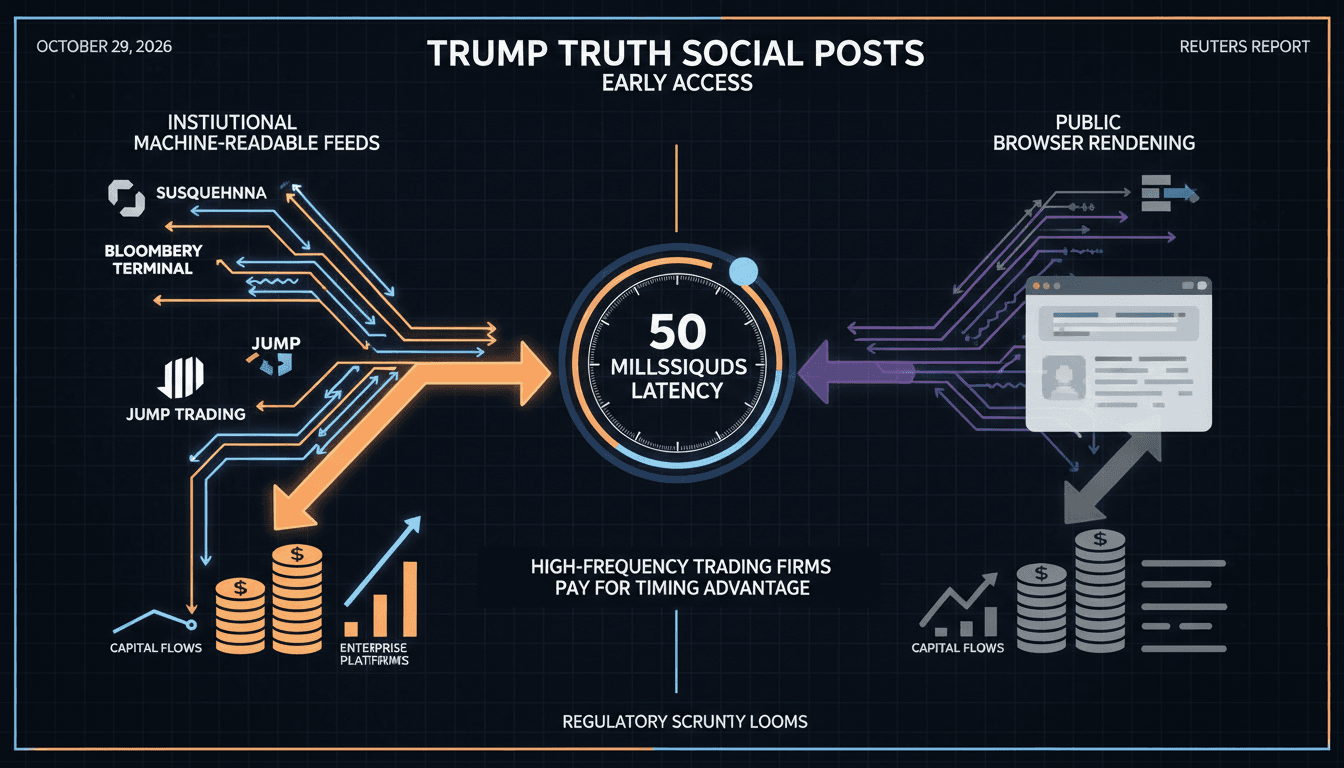
* Wall Street buys the pipe: Bloomberg, Susquehanna International Group, and Jump Trading subscribed to Trump Media & Technology Group's Truth API to ingest posts from key accounts, including President Donald Trump. * The structural edge: The specialized enterprise feed delivers raw data approximately 50 milliseconds ahead of standard public delivery networks. * The pricing model: Trump Media charges institutional clients $60,000 to $100,000 per month, already logging more than 10 paying customer contracts since launching on August 1, 2026.
The context you actually need
* Market-moving precedent: Presidential posts have repeatedly shifted global assets in real time, demonstrated by sharp oil futures declines following an April 2026 ceasefire message. * Corporate revenue pivot: Trump Media launched Truth API in July 2026 to diversify revenue as its underlying equity dropped more than 50% year-to-date, with the Trump family trust maintaining an approximate 41% ownership stake. * Mounting legal scrutiny: Following July 2026 requests from Democratic senators for an SEC inquiry, the Freedom of the Press Foundation and The Intercept filed an ongoing federal lawsuit in August 2026 alleging constitutional violations.
What's really happening
The commercialization of the Truth API exposes the financial mechanics of latency arbitrage applied directly to head-of-state communication. High-frequency trading firms do not evaluate political communications as rhetorical narrative; they process raw text as structured, directional signals designed to trigger algorithmic executions across futures, currencies, and sovereign debt.
In automated market architecture, 50 milliseconds is an operational lifetime. When a machine-readable feed arrives 50 milliseconds ahead of browser rendering or consumer push notifications, automated market-making algorithms can calculate sentiment, balance risk exposure, and execute orders across exchange order books before ordinary retail participants or non-subscribed institutions observe the event. By paying $60,000 to $100,000 every month, institutional desks are not purchasing political commentary; they are purchasing execution priority on exogenous macro shocks.
This structure sets up distinct commercial incentives. For Trump Media & Technology Group, building institutional enterprise feeds provides recurring, high-margin software revenue during an operating year where company stock has fallen by more than 50%. The product transforms volatile executive rhetoric into reliable enterprise software contracts. Rather than relying entirely on digital advertising or retail engagement metrics, the platform has monetized the regulatory and trade volatility generated by its primary user.
For institutional trading firms like Jump Trading and Susquehanna, subscribing is a defensive necessity. If automated desks do not ingest policy shifts on tariffs, trade negotiations, or international security at the fastest physically available latency, they risk being adversely selected by rival algorithms that do. The economic value of the data feed relies entirely on policy unpredictability: the more frequently spontaneous executive posts move bond yields, energy commodities, or equities, the higher the commercial return on an enterprise API subscription.
Trump Media positions the product as an ordinary commercial data service consistent with traditional media distribution networks. Yet, because the company's equity remains approximately 41% held by the Trump family trust, the monetized asset is the latency of sovereign communication itself. While the White House notes that neither the president nor his family directly manages active investment operations, the business model extracts private market cash flows directly from the speed of public governance announcements.
Who feels it first (and how)
* High-frequency market makers: Quantitative trading desks gain immediate order-routing priority, allowing algorithms to adjust bid-ask spreads and capture pricing discrepancies before general market participants can react. * Institutional asset managers: Traditional investment funds relying on public feeds or standard terminals face persistent execution drag, consistently buying or selling assets milliseconds behind API subscribers during flash volatility events. * Commodity and macro traders: Desks focused on energy, currencies, and sovereign debt must factor a two-tier information release model into their automated risk management frameworks. * Retail and cross-border investors: Global market participants, including international allocators in European and Middle Eastern financial hubs, absorb downstream pricing after automated algorithms have already cleared liquidity pools.
What to watch next
* Federal court rulings on access parity: The ongoing lawsuit brought by media and transparency groups tests whether monetizing latency for official presidential statements violates constitutional standards, establishing legal precedent for sovereign data distribution. * Regulatory positioning from the SEC: While the SEC declined comment following the initial July 2026 congressional scrutiny, any future formal enforcement position would reset how trading firms handle monetized executive communications. * Expansion of the customer base: Watch upcoming earnings disclosures from Trump Media to verify if institutional client counts expand beyond the initial cohort of 10 agreements, signaling wider institutional normalization of the service.
Trump Media operates a live, paid API charging $60,000 to $100,000 per month; Bloomberg, Susquehanna International Group, and Jump Trading are active subscribers; the feed provides an approximate 50-millisecond delivery advantage over public networks.
Algorithmic desks will continue paying premium enterprise fees as long as presidential posts maintain a verified track record of triggering immediate cross-asset market shifts.
Whether pending legal challenges will force the platform to make machine-readable presidential posts simultaneously accessible to the general public without latency tiers.
Frequently Asked Questions
- Why it matters?
- Financial infrastructure firms are paying up to $100,000 monthly to monetize a sub-second transmission edge on sovereign policy announcements.
- What happened (in 30 seconds)?
- Wall Street buys the pipe: Bloomberg, Susquehanna International Group, and Jump Trading subscribed to Trump Media & Technology Group's Truth API to ingest posts from key accounts, including President Donald Trump. The structural edge: The specialized enterprise feed delivers raw data approximately 50 milliseconds ahead of standard public delivery networks. The pricing model: Trump Media charges institutional clients $60,000 to $100,000 per month, already logging more than 10 paying customer cont
- What's really happening?
- The commercialization of the Truth API exposes the financial mechanics of latency arbitrage applied directly to head-of-state communication. High-frequency trading firms do not evaluate political communications as rhetorical narrative; they process raw text as structured, directional signals designed to trigger algorithmic executions across futures, currencies, and sovereign debt. In automated market architecture, 50 milliseconds is an operational lifetime. When a machine-readable feed arrives
- Who feels it first (and how)?
- High-frequency market makers: Quantitative trading desks gain immediate order-routing priority, allowing algorithms to adjust bid-ask spreads and capture pricing discrepancies before general market participants can react. Institutional asset managers: Traditional investment funds relying on public feeds or standard terminals face persistent execution drag, consistently buying or selling assets milliseconds behind API subscribers during flash volatility events. Commodity and macro traders: Desks
- What to watch next?
- Federal court rulings on access parity: The ongoing lawsuit brought by media and transparency groups tests whether monetizing latency for official presidential statements violates constitutional standards, establishing legal precedent for sovereign data distribution. Regulatory positioning from the SEC: While the SEC declined comment following the initial July 2026 congressional scrutiny, any future formal enforcement position would reset how trading firms handle monetized executive communicatio
Global business headlines with AI angles.
"General business outlet that frequently covers AI."
— A47 Editor
More Top Wall Street Firms Are Paying Up To $100,000 a Month to See Trump's Social Media Posts First
More top Wall Street firms are reportedly paying up to $100,000 a month for early access to President Trump's social media posts, according to reporting by International Business Times. The arrangement has drawn fresh scrutiny amid a federal lawsuit ...
Coverage of national news and events from across the United States.
"HuffPost is known for its progressive editorial stance, offering opinionated yet comprehensive coverage on social, political, and cultural topics."
— A47 Editor
Bloomberg, 2 Trading Firms Agree To Pay Trump's Truth Social For Faster Access To His Posts: Reuters
Bloomberg and two trading firms have agreed to pay Truth Social, the social media platform associated with Donald Trump, for faster access to his posts, according to Reuters. The arrangement, as reported in the base article, involves paying for earli...
Curated tech headlines including AI stories.
"Influential aggregator surfacing the day’s top tech/AI links."
— A47 Editor
Sources: Bloomberg, Susquehanna, and Jump Trading signed up for Truth Social's fast API feed of President Trump's posts, paying $60K to $100K per month (Reuters)
Bloomberg, Susquehanna, and Jump Trading have signed up for Truth Social's fast API feed of posts from President Donald Trump, according to sources cited by Reuters. The firms are reportedly paying between $60,000 and $100,000 per month for early acc...