
Anthropic Discloses $895.4 Billion in Compute and Infrastructure Commitments in Amended IPO Filing
Why it matters
The sheer scale of frontier AI compute obligations transforms software economics from flexible operating margins into fixed-capital industrial commitments, shifting financial leverage directly to cloud and hardware providers.
What happened (in 30 seconds)
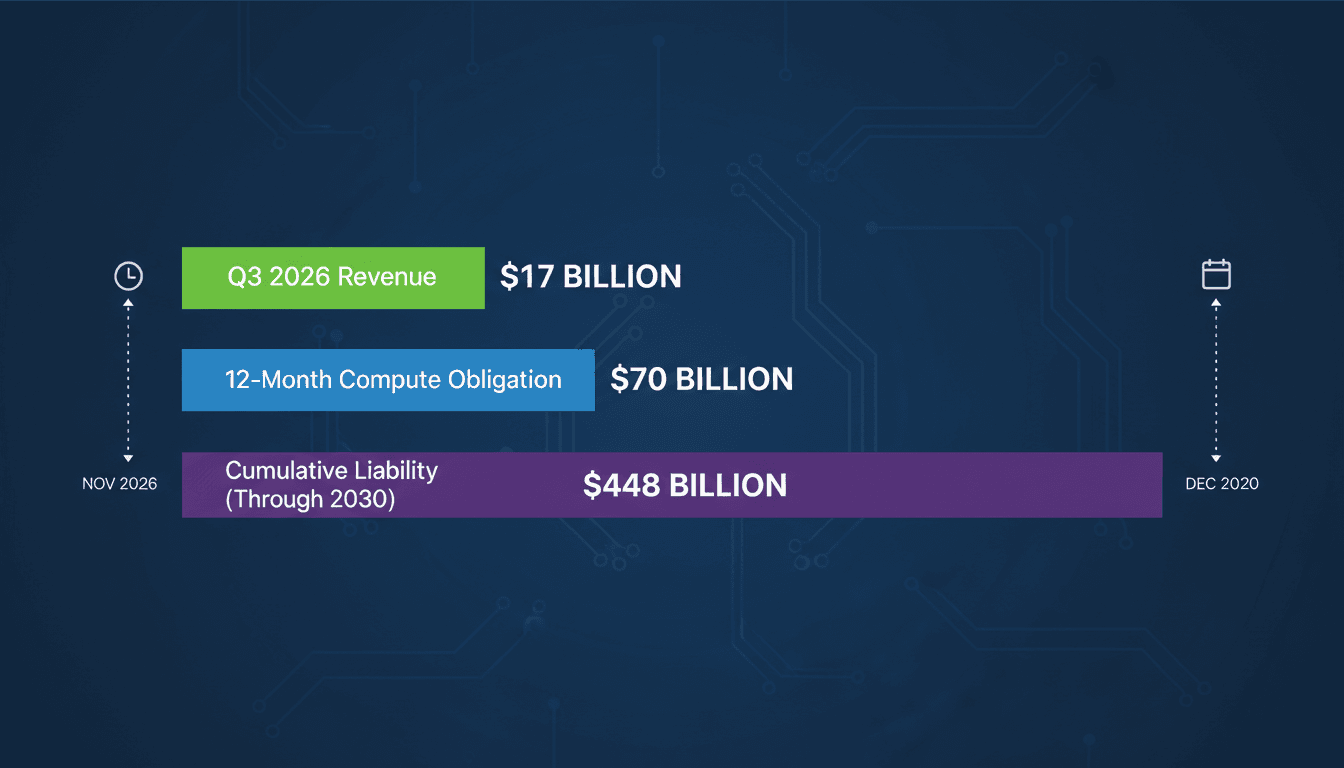
- An amended S-1 filing revealed $895.4 billion in infrastructure obligations. Anthropic disclosed aggregate purchase commitments and lease agreements for computing capacity, with roughly $70 billion due within the next 12 months and $448 billion scheduled through 2030.
- Top-line growth expanded alongside widening quarterly net losses. The company posted third-quarter 2026 revenue of approximately $17 billion—a twelve-fold rise from $1.4 billion a year prior—against a quarterly net loss of $23.3 billion.
- Hardware and cloud vendor stocks gained on confirmed order visibility. Shares of key suppliers including Amazon and SpaceX rose following the disclosure, which formally ties Anthropic’s model deployment to Amazon, Google, Microsoft, Broadcom, and SpaceX.
The context you actually need
- Frontier model training operates on non-negotiable take-or-pay terms. Anthropic’s SEC filing establishes that its compute obligations must be paid regardless of actual server utilization, while its inbound revenue remains tied to usage-based customer consumption.
- Sovereign and institutional capital funded the pre-IPO ramp. Prior financing rounds drew major capital from global institutions such as Wellington Management along with Gulf sovereign entities including Abu Dhabi’s MGX and the Qatar Investment Authority (QIA).
- Secondary commitments add further overhead. Beyond the core $895.4 billion baseline, the filing outlines additional non-fixed commitments estimated between $150 billion and $175 billion that could materialize as deployment expands.
What's really happening
The traditional software playbook depends on near-zero marginal costs: write the code once, deploy it globally, and expand gross margins as customer acquisition scales. Anthropic’s amended S-1 demonstrates that frontier artificial intelligence behaves less like pure software and more like capital-intensive infrastructure utility networks, defined by severe asset depreciation and rigid procurement obligations.
To secure access to cutting-edge clusters, Anthropic has entered binding agreements with infrastructure vendors including Amazon, Google, Microsoft, Broadcom, and SpaceX. These suppliers require upfront commitments to justify their own hardware buildouts and power grid leases. Consequently, Anthropic has shouldered $895.4 billion in liabilities. The core financial tension lies in the structural mismatch between contract types. Anthropic’s expenses are fixed and mandatory: approximately $70 billion must be settled over the next twelve months alone, with $448 billion committed through 2030. By contrast, its commercial revenue remains largely variable, derived from developers and corporate customers paying for API calls and model usage as needed.
This revenue model performed remarkably well in the third quarter of 2026, delivering roughly $17 billion in revenue—a twelve-fold expansion compared to the $1.4 billion recorded in the same period of 2025. Yet that rapid growth was outpaced by delivery costs, resulting in a net quarterly loss of $23.3 billion. When non-fixed operational additions of $150 billion to $175 billion are factored in, Anthropic is managing a total compute bill that hovers near $1 trillion across its planning horizon.
The market incentives behind this structure favor upstream infrastructure owners. Amazon, Google, and Microsoft function not merely as capital backers or equity partners, but as primary commercial vendors capturing guaranteed revenue streams. By converting Anthropic’s prospective public equity value into multi-year compute commitments, cloud and semiconductor vendors have hedged their own capital expenditures. If demand for Claude and enterprise reasoning engines continues its current trajectory, Anthropic secures the physical compute required to compete at the frontier. If customer demand moderates, however, Anthropic remains legally responsible for servicing fixed-capacity leases out of operating reserves or fresh equity dilution.
Who feels it first (and how)
- Enterprise software buyers and CFOs: Organizations relying on consumption-based pricing for frontier models will find that vendors face little incentive to discount foundational model access while servicing $70 billion in near-term fixed hardware debt.
- Hyperscale cloud providers and semiconductor partners: Firms such as Amazon, Google, Microsoft, and Broadcom gain unprecedented revenue visibility, as their infrastructure outlays are backstopped by binding long-term contracts.
- Pre-IPO institutional investors: Backers like Wellington Management, alongside sovereign vehicles including MGX and QIA, now face public market evaluation based on whether quarterly enterprise revenue can catch up with a nearly $900 billion obligations ledger.
- Frontier AI competitors: Rival model developers face heightened barriers to entry, as the baseline capital threshold for competing at the frontier now demands multi-hundred-billion-dollar infrastructure guarantees.
What to watch next
- The timing and valuation of the IPO: With filing amendments underway for an offering targeted ahead of U.S. Thanksgiving, public equity pricing will establish whether institutional markets are willing to absorb a company balancing $17 billion in quarterly revenue against $23.3 billion in quarterly net losses.
- Contract utilization ratios: Watch subsequent quarterly disclosures to see whether Anthropic's enterprise intake fills the committed capacity, as excess unused compute must still be funded in full.
- Supplier earnings revisions: Financial updates from key partners like Amazon, Google, and Broadcom will show the speed at which Anthropic’s multi-year purchase agreements convert into recognized commercial revenue.
Anthropic has formally filed an amended SEC S-1 confirming $895.4 billion in infrastructure purchase and lease commitments, including roughly $70 billion due over the next twelve months, with third-quarter 2026 revenue of roughly $17 billion against a $23.3 billion net loss.
The planned public offering will set benchmark valuation multiples for how public markets evaluate capital-intensive frontier AI providers against traditional software firms.
Whether variable enterprise customer consumption can scale quickly enough across 2027 and 2028 to prevent ongoing balance-sheet compression from mandatory take-or-pay agreements.
Frequently Asked Questions
- Why it matters?
- The sheer scale of frontier AI compute obligations transforms software economics from flexible operating margins into fixed-capital industrial commitments, shifting financial leverage directly to cloud and hardware providers.
- What happened (in 30 seconds)?
- An amended S-1 filing revealed $895.4 billion in infrastructure obligations. Anthropic disclosed aggregate purchase commitments and lease agreements for computing capacity, with roughly $70 billion due within the next 12 months and $448 billion scheduled through 2030. Top-line growth expanded alongside widening quarterly net losses. The company posted third-quarter 2026 revenue of approximately $17 billion—a twelve-fold rise from $1.4 billion a year prior—against a quarterly net loss of $23.3 bi
- What's really happening?
- The traditional software playbook depends on near-zero marginal costs: write the code once, deploy it globally, and expand gross margins as customer acquisition scales. Anthropic’s amended S-1 demonstrates that frontier artificial intelligence behaves less like pure software and more like capital-intensive infrastructure utility networks, defined by severe asset depreciation and rigid procurement obligations. To secure access to cutting-edge clusters, Anthropic has entered binding agreements wi
- Who feels it first (and how)?
- Enterprise software buyers and CFOs: Organizations relying on consumption-based pricing for frontier models will find that vendors face little incentive to discount foundational model access while servicing $70 billion in near-term fixed hardware debt. Hyperscale cloud providers and semiconductor partners: Firms such as Amazon, Google, Microsoft, and Broadcom gain unprecedented revenue visibility, as their infrastructure outlays are backstopped by binding long-term contracts. Pre-IPO institution
- What to watch next?
- The timing and valuation of the IPO: With filing amendments underway for an offering targeted ahead of U.S. Thanksgiving, public equity pricing will establish whether institutional markets are willing to absorb a company balancing $17 billion in quarterly revenue against $23.3 billion in quarterly net losses. Contract utilization ratios: Watch subsequent quarterly disclosures to see whether Anthropic's enterprise intake fills the committed capacity, as excess unused compute must still be funded
Technology business and AI-related headlines.
"Data-driven tech newsroom with global scope."
— A47 Editor
Anthropic to Spend $895 Billion in the Years Ahead
Anthropic, the maker of the Claude chatbot, revealed it plans to spend more than $895 billion in the years ahead, ahead of its highly anticipated public market debut. The company also disclosed that its quarterly revenue rose twelve-fold from the pri...
Technology business news, market impacts, and innovation trends.
"Bloomberg is a premier financial and tech news provider, respected for its in-depth reporting and analytical rigor."
— A47 Editor
Anthropic to Spend $895 Billion in the Years Ahead
Anthropic, the maker of the Claude chatbot, revealed it plans to spend more than $895 billion in the years ahead, ahead of its highly anticipated public market debut. The company also disclosed that its quarterly revenue rose twelve-fold from the pri...
Editor-curated FT homepage stories spanning markets, business, world, and opinion.
"The Financial Times is a globally respected business publication with a centrist/center-left tone and strong markets focus."
— A47 Editor
Anthropic reveals $900bn AI spending commitments ahead of IPO
Anthropic, the AI company behind the Claude chatbot, has revealed roughly $900bn in AI spending commitments ahead of a planned US initial public offering, according to the Financial Times. The disclosure comes as the company's infrastructure costs ar...
Daily AI news: models, tools, and policy.
"Independent outlet tracking the fast pace of AI."
— A47 Editor
Anthropic grows revenue twelvefold but posts $23 billion loss
Anthropic, the San Francisco-based AI company behind the Claude chatbot, reported roughly twelvefold year-over-year revenue growth in its latest quarter, reaching nearly $17 billion, while posting a net loss of about $23.3 billion, according to its S...