
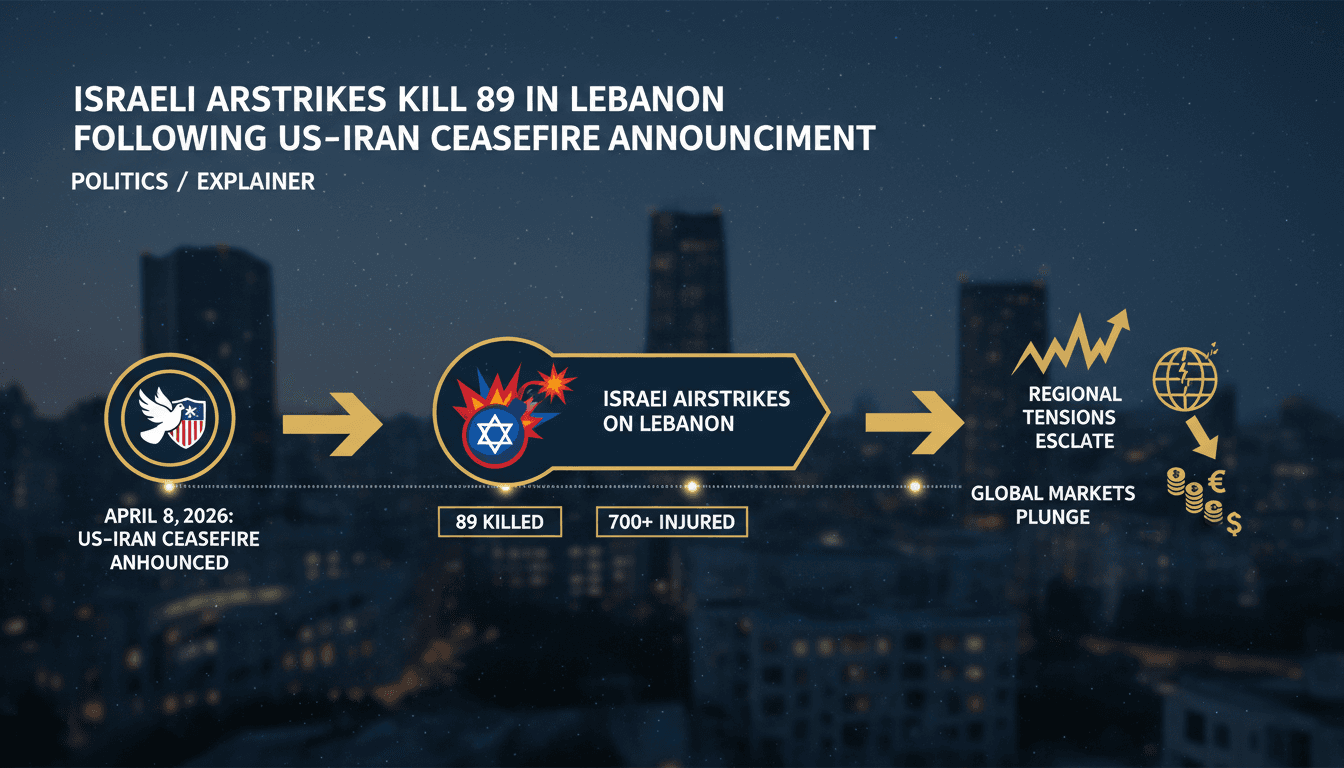
Israeli Airstrikes Kill 89 in Lebanon Following US-Iran Ceasefire Announcement
Here's what it means for you.
The escalation in Lebanon could disrupt regional stability, impacting global markets and travel.
Why it matters
The airstrikes signal a significant escalation in the Israel-Hezbollah conflict, which could have broader implications for Middle Eastern stability and global oil prices.
What happened (in 30 seconds)
- On April 8, 2026, Israeli airstrikes targeted Hezbollah positions across Lebanon, resulting in at least 89 deaths and over 700 injuries.
- The strikes occurred shortly after a U.S.-brokered ceasefire was announced between the U.S., Israel, and Iran, which Israel claimed did not apply to Hezbollah.
- Lebanon's Health Ministry reported the casualties, marking one of the deadliest days in the ongoing conflict.
The context you actually need
- The airstrikes are part of an ongoing conflict between Israel and Hezbollah, exacerbated by U.S.-Iran tensions and Hezbollah's support for Iran-backed operations.
- Israel's military operations are justified by the government as necessary to counter Hezbollah's military capabilities, which they view as a direct threat.
- The ceasefire announcement by President Trump was intended to ease tensions but did not include provisions for Hezbollah, highlighting the complexities of regional alliances.
What's really happening
The airstrikes on April 8, 2026, represent a critical moment in the ongoing Israel-Hezbollah conflict, which has been intensifying due to a confluence of factors. The Israeli military launched over 100 airstrikes targeting Hezbollah infrastructure in Lebanon, including densely populated areas such as Beirut and the Bekaa Valley. This operation came just hours after U.S. President Donald Trump announced a ceasefire agreement with Iran, aimed at facilitating safe transit in the Strait of Hormuz, a vital shipping route for global oil. However, Israeli officials quickly clarified that this ceasefire did not extend to Hezbollah, asserting their right to act against what they perceive as a significant threat.
The airstrikes resulted in at least 89 fatalities and hundreds of injuries, with reports indicating that medical facilities were also affected. This level of violence marks one of the deadliest days in the ongoing conflict, raising alarms about the humanitarian impact and the potential for further escalation. Hezbollah's response has been one of condemnation and promises of retaliation, indicating that the cycle of violence is likely to continue.
The broader implications of these events extend beyond the immediate casualties. The ongoing conflict has significant ramifications for regional stability, particularly as it intertwines with U.S.-Iran relations. The announcement of a ceasefire, while intended to de-escalate tensions, has highlighted the complexities of the situation, as Israel maintains that Hezbollah's actions fall outside the agreement's scope. This creates a precarious balance where military actions can undermine diplomatic efforts, leading to a cycle of violence that can destabilize the region.
Additionally, the airstrikes have triggered economic repercussions, particularly in the Gulf states. The UAE and Saudi Arabia issued travel warnings, affecting regional economies and prompting volatility in stock markets. The impact on oil prices is also noteworthy, as concerns about the security of the Strait of Hormuz could lead to increased prices, affecting global markets.
Who feels it first (and how)
- Travelers: Increased travel warnings and flight disruptions in the UAE and Saudi Arabia.
- Investors: Stock market volatility in Dubai and Abu Dhabi, with potential losses in the billions.
- Local populations: Civilians in Lebanon facing humanitarian crises due to casualties and infrastructure damage.
What to watch next
- Hezbollah's response: Their potential retaliation could escalate military actions further, impacting regional stability.
- U.S. diplomatic efforts: Watch for any shifts in U.S. policy regarding Israel and Iran, which could influence future conflicts.
- Oil market fluctuations: Monitor oil prices for spikes related to security concerns in the Strait of Hormuz, which could affect global economies.
At least 89 people killed and over 700 injured in the airstrikes.
Continued military operations by Israel against Hezbollah and potential retaliatory actions from Hezbollah.
The long-term impact on U.S.-Iran relations and the effectiveness of diplomatic efforts to stabilize the region.
Frequently Asked Questions
- Why it matters?
- The airstrikes signal a significant escalation in the Israel-Hezbollah conflict, which could have broader implications for Middle Eastern stability and global oil prices.
- What happened (in 30 seconds)?
- On April 8, 2026, Israeli airstrikes targeted Hezbollah positions across Lebanon, resulting in at least 89 deaths and over 700 injuries. The strikes occurred shortly after a U.S.-brokered ceasefire was announced between the U.S., Israel, and Iran, which Israel claimed did not apply to Hezbollah. Lebanon's Health Ministry reported the casualties, marking one of the deadliest days in the ongoing conflict.
- What's really happening?
- The airstrikes on April 8, 2026, represent a critical moment in the ongoing Israel-Hezbollah conflict, which has been intensifying due to a confluence of factors. The Israeli military launched over 100 airstrikes targeting Hezbollah infrastructure in Lebanon, including densely populated areas such as Beirut and the Bekaa Valley. This operation came just hours after U.S. President Donald Trump announced a ceasefire agreement with Iran, aimed at facilitating safe transit in the Strait of Hormuz, a
- Who feels it first (and how)?
- Travelers: Increased travel warnings and flight disruptions in the UAE and Saudi Arabia. Investors: Stock market volatility in Dubai and Abu Dhabi, with potential losses in the billions. Local populations: Civilians in Lebanon facing humanitarian crises due to casualties and infrastructure damage.
- What to watch next?
- Hezbollah's response: Their potential retaliation could escalate military actions further, impacting regional stability. U.S. diplomatic efforts: Watch for any shifts in U.S. policy regarding Israel and Iran, which could influence future conflicts. Oil market fluctuations: Monitor oil prices for spikes related to security concerns in the Strait of Hormuz, which could affect global economies.
International coverage from The Guardian's global desks.
"The Guardian is known for its progressive editorial stance and in-depth analysis."
— A47 Editor
At least 254 killed after Israel hits Lebanon with massive wave of airstrikes
Israel has conducted its largest airstrike on Lebanon since the onset of its conflict with Hezbollah, resulting in at least 254 fatalities and 837 injuries. This unprecedented assault targeted multiple buildings in Beirut, marking a significant escal...
National headlines across the United States including breaking stories and societal issues.
"NBC News is a mainstream media outlet known for comprehensive national and international news coverage with a centrist to slightly left-leaning editorial tone."
— A47 Editor
Video shows strike in Lebanon as Israel launches attacks
Recent video footage has captured a strike in Lebanon as Israel escalates its military operations, intensifying airstrikes against Hezbollah and causing widespread panic among civilians. The situation has led to significant displacement, with over 1 ...
24/7 international news from a French perspective in multiple languages.
"France 24 is viewed as a globally focused outlet with balanced coverage and a European perspective."
— A47 Editor
Israel pounds Lebanon with heaviest air strikes of the war
Israel has intensified its military operations in Lebanon, executing its heaviest airstrikes since the conflict with Hezbollah began last month, despite a ceasefire agreement between the US and Iran. The strikes have targeted multiple neighborhoods i...
24/7 international news from a French perspective in multiple languages.
"France 24 is viewed as a globally focused outlet with balanced coverage and a European perspective."
— A47 Editor
Israel pounds Beirut as Lebanon left out of ceasefire deal
Israeli airstrikes have intensified across Lebanon, particularly in Beirut, resulting in dozens of fatalities and hundreds of injuries. This escalation occurred despite a ceasefire agreement between the United States and Iran, which Israel claims doe...
Comprehensive coverage of Middle Eastern and global issues.
"Al Jazeera is a prominent voice from the Global South, especially the Middle East, with an emphasis on underreported stories."
— A47 Editor
Israel launches 100 air strikes in 10 minutes across Lebanon
Israel has launched an unprecedented wave of military action, executing 100 air strikes across Lebanon in just 10 minutes, marking a significant escalation in the ongoing conflict. This surge in airstrikes has particularly targeted central Beirut, le...
Global news coverage with extensive reporting on Middle Eastern conflicts and geopolitics.
"Al Jazeera is a Qatar-based broadcaster known for wide regional coverage and alternative perspectives."
— A47 Editor
Israel strikes central Beirut without warning
Israeli airstrikes targeted central Beirut without warning, resulting in numerous casualties, with reports indicating dozens killed and hundreds wounded. This escalation follows a recent ceasefire agreement between the United States and Iran, which I...
Comprehensive coverage of Middle Eastern and global issues.
"Al Jazeera is a prominent voice from the Global South, especially the Middle East, with an emphasis on underreported stories."
— A47 Editor
Israel strikes central Beirut without warning
Israeli airstrikes have targeted central Beirut without warning, resulting in numerous casualties and extensive damage across multiple neighborhoods. This military action follows a ceasefire agreement between the United States and Iran, which Israel ...