
Tech Transparency Project Exposes Apple and Google for Promoting Policy-Violating Nudify Apps
Here's what it means for you.
As a user, your app store experience may be compromised by algorithms prioritizing profit over safety.
Why it matters
This incident highlights significant failures in content moderation by major tech companies, raising concerns about user safety and ethical standards in app distribution.
What happened (in 30 seconds)
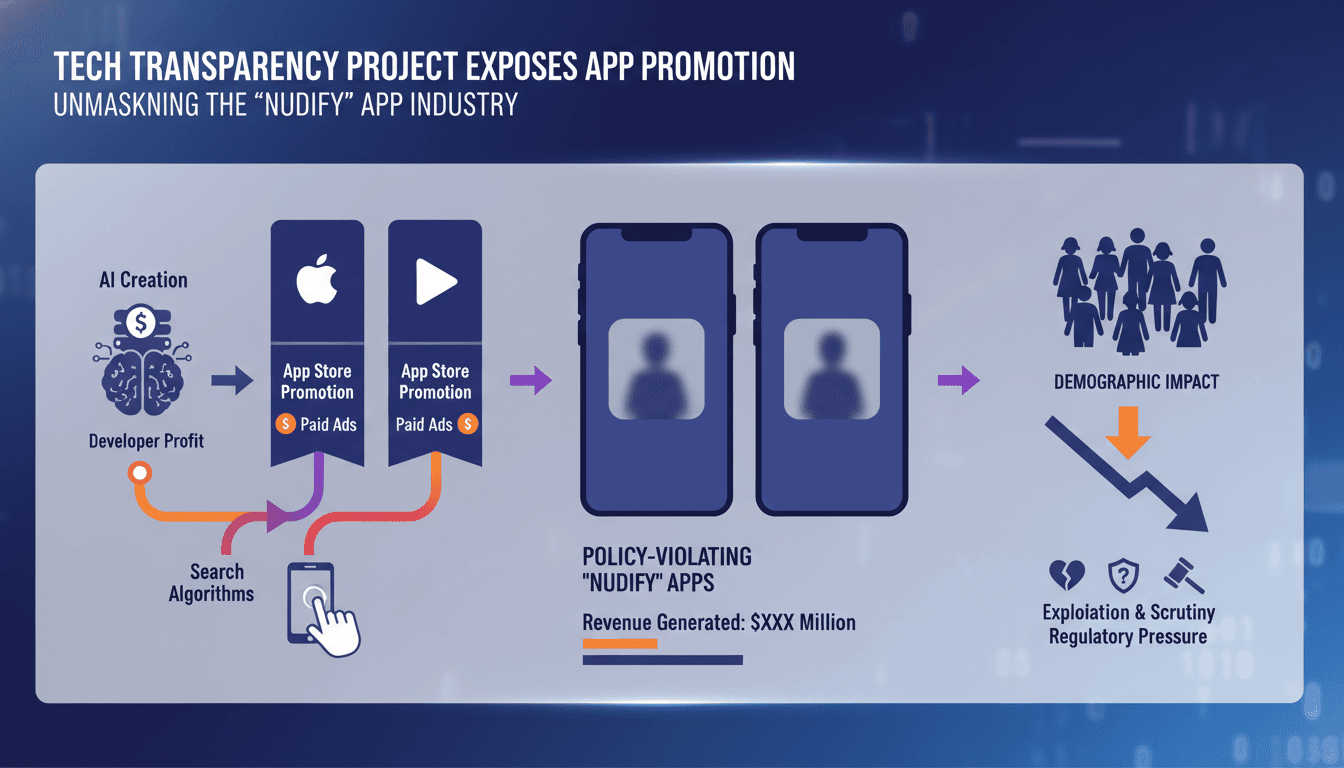
- April 15, 2026: The Tech Transparency Project released a report revealing that Apple and Google directed users to 'nudify' apps that violate their content policies.
- 483 million downloads: The identified apps generated significant revenue, with 31 of them rated suitable for minors.
- Partial removals: Following the report, Apple and Google took action by removing some apps but continued to promote others through search functions.
The context you actually need
- Generative AI tools: Since 2023, advancements in AI have enabled the creation of 'nudify' applications that can digitally alter images to produce nonconsensual explicit content.
- Initial findings: In January 2026, the Tech Transparency Project identified over 100 such apps, prompting partial removals by both companies.
- Ongoing issues: Despite initial actions, many apps persisted in modified forms, raising alarms about the effectiveness of content moderation practices.
What's really happening
The Tech Transparency Project's report underscores a troubling trend in the app ecosystem, where profit motives can overshadow user safety. The identified 'nudify' apps, which exploit generative AI technology, have gained traction due to their ability to create nonconsensual deepfake images. This not only violates the explicit content policies of Apple and Google but also poses significant risks to individuals, particularly women, who are often the targets of such applications.
The investigation revealed that these apps collectively amassed 483 million downloads and generated over $122 million in revenue. This financial success is likely a driving factor behind the companies' initial reluctance to fully remove these apps from their platforms. The report indicates that 40% of the identified apps were actively promoted through search suggestions, sponsored ads, and result carousels, effectively steering users toward content that contravenes established guidelines.
The structural implications of this situation are profound. Both Apple and Google operate under a dual mandate: to provide a safe user experience while maximizing revenue from app developers. This conflict of interest can lead to inadequate enforcement of content policies, as seen in the case of the nudify apps. The companies' responses to the report—partial removals and blocking certain search terms—suggest a reactive rather than proactive approach to content moderation.
Moreover, the presence of apps rated suitable for minors raises ethical questions about the effectiveness of age rating systems and the responsibilities of tech companies in safeguarding vulnerable users. Advocacy groups have criticized the platforms for profiting from exploitation, highlighting the need for more stringent oversight and accountability in the app marketplace.
As the landscape of generative AI continues to evolve, the potential for misuse will likely grow, necessitating a reevaluation of content moderation strategies. The ongoing enforcement actions by Apple and Google may serve as a litmus test for their commitment to user safety and ethical standards in the face of emerging technologies.
Who feels it first (and how)
- App developers: Those creating and distributing apps may face stricter scrutiny and potential revenue loss due to increased regulation.
- Consumers: Users, especially minors, are at risk of exposure to harmful content and exploitation.
- Advocacy groups: Organizations focused on digital rights and safety will likely increase pressure on tech companies for better protections.
What to watch next
- Increased regulation: Watch for potential legislative actions aimed at tightening content moderation standards in app stores, which could reshape the app marketplace.
- User backlash: Monitor consumer reactions to these findings, as public sentiment may drive changes in how companies approach app safety.
- Technological advancements: Keep an eye on developments in AI moderation tools that could enhance the ability of platforms to detect and remove harmful content proactively.
Apple and Google have removed some nudify apps and are blocking certain search terms.
Increased regulatory scrutiny on app stores will lead to more stringent content moderation practices.
The long-term impact on user trust and app developer behavior remains uncertain.
Frequently Asked Questions
- Why it matters?
- This incident highlights significant failures in content moderation by major tech companies, raising concerns about user safety and ethical standards in app distribution.
- What happened (in 30 seconds)?
- April 15, 2026: The Tech Transparency Project released a report revealing that Apple and Google directed users to 'nudify' apps that violate their content policies. 483 million downloads: The identified apps generated significant revenue, with 31 of them rated suitable for minors. Partial removals: Following the report, Apple and Google took action by removing some apps but continued to promote others through search functions.
- What's really happening?
- The Tech Transparency Project's report underscores a troubling trend in the app ecosystem, where profit motives can overshadow user safety. The identified 'nudify' apps, which exploit generative AI technology, have gained traction due to their ability to create nonconsensual deepfake images. This not only violates the explicit content policies of Apple and Google but also poses significant risks to individuals, particularly women, who are often the targets of such applications. The investigatio
- Who feels it first (and how)?
- App developers: Those creating and distributing apps may face stricter scrutiny and potential revenue loss due to increased regulation. Consumers: Users, especially minors, are at risk of exposure to harmful content and exploitation. Advocacy groups: Organizations focused on digital rights and safety will likely increase pressure on tech companies for better protections.
- What to watch next?
- Increased regulation: Watch for potential legislative actions aimed at tightening content moderation standards in app stores, which could reshape the app marketplace. User backlash: Monitor consumer reactions to these findings, as public sentiment may drive changes in how companies approach app safety. Technological advancements: Keep an eye on developments in AI moderation tools that could enhance the ability of platforms to detect and remove harmful content proactively.
Latest tech news, product reviews, and analysis for consumers and professionals.
"CNET delivers accessible and detailed technology reporting, including trusted product reviews and how-to guides."
— A47 Editor
Apple and Google Broke Their Own Rules by Promoting 'Nudify' Apps, Report Says
A report from the Tech Transparency Project has revealed that over 100 apps available on Apple and Google's app stores are designed to create nonconsensual sexualized images, violating the companies' own policies against such content. This situation ...
Independent journalism covering technology, AI, and digital culture.
"An independent newsroom by veteran tech reporters known for critical, investigative coverage of AI and tech power."
— A47 Editor
App Stores Push Users Toward Nudify Apps, New Research Shows
Recent findings from the Tech Transparency Project indicate that app stores operated by Google and Apple not only host harmful nudify applications but also actively guide users towards them, raising serious ethical concerns.
Photography news including AI tools and ethics.
"Covers AI’s impact on imaging and creative workflows."
— A47 Editor
Apple and Google Direct Users to AI ‘Nudify’ Apps: Report
A recent investigation revealed that Apple and Google are directing users to applications that create deepfake nude images, raising significant ethical concerns regarding privacy and consent. Despite their stated policies against such content, these ...
Curated tech headlines including AI stories.
"Influential aggregator surfacing the day’s top tech/AI links."
— A47 Editor
A TTP analysis finds dozens of nudify apps in Apple and Google app stores via search, despite company policy prohibiting them; the apps earned $122M+ in revenue (Bloomberg)
A recent analysis by the Tech Transparency Project has revealed that Apple Inc. and Google continue to host numerous nudify apps in their app stores, despite their policies prohibiting such content. These applications, which allow users to create non...
Technology business and AI-related headlines.
"Data-driven tech newsroom with global scope."
— A47 Editor
Apple, Google Offer ‘Nudify’ Apps Despite Policies Against Them
A report by the Tech Transparency Project reveals that Apple Inc. and Google continue to offer mobile applications that enable users to create nonconsensual sexualized images of individuals, despite their stated policies against such content. This ra...
Technology business news, market impacts, and innovation trends.
"Bloomberg is a premier financial and tech news provider, respected for its in-depth reporting and analytical rigor."
— A47 Editor
Apple, Google Offer ‘Nudify’ Apps Despite Policies Against Them
A report by the Tech Transparency Project reveals that Apple Inc. and Google continue to offer mobile applications that enable users to create nonconsensual sexualized images of individuals, despite their stated policies against such content. This ra...