
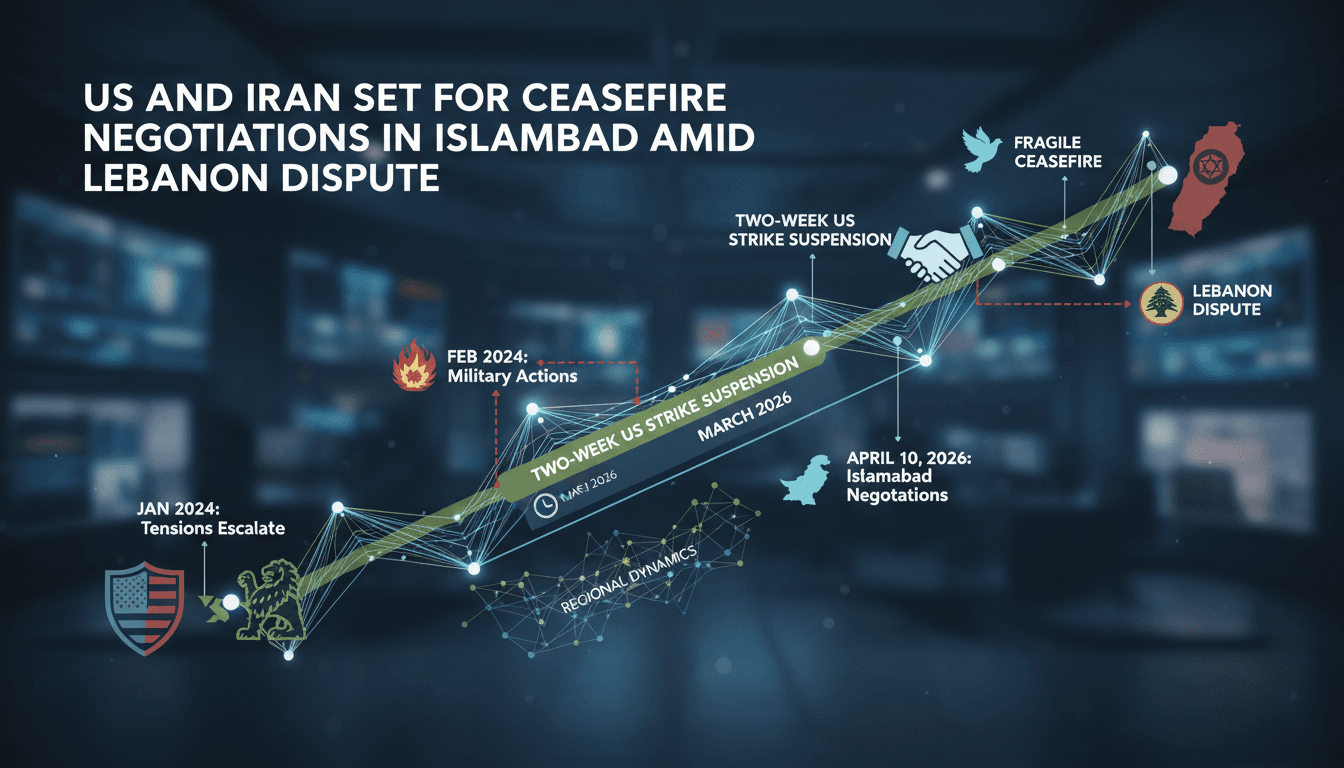
US and Iran Set for Ceasefire Negotiations in Islamabad Amid Lebanon Dispute
Here's what it means for you.
The outcome of these negotiations could reshape energy markets and geopolitical stability, impacting global trade and fuel prices.
Why it matters
This ceasefire negotiation is crucial for regional stability and could influence global oil prices and security dynamics.
What happened (in 30 seconds)
- Negotiations are set to begin on April 10, 2026, in Islamabad, mediated by Pakistan, following a conditional US suspension of military strikes on Iran.
- Disputes have arisen over whether the ceasefire should include Israeli operations in Lebanon, with Iran advocating for inclusion while the US and Israel oppose it.
- Escalations in violence have led to significant casualties and displacement in Lebanon, with over 1.2 million people affected.
The context you actually need
- Heightened tensions between the US and Iran have escalated due to military strikes and retaliatory actions from Hezbollah in Lebanon.
- Pakistan's role as a mediator highlights its strategic position in regional diplomacy, aiming to facilitate dialogue between adversaries.
- Economic implications are significant, as oil prices have fluctuated amid conflict threats, directly affecting global markets and local economies.
What's really happening
The upcoming US-Iran negotiations in Islamabad represent a critical juncture in Middle Eastern geopolitics, driven by escalating tensions and military actions. In early April 2026, the US and Israel launched strikes on Iranian targets, prompting a robust response from Hezbollah, which fired rockets from Lebanon in solidarity with Iran. This cycle of retaliation has not only intensified military engagements but also resulted in severe humanitarian crises, with over 1.2 million Lebanese displaced due to Israeli military operations.
In response to these escalating conflicts, President Donald Trump announced a conditional two-week suspension of US strikes on Iran, contingent upon Iranian concessions regarding its nuclear program, missile capabilities, and support for terrorism. This pause, however, is complicated by the exclusion of Israeli operations in Lebanon from the ceasefire, a point of contention that Iran and Pakistan are pushing to include in the negotiations.
The negotiations are set against a backdrop of significant casualties and displacement, with the conflict having resulted in over 1,500 deaths in Lebanon alone. The humanitarian implications are dire, and the potential for further escalation remains high if the ceasefire does not encompass all parties involved, particularly in Lebanon. The Pakistani Prime Minister, Shehbaz Sharif, has positioned himself as a mediator, leveraging diplomatic channels to facilitate direct talks between the US and Iran.
The stakes are high not only for the immediate parties involved but also for global markets. Oil prices have already reacted to the announcement of the ceasefire, retreating below $100 per barrel, which could ease fuel costs and economic pressures for consumers in regions like Dubai. The negotiations will likely focus on Iran's compliance with a 10-point plan that includes the reopening of the Strait of Hormuz, a critical maritime route for global oil shipments.
As these talks unfold, the potential for a broader peace agreement hinges on the ability of all parties to navigate their respective interests and the complex geopolitical landscape. The outcome will have lasting implications for regional stability, economic conditions, and the balance of power in the Middle East.
Who feels it first (and how)
- Energy sector: Fluctuations in oil prices directly impact profitability and operational costs.
- Middle Eastern countries: Nations reliant on stability in the region will feel immediate economic and security effects.
- Global consumers: Changes in fuel prices will affect everyday costs, particularly in energy-dependent economies like Dubai.
What to watch next
- Negotiation outcomes: The specifics of the ceasefire agreement will determine the immediate geopolitical landscape and influence future military actions.
- Oil price movements: Continued fluctuations in oil prices will signal market reactions to the negotiations and broader geopolitical stability.
- Humanitarian developments: The situation in Lebanon will evolve based on the ceasefire's terms, impacting regional stability and international humanitarian responses.
Negotiations are scheduled for April 10, 2026, in Islamabad.
Continued tensions and potential escalations if the ceasefire does not include Lebanon.
The long-term effectiveness of the ceasefire and its impact on regional stability.
Frequently Asked Questions
- Why it matters?
- This ceasefire negotiation is crucial for regional stability and could influence global oil prices and security dynamics.
- What happened (in 30 seconds)?
- Negotiations are set to begin on April 10, 2026, in Islamabad, mediated by Pakistan, following a conditional US suspension of military strikes on Iran. Disputes have arisen over whether the ceasefire should include Israeli operations in Lebanon, with Iran advocating for inclusion while the US and Israel oppose it. Escalations in violence have led to significant casualties and displacement in Lebanon, with over 1.2 million people affected.
- What's really happening?
- The upcoming US-Iran negotiations in Islamabad represent a critical juncture in Middle Eastern geopolitics, driven by escalating tensions and military actions. In early April 2026, the US and Israel launched strikes on Iranian targets, prompting a robust response from Hezbollah, which fired rockets from Lebanon in solidarity with Iran. This cycle of retaliation has not only intensified military engagements but also resulted in severe humanitarian crises, with over 1.2 million Lebanese displaced
- Who feels it first (and how)?
- Energy sector: Fluctuations in oil prices directly impact profitability and operational costs. Middle Eastern countries: Nations reliant on stability in the region will feel immediate economic and security effects. Global consumers: Changes in fuel prices will affect everyday costs, particularly in energy-dependent economies like Dubai.
- What to watch next?
- Negotiation outcomes: The specifics of the ceasefire agreement will determine the immediate geopolitical landscape and influence future military actions. Oil price movements: Continued fluctuations in oil prices will signal market reactions to the negotiations and broader geopolitical stability. Humanitarian developments: The situation in Lebanon will evolve based on the ceasefire's terms, impacting regional stability and international humanitarian responses.
Arabic-language coverage of political affairs and current events.
"Okaz political coverage typically follows mainstream Saudi framing on national and regional affairs."
— A47 Editor
مفاوضات أمريكية-إيرانية في إسلام أباد الجمعة.. وخلاف حول شمول لبنان
Israel has expressed support for U.S. President Donald Trump's decision to suspend military strikes against Iran for two weeks, aiming to reduce tensions and facilitate diplomatic negotiations. However, Israel's Prime Minister Benjamin Netanyahu emph...
Pan-Arab news coverage spanning politics, business, sports, and regional affairs.
"Asharq Al-Awsat reflects a broad Arab editorial perspective with strong attention to regional geopolitics."
— A47 Editor
إسرائيل: ندعم تعليق قصف إيران لكنه لا يشمل لبنان
The Israeli Prime Minister's Office announced support for U.S. President Donald Trump's decision to suspend attacks on Iran for two weeks, indicating a shift in military strategy in the region. However, this support does not extend to Lebanon, sugges...
Arabic-language UAE newspaper coverage focused on domestic affairs, public institutions, business, society, and regional developments.
"Al Khaleej coverage generally reflects a mainstream UAE editorial lens with strong attention to public affairs, institutions, and regional developments."
— A47 Editor
مكتب نتنياهو: وقف إطلاق النار لا يشمل لبنان
Israel announced its support for U.S. President Donald Trump's decision to suspend strikes on Iran for two weeks under a ceasefire agreement, contingent upon Tehran reopening the Strait of Hormuz. However, this ceasefire does not extend to Lebanon.