
JD Vance Accuses EU of Interfering in Hungary's Election Ahead of Parliamentary Vote
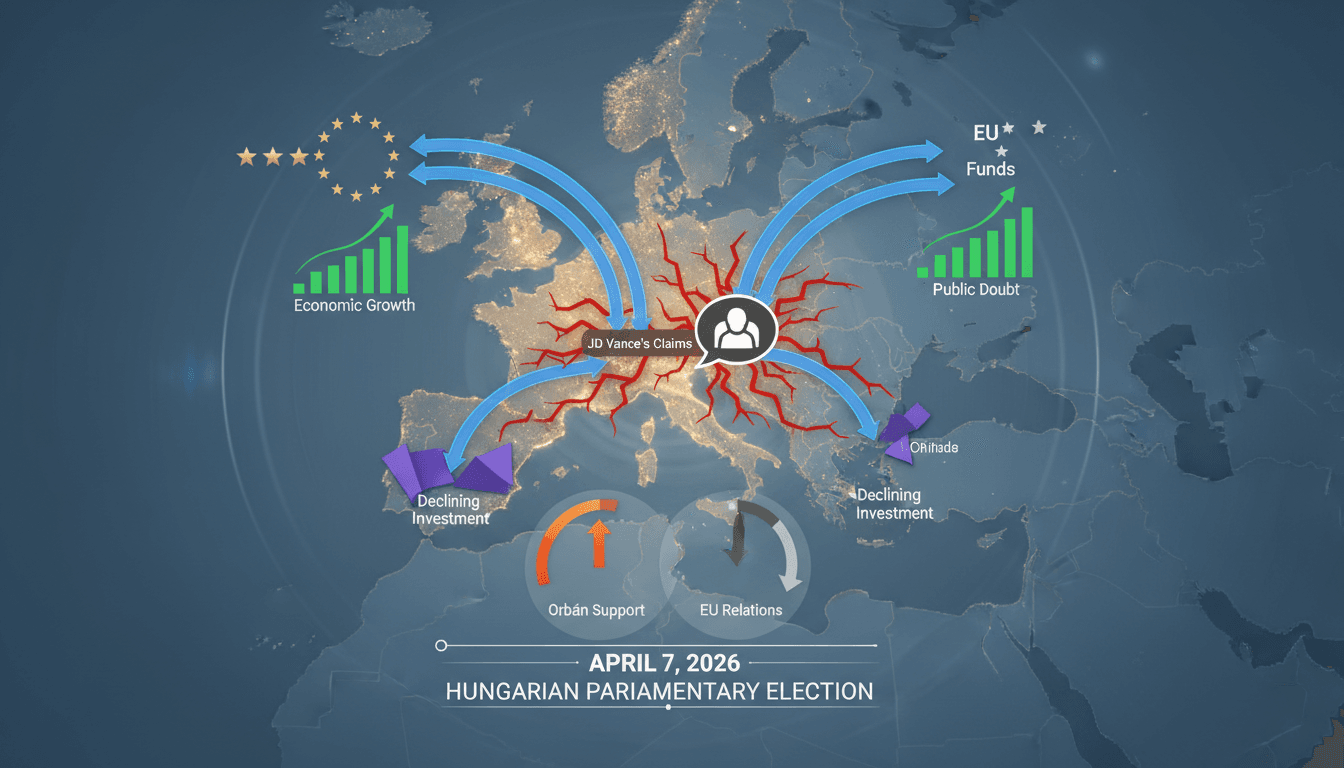
Here's what it means for you.
As global markets react to political narratives, understanding the implications of U.S. foreign policy on European stability is crucial for international investors.
Why it matters
The claims made by U.S. Vice President JD Vance could influence Hungary's political landscape and its economic ties with the EU, affecting broader European market dynamics.
What happened (in 30 seconds)
- On April 7, 2026, U.S. Vice President JD Vance accused EU bureaucrats of interfering in Hungary's elections and harming its economy during a speech in Budapest.
- Fact-checks published on April 9 revealed that Vance's claims misrepresented EU policies, highlighting Hungary's net benefits from EU membership.
- Hungary's parliamentary election is scheduled for April 12, 2026, with Vance's remarks potentially impacting the political climate leading up to the vote.
The context you actually need
- Hungary has been an EU member since 2004, receiving substantial funding for development, with over 80% of public investment sourced from the EU by 2018.
- Tensions between Hungary and the EU have escalated under Prime Minister Viktor Orbán's leadership, particularly regarding rule-of-law issues, leading to €18 billion in frozen EU funds.
- Vance's visit comes amid a tight election, where Orbán seeks international support to bolster his position against challenger Péter Magyar.
What's really happening
The backdrop to JD Vance's claims lies in a complex interplay of political narratives and economic realities. Hungary, under Prime Minister Viktor Orbán, has been at the center of contentious EU relations, primarily due to its perceived erosion of democratic norms and rule-of-law standards. Since Orbán's Fidesz party came to power in 2010, the government has faced criticism over issues such as judicial independence, LGBTQ+ rights, and academic freedoms. These tensions have led to significant financial repercussions, including the freezing of €18 billion in EU cohesion funds, which were withheld due to concerns about Hungary's adherence to EU legal standards.
Vance's assertions of EU interference and economic sabotage appear to serve multiple purposes. Firstly, they align with a broader populist narrative that positions the EU as an adversary of national sovereignty, which resonates with Orbán's base. By framing the EU as a malicious actor, Vance not only bolsters Orbán's re-election campaign but also reinforces his own political alignment with right-wing populism in the U.S., appealing to voters who share skepticism toward international institutions.
Moreover, Vance's claims come at a critical juncture, just days before Hungary's parliamentary elections. The timing suggests a strategic move to galvanize support for Orbán, who is facing a formidable challenge from Péter Magyar. The endorsement from a high-profile U.S. official could provide a much-needed boost to Orbán's campaign, leveraging international populist sentiment to counter domestic opposition.
However, fact-checking efforts have debunked many of Vance's assertions. Reports indicate that Hungary has benefited economically from EU membership, with the country receiving substantial funds that have supported public investment and development. The economic challenges faced by Hungary, including rising energy prices, are largely attributed to external factors such as the ongoing war in Ukraine and previous supply cuts, rather than direct EU actions.
This situation illustrates the delicate balance of political rhetoric and economic realities. While Vance's claims may resonate with certain voter demographics, they also risk alienating Hungary from the EU, potentially jeopardizing future funding and cooperation. As Hungary navigates its political landscape, the implications of these narratives extend beyond its borders, influencing perceptions and relationships within the broader European context.
Who feels it first (and how)
- Hungarian voters: The electorate may be swayed by Vance's endorsement, impacting their voting decisions in the upcoming election.
- EU officials: Increased scrutiny and potential diplomatic tensions could arise as EU leaders respond to the allegations.
- Investors in Hungary: Businesses and investors may face uncertainty regarding Hungary's economic stability and future EU relations.
What to watch next
- Election results on April 12, 2026: The outcome will reveal the effectiveness of Vance's endorsement and its impact on Hungary's political landscape.
- EU's response to Vance's claims: Watch for statements from EU officials regarding the allegations and any potential diplomatic fallout.
- Economic indicators in Hungary: Monitor changes in investment flows and economic performance post-election, particularly in relation to EU funding.
Vance's claims have been fact-checked and largely debunked.
The Hungarian election will be influenced by international narratives, including Vance's remarks.
The long-term impact of these claims on Hungary's relationship with the EU and future funding.
Frequently Asked Questions
- Why it matters?
- The claims made by U.S. Vice President JD Vance could influence Hungary's political landscape and its economic ties with the EU, affecting broader European market dynamics.
- What happened (in 30 seconds)?
- On April 7, 2026, U.S. Vice President JD Vance accused EU bureaucrats of interfering in Hungary's elections and harming its economy during a speech in Budapest. Fact-checks published on April 9 revealed that Vance's claims misrepresented EU policies, highlighting Hungary's net benefits from EU membership. Hungary's parliamentary election is scheduled for April 12, 2026, with Vance's remarks potentially impacting the political climate leading up to the vote.
- What's really happening?
- The backdrop to JD Vance's claims lies in a complex interplay of political narratives and economic realities. Hungary, under Prime Minister Viktor Orbán, has been at the center of contentious EU relations, primarily due to its perceived erosion of democratic norms and rule-of-law standards. Since Orbán's Fidesz party came to power in 2010, the government has faced criticism over issues such as judicial independence, LGBTQ+ rights, and academic freedoms. These tensions have led to significant fin
- Who feels it first (and how)?
- Hungarian voters: The electorate may be swayed by Vance's endorsement, impacting their voting decisions in the upcoming election. EU officials: Increased scrutiny and potential diplomatic tensions could arise as EU leaders respond to the allegations. Investors in Hungary: Businesses and investors may face uncertainty regarding Hungary's economic stability and future EU relations.
- What to watch next?
- Election results on April 12, 2026: The outcome will reveal the effectiveness of Vance's endorsement and its impact on Hungary's political landscape. EU's response to Vance's claims: Watch for statements from EU officials regarding the allegations and any potential diplomatic fallout. Economic indicators in Hungary: Monitor changes in investment flows and economic performance post-election, particularly in relation to EU funding.
News and current affairs from across Europe.
"The Guardian is known for its progressive editorial stance and in-depth analysis."
— A47 Editor
JD Vance’s claims about Orbán, the EU and Hungary fact-checked
During a recent visit to Budapest, U.S. Vice President JD Vance expressed strong support for Hungarian Prime Minister Viktor Orbán, accusing the European Union of attempting to undermine Hungary's economy and energy independence ahead of the country'...
European current affairs, EU politics, and regional developments.
"France 24 is viewed as a globally focused outlet with balanced coverage and a European perspective."
— A47 Editor
Trump, Vance support for Hungary's Orban is not 'meddling' in upcoming vote, says US envoy
U.S. President Donald Trump and Vice President JD Vance have expressed their support for Hungarian Prime Minister Viktor Orban, with Vance visiting Budapest to bolster Orban's campaign ahead of the parliamentary elections. The U.S. ambassador to the ...